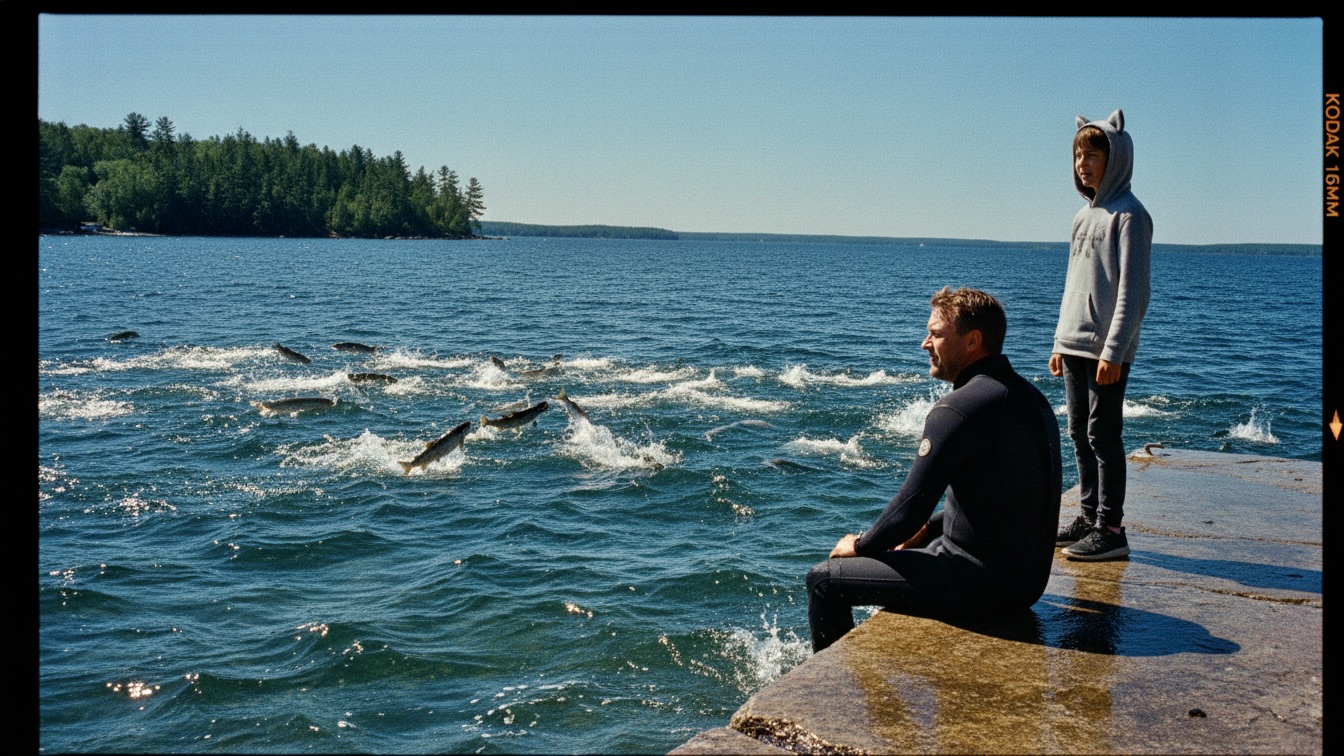
The story unfolds in the isolated community of Silver Islet, where a conservation officer named Jae discovers lake trout behaving in an uncanny, catatonic manner. These "zombie fish" appear to be entranced by an unseen force, ignoring their natural instincts and surroundings. As the town grapples with a supply shortage caused by international conflict, a massive hatch of black flies descends upon the area, creating a suffocating "wall of wings" that traps the residents indoors.
Amidst this environmental crisis, a group of eccentric local children known as the Wolf-Skinners, led by a boy named Rowan, claim to hear a "frequency" calling from the water. Rowan leads Jae to a location known as the Devil’s Throat, where a rhythmic blue light pulses from the depths. Jae realizes that a sunken shipping container, carrying an experimental communication array, is emitting a signal that has hijacked the sensory systems of the local aquatic life.
Driven by a need to save the ecosystem, Jae performs a dangerous dive into the freezing waters of Lake Superior. He successfully navigates a swarm of unresponsive fish and enters the container to manually deactivate the malfunctioning device. Upon shutting down the signal, the natural order is restored; the fish regain their vitality, and a sudden northern wind clears the oppressive plague of flies. The narrative concludes with Jae acknowledging the intuitive wisdom of the children who helped him save the lake.
A primary theme of the narrative is the intrusive and destructive nature of human technology on the environment. The "Peace Initiative" device serves as a poignant irony; while intended to foster human harmony by jamming war-zone signals, it creates ecological chaos in a pristine wilderness. The device's "siren song" overrides the lateral lines of the fish, demonstrating how anthropogenic noise—whether literal or electronic—can deafen nature to its own survival instincts.
The story also explores the concept of stagnation versus vitality. The early descriptions of the "heavy" sun, the "muddy" gloves, and the "flat" water reflect a world that has lost its momentum. This physical stagnation is mirrored in the town’s isolation due to the shipping crisis and the fish's refusal to eat. The eventual breaking of the "trance" represents a return to the messy, active, and necessary struggle of life, moving from the "glass eyes" of the fish back to the "spark" of the living.
Furthermore, the narrative examines the validity of non-traditional perception and the resilience of childhood wonder. While the adults in Silver Islet dismiss the Wolf-Skinners as "weird," these children are the only ones capable of sensing the shift in the world's frequency. Their theatricality and costumes are not merely play; they are a framework that allows them to remain engaged with a reality that the adults find too overwhelming or "creepy" to confront.
Jae is a pragmatic and dedicated professional who initially relies on scientific observation to understand the world around him. His frustration stems from his inability to use traditional tools, such as lab kits or fuel, due to the town's isolation. He views his environment through the lens of a conservation officer, focusing on biological causes like viruses or parasites. This grounded perspective makes his eventual acceptance of Rowan's "frequency" a significant moment of character growth.
As the story progresses, Jae’s internal conflict shifts from professional duty to a more visceral, heroic impulse. He is plagued by a "hum" in his own teeth, suggesting that he is more sensitive to the environment than he initially admits. His decision to dive into the freezing water highlights his self-sacrificing nature and his deep-seated protective instinct for the lake. By the end of the chapter, he has moved beyond his initial cynicism, recognizing that his survival depended on the very "weirdness" he once patronized.
Rowan is a complex figure who uses performance and mythology to navigate a world that feels increasingly unstable. His theatrical speech and wolf-themed costume serve as a psychological shield, allowing him to maintain a sense of agency while the adults hide under blankets. He views himself not as a child playing a game, but as a "sentinel" with a spiritual obligation to the earth. This persona grants him the courage to face the black flies and the "metal heart" beneath the waves.
Despite his dramatic flair, Rowan possesses a keen sense of empathy and intuition. He is the first to recognize that the fish are "listening" rather than merely sick, and he correctly identifies the "discord" caused by the human device. His role as the "tether to the world of the living" for Jae during the dive shows a maturity that belies his twelve years. Rowan represents the "spark" of human intuition that remains functional even when the systems of the modern world fail.
The narrative voice utilizes heavy, oppressive sensory details to establish a mood of environmental dread. The author describes the air as "warm soup" and the mud as something that "sucked at his boots," creating a tactile sense of being trapped. This sensory weight builds tension throughout the first half of the story, making the eventual arrival of the black flies feel like an inevitable escalation of nature’s hostility.
Pacing is used effectively to mirror the internal state of the characters and the environment. The story begins with a slow, lethargic rhythm that matches the "zombie" state of the fish and the stagnant heat of the islet. Once the "frequency" is identified and Jae begins his dive, the prose becomes more frantic and rhythmic. The use of short, punchy sentences during the underwater sequence conveys the urgency and physical strain of Jae’s mission.
The tone shifts from eerie and claustrophobic to one of cathartic liberation in the final scenes. The transition is marked by the arrival of the "clean northern" wind, which acts as a stylistic and literal cleanser for the narrative. The contrast between the "bruised eye" of the blue light and the "piercing blue" of the cleared sky provides a visual resolution to the conflict. This shift reinforces the story's ultimate message of hope and the enduring resilience of the natural world.


