Format: Short Film / Anthology Episode | Est. Length: 10-12 minutes
Imagine a world where the rugged isolation of the Great Lakes becomes the backdrop for a haunting exploration of ecological fragility and technological interference. This story serves as a visceral entry in a speculative anthology series, blending the grounded realism of a conservation officer’s daily struggle with the surreal, high-stakes tension of a town cut off from the world and besieged by a silent, underwater siren.
"The Glass Eyes" is a standalone episode within The Superior Files, an anthology series exploring anomalous events along the shores of Lake Superior. The series focuses on the intersection of ancient nature and modern technological fallout, where the isolation of the North Shore creates a vacuum for strange phenomena to take root. Each episode follows different local residents—rangers, lighthouse keepers, or indigenous youth—as they confront environmental "glitches" that threaten the delicate balance of the wilderness.
In the stagnant, unnatural heat of Silver Islet, Conservation Officer Jae discovers a lake trout floating perfectly upright and unresponsive, its eyes transformed into clear, hard marbles that stare into a void beyond the physical world.
When a malfunctioning electronic array traps the local wildlife in a catatonic trance, a weary conservation officer must brave a suffocating swarm of black flies to silence the signal. He must rely on a group of eccentric local children to act as his guides before the lake’s ecosystem collapses into a permanent, silver tomb.
The primary theme explores the collision between technological hubris and environmental fragility. The "Peace Initiative" device, intended to solve human conflict, inadvertently creates an ecological disaster, highlighting how man-made solutions often ignore the biological frequencies of the natural world. It questions the definition of "progress" when that progress silences the very environment it is meant to protect.
A secondary theme focuses on the value of unconventional perspectives and the resilience of the young. While the adults of Silver Islet hide behind boarded windows, the "Wolf-Skinners" embrace the strangeness, using their imaginative play to tune into the reality of the crisis. Their "weirdness" is framed not as a social deficiency, but as a survival mechanism that allows them to perceive truths that the rational, adult world has filtered out.
The stakes are both immediate and existential: if the signal is not silenced, the entire aquatic food chain of Lake Superior will collapse as the fish starve themselves to death in a catatonic state. For Jae, the stakes are professional and personal, as he risks hypothermia and a gruesome death by the fly swarm to protect a community that is already on the brink of starvation due to global shipping crises.
The external conflict is a three-front battle against a malfunctioning high-frequency array, a record-breaking swarm of predatory black flies, and the freezing, crushing depths of the lake. Internally, Jae struggles with his own cynicism and isolation, feeling helpless without the modern tools and lab kits he usually relies on. The antagonistic force is not sentient malice, but the cold, unfeeling persistence of a machine that does not know it is killing the world it was designed to save.
In the midst of a global shipping crisis that has left the remote town of Silver Islet isolated, Conservation Officer Jae discovers "zombie fish" in Lake Superior—trout that are alive but unresponsive, with eyes like clear glass marbles. He encounters Rowan and the "Wolf-Skinners," a group of eccentric local children who claim the fish are listening to a "metal heart" beneath the waves. As an unprecedented and suffocating swarm of black flies descends upon the town, turning the sky black and trapping the residents indoors, Jae realizes the fish are starving to death, paralyzed by an unknown frequency.
Rowan leads Jae to the "Devil’s Throat," a deep bay where the fish have gathered in a massive, silent circle around a pulsing blue light. Jae discovers the source is a sunken shipping container holding an experimental peace-initiative communication array that is broadcasting a dominant, hypnotic signal. Despite the blinding flies and the freezing water, Jae dives into the depths, guided by the rhythmic drumming of the children on the shore. He successfully overrides the device, shattering the trance; the flies are swept away by a sudden northern wind, and the lake returns to life as the fish awaken from their glassy-eyed slumber.
Jae (The Stoic Protector): A weary, practical conservation officer who prides himself on logic and scientific data. At the start, he is frustrated by his lack of resources and dismissive of the local children's "theatrical" behavior. By the end, he experiences a psychological shift from rigid rationalism to an appreciation for the intuitive and the unconventional, recognizing that the "Wolf-Skinners" were the only ones truly listening to the earth.
Rowan (The Visionary Child): A twelve-year-old boy who leads the "Wolf-Skinners" with a flair for the dramatic and a self-imposed duty to guard the nature he loves. He begins as a town curiosity, viewed as "weird" by adults, but remains steadfast in his belief that he is tuned into the earth's frequency. His arc is one of validation; he proves that his imagination is a bridge to understanding a world that adults have become too deaf to hear.
Officer Chan (The Realist): Jae’s partner, who represents the common reaction to the crisis—fear and retreat. He serves as a foil to Jae’s sense of duty, highlighting the danger of the mission and the overwhelming nature of the fly swarm.
The Discovery: Jae finds the catatonic trout with marble eyes and meets the Wolf-Skinners, who provide the first hint that the anomaly is a "meditation" on a frequency. The heat is oppressive, and the lake is unnaturally still, establishing a sense of dread and environmental wrongness. Jae’s frustration with the lack of supplies and the town’s isolation sets the stakes for the community's survival.
The Wall of Wings: Three days later, the black fly hatch occurs, creating a literal wall of biting insects that coats the ranger station and plunges the rooms into darkness. Rowan arrives through the swarm, battered but determined, to report the "metal heart" pulsing in the bay. Jae is forced to choose between staying safe inside or trusting the children to lead him into the heart of the swarm to investigate the light.
The Sunken Pulse: Jae and the kids trek to the Devil’s Throat through the blinding flies, using the children's "howls" as a navigational tether. Jae dives into the freezing water, swimming through a ghostly, unmoving crowd of thousands of fish to reach the sunken shipping container. The blue light of the malfunctioning array creates a hypnotic, dizzying effect, nearly luring Jae into the same catatonic state as the fish.
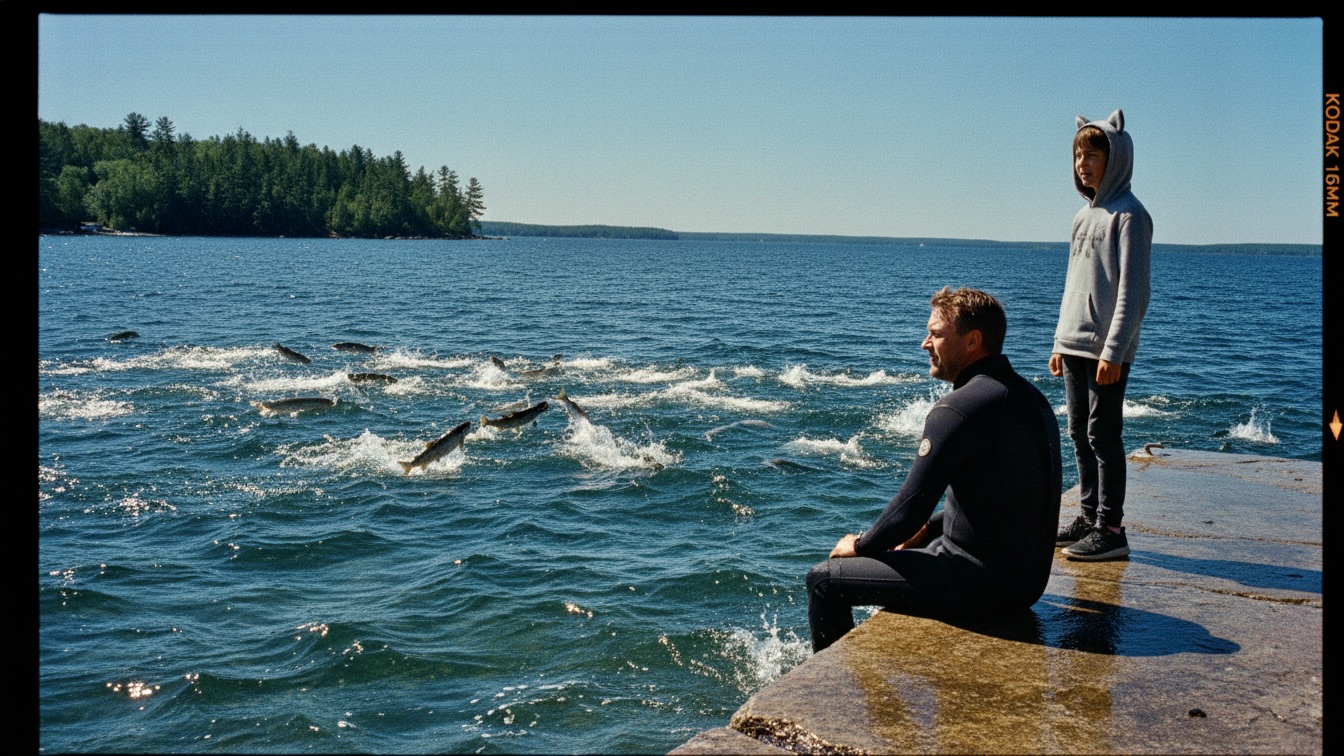
The Awakening: In a final burst of human will, triggered by the sound of the children drumming on the rocks above, Jae kicks the rusted manual override and silences the signal. The blue light dies, the fish instantly regain their senses in a chaotic silver frenzy, and Jae surfaces to find a cold northern wind clearing the sky. The episode ends with Jae and the Wolf-Skinners standing on the pier, watching the trout leap in the sunlight, acknowledging that the "spark" of life has been restored.
The episode begins with a sense of Uncanny Stagnation, characterized by the heavy heat and the eerie, unmoving fish. This shifts into Claustrophobic Terror during the fly hatch, where the audience feels the suffocating pressure of the swarm. The climax is a sequence of Hypnotic Peril underwater, blending the beauty of the blue light with the lethality of the cold. The final resolution is one of Piercing Relief, as the wind clears the air and the natural rhythm of the lake is restored, leaving the audience with a sense of wonder and respect for the resilience of nature.
If expanded, the season would follow Jae as he investigates other "Peace Initiative" containers that fell overboard along the North Shore, each causing a different environmental mutation. The Wolf-Skinners would evolve from a local curiosity into an essential "scout" group, helping Jae track signals that modern technology cannot detect. The overarching narrative would explore the mystery of the company behind the devices and their refusal to admit the ecological cost of their "peace" project.
Thematic escalation would involve the town of Silver Islet slowly transforming into a hub for "frequency-sensitive" individuals, creating a tension between the government's desire to recover the tech and the locals' desire to protect their home. Jae’s character arc would culminate in him choosing between his duty to the state and his loyalty to the unique, fragile ecosystem he has sworn to protect.
The visual style is "Industrial Gothic North," utilizing a desaturated palette of deep blues, slate greys, and muddy browns, contrasted with the sickly, artificial neon blue of the malfunctioning array. The cinematography should feel intimate and handheld during the fly swarm to enhance the feeling of claustrophobia, shifting to wide, majestic, yet haunting shots of the still lake. The "marble eyes" of the fish should be rendered with practical effects to maintain a grounded, unsettling realism.
The tone is a blend of environmental horror and a coming-of-age adventure, comparable to the atmospheric dread of The Lighthouse mixed with the youthful, defiant spirit of Stand By Me. The sound design is critical, moving from the maddening, high-pitched drone of the flies to the rhythmic, heart-like thumping of the underwater signal, and finally to the crisp, clean silence of the northern wind.
The target audience includes fans of "Cli-Fi" (Climate Fiction), ecological thrillers, and elevated genre anthologies like Tales from the Loop. It appeals to viewers aged 16-45 who enjoy stories that blend rugged outdoor realism with speculative, high-concept mysteries. The episode’s focus on the "Wolf-Skinners" also provides a "Stranger Things" style appeal for younger audiences interested in themes of youth autonomy and adventure.
The pacing follows a "Slow-Burn to Frenzy" structure. The first 4 minutes focus on the slow buildup of the anomaly and the oppressive heat. The middle 4 minutes accelerate into the chaos of the fly swarm and the trek to the bay. The final 4 minutes are a high-tension climax underwater followed by a rapid, cathartic resolution. The 10-12 minute runtime ensures a tight, focused narrative that emphasizes atmosphere over exposition.
The black fly swarm should be achieved through a combination of practical "dust" and debris for physical interaction, layered with high-density CGI particle systems to create the "wall of wings" effect. The underwater sequence requires a specialized tank or a controlled cove with high-clarity water to capture the "crowd" of fish, which can be achieved using a mix of realistic animatronic trout and digital doubling.
The "Peace Initiative" container should be a practical set piece to allow for authentic interaction during the manual override scene. Special attention must be paid to the "marble eyes" of the trout; these should be physical inserts for close-up shots to ensure the "glassy" texture feels tangible and disturbing to the viewer.


