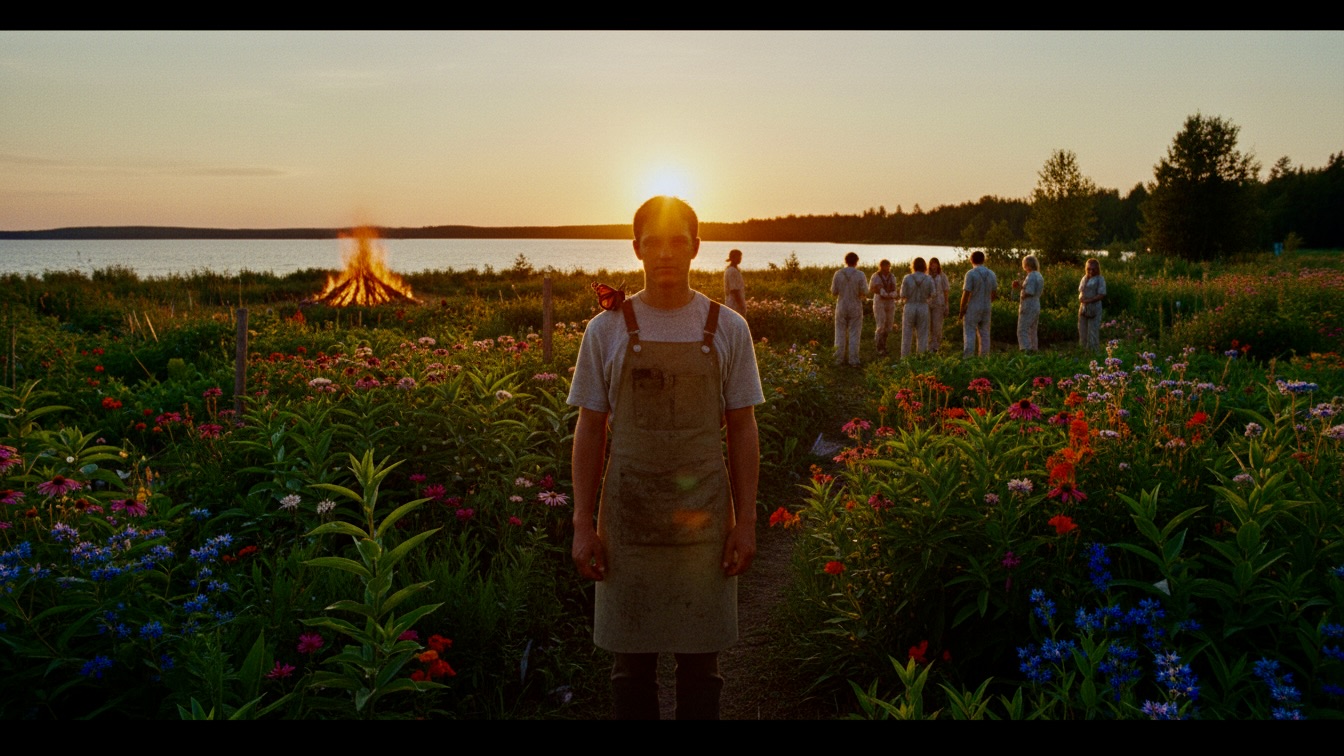
The story opens in the oppressive humidity of Lac Seul at four in the morning, where two young men, Mac and Theo, are engaged in a high-stakes mission to plant "Soul Siphon" milkweed seeds. These seeds are treated as a vital currency in a world where ecological collapse feels imminent, and the survival of Monarch butterflies is viewed as a non-negotiable necessity. Their efforts are interrupted by the arrival of Chloe and her "Petal Pushers," a rival group of gardeners who prioritize social media aesthetics and professional curation over raw, functional ecology.
What begins as a tactical standoff involving a drone and a "compost bomb" quickly escalates into a genuine survival situation when a massive swarm of invasive Japanese beetles threatens the garden. Realizing that their internal bickering will lead to the total destruction of the habitat, the two groups form an uneasy alliance. They combine their chemical knowledge and equipment to create a potent repellent that diverts the swarm, saving the Monarch zone. The chapter concludes with a moment of quiet reconciliation as the rivals watch actual Monarchs land on the saved plants, choosing to experience the wonder of the moment without the mediation of a camera lens.
One of the most prominent themes in the narrative is the tension between authenticity and performative activism. Chloe represents the modern commodification of nature, where the act of gardening is "curated" for an audience and measured by engagement metrics rather than biological success. In contrast, Mac and Theo represent a more primal, gritty form of environmentalism that embraces the "rot" and the "dirt" as necessary components of life. Their conflict highlights a generational struggle to find meaning in a world that often feels like it is being reduced to a series of digital aesthetics.
The story also explores the concept of "Ecological Panic" as a driving force for Gen Z identity. Mac and Theo are not gardening for a hobby; they are gardening because they feel they have no other choice if they want the "system" to stay online. The use of tactical language—calling themselves "Seed Runners" and wearing "tactical gardening aprons"—suggests that they have repurposed the imagery of war to deal with climate anxiety. This mock-heroic tone reveals a deep-seated fear that the natural world is a fortress that must be defended against both invasive species and human indifference.
Finally, the theme of collaboration in the face of catastrophe serves as the story's emotional anchor. The arrival of the Japanese beetles acts as a literal "common enemy" that strips away the superficial differences between the two groups. When the survival of the ecosystem is at stake, the distinction between a "hobbyist" and a "professional" becomes irrelevant. The resolution suggests that while individual passion is necessary, the scale of current environmental challenges requires the sharing of resources and the abandonment of ego.
Mac serves as the grounded, sensory-focused protagonist who experiences the physical toll of their environmental crusade. He is deeply attuned to the discomfort of his environment, describing the humidity as a "wet wool blanket" and the sun as a "threat." While he participates in the high-stakes world of seed running, he maintains a level of skepticism that keeps the narrative from becoming overly idealistic. He often questions if their work is "worth it," reflecting a common psychological response to overwhelming tasks where progress is slow and the opposition is well-funded.
Despite his sarcasm and exhaustion, Mac is driven by a fierce sense of loyalty to the mission and to his partner, Theo. He acts as the pragmatic enforcer, ready to protect Theo from physical confrontation while managing the manual labor of the garden. His internal conflict is rooted in a sense of displaced purpose; he feels he should be doing something modern like "buying crypto," yet he finds himself unable to walk away from the dirt. This suggests a character who finds his true identity not in the digital world he mocks, but in the tangible, albeit difficult, reality of the soil.
Theo is the intellectual architect of the operation, possessing a scientific mind that borders on the obsessive. He views the world through the lens of pH levels, nitrogen cycles, and biological precision, using his knowledge as a defense mechanism against the chaos of the world. To him, the garden is not a place of leisure but a "fortress" that requires exact specifications to function. This rigidity is a manifestation of his anxiety, as he believes that a "point-two deviation" in soil acidity could lead to the failure of an entire species' migration.
His decision to swap the seeds for a "decoy pouch" of birdseed reveals a surprising level of tactical cunning and distrust of his rivals. While he appears to be a "confused landscaper," he is actually the most strategically minded person in the garden. He is the one who ultimately bridges the gap with Chloe by recognizing that her resources are necessary for the long-term survival of the "Soul Siphon" cultivar. This shows significant growth, as he moves from a protective, gatekeeping mindset to one of strategic distribution for the greater good.
Chloe represents the antagonist whose primary motivation is the acquisition of social capital through environmentalism. She is a "botany master" who has successfully merged her academic background with the demands of the "influencer" economy. Her initial arrival is marked by an air of professional superiority, as she uses her high-end electric truck and drone surveillance to intimidate Mac and Theo. For her, the garden is a "controlled environment" that must be optimized for the best possible "content," showcasing a psychological need for control and validation.
However, Chloe is not a one-dimensional villain, as she demonstrates genuine competence and a willingness to adapt when the beetle swarm arrives. When she lowers her sprayer and joins the "tactical gardening" effort, she sheds her influencer persona in favor of her foundational knowledge as a botanist. Her decision to keep the seeds "underground" and off her main feed at the end of the story marks a pivotal shift in her character. It indicates that she has rediscovered the intrinsic value of nature, separate from the "engagement metrics" that previously dictated her life.
The pacing of the story is remarkably brisk, utilizing a "mock-heroic" tone that treats gardening with the intensity of a high-stakes heist or a military operation. The author uses short, punchy sentences and technical jargon to create a sense of urgency and modern relevance. By framing the search for milkweed seeds as "black market" activity on "private Discord servers," the narrative successfully maps contemporary digital culture onto the ancient practice of agriculture. This stylistic choice makes the ecological themes feel immediate and high-stakes rather than distant or purely academic.
Sensory details are used effectively to ground the reader in the physical reality of Lac Seul. The "metallic tang of rusted wire," the "sickly, iridescent green" of the repellent, and the "dry, rhythmic sound" of the beetle wings create a vivid, often visceral atmosphere. These descriptions emphasize the "un-aesthetic" side of nature that Chloe initially tries to ignore. The contrast between the "expensive click" of the electric truck and the "scent of decomposition" from the compost bins highlights the central conflict between the clean, digital world and the messy, biological one.
The narrative voice is heavily influenced by Gen Z slang and cultural touchstones, which adds a layer of irony to the proceedings. Terms like "mid," "no cap," and "L" are used by the characters to navigate their emotions and insults, providing a unique linguistic texture to the story. This use of language serves a dual purpose: it characterizes the protagonists as products of their time while also highlighting the absurdity of their situation. The final scene, where Mac uses sarcasm to hide his genuine wonder at the butterflies, perfectly encapsulates the story's balance of cynical modernism and earnest environmentalism.


