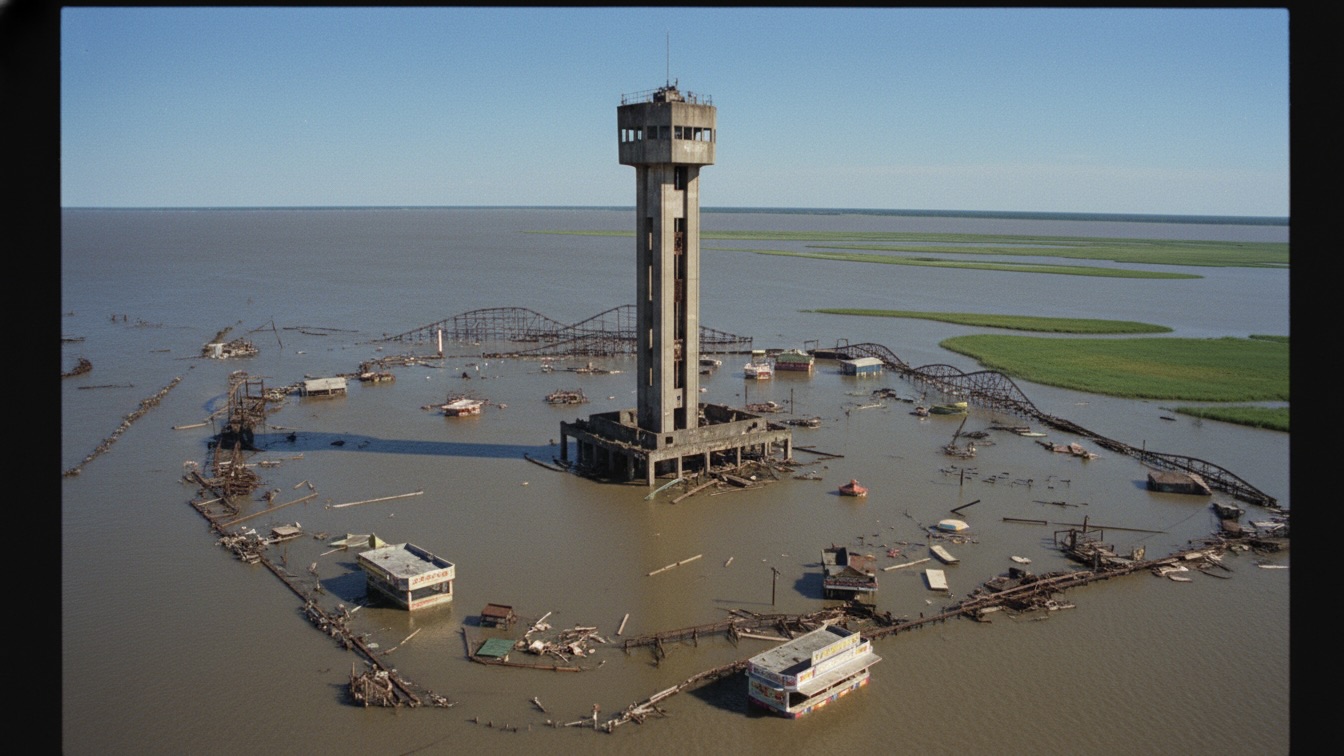
The story begins with Caleb, an aging man with a maritime background, monitoring a rapidly falling barometer as a catastrophic Category Five hurricane approaches the South Carolina coast. His daughter, Jae, arrives desperately with her two children, Lonnie and Melissa, reporting that the inland escape routes are already submerged. Recognizing that his stilted shack cannot withstand the predicted storm surge, Caleb makes the executive decision to evacuate the family via his small boat, aiming for a reinforced concrete tower in a nearby amusement park.
During the perilous journey, the boat's engine is fouled by debris, forcing the family to abandon ship and swim through treacherous, oil-slicked waters to a Victorian glass conservatory. While seeking temporary shelter in the orchid house, the life-threatening environment triggers a long-simmering emotional confrontation between Jae and Caleb regarding his past neglect as a father. This psychological tension is interrupted by the physical collapse of the conservatory, forcing the family to traverse a narrow steel beam over the churning sea to reach the safety of the "Star-Drop" tower.
In a final act of redemption, Caleb risks his life to retrieve a box of family photographs that Jae had lost in the floodwaters. They successfully reach the top of the tower and huddle together as the hurricane pulverizes the coastline around them. The narrative concludes at dawn, revealing a completely transformed and devastated landscape. Despite the loss of their material world, the family finds a sense of unity and a new beginning amidst the ruins.
The central theme of the narrative is the conflict between man and an indifferent, predatory nature. The author personifies the storm as an "aggressive" force that "presses" and "shreds," emphasizing that human structures—whether they are sturdy shacks or iconic rollercoasters—are ultimately fragile illusions of safety. The "Black Tide" serves as a literal and metaphorical eraser, stripping away the geography of the characters' lives to reveal the rawest versions of their identities.
Another profound theme explored is the nature of heroism versus the domestic duties of fatherhood. Through the dialogue between Caleb and Jae, the story examines the cost of a life spent "on duty." While Caleb viewed his past rescues as a noble calling, Jae experienced them as a series of abandonments. The storm acts as a crucible, forcing Caleb to integrate these two halves of his identity by using his professional survival skills specifically to protect his own kin rather than strangers.
The preservation of memory and legacy is a tertiary theme, symbolized by the blue box of physical photographs. In a world where the digital infrastructure has died and the physical landscape has been erased, these images become the only tether to a shared history. Caleb’s decision to dive back into the surge for the photos signifies a shift in his values. He moves from saving lives as a detached professional to salvaging the emotional artifacts that give those lives meaning.
Finally, the story touches upon the theme of resilience and the "new map." The ending suggests that while the physical world can be destroyed, the human capacity to adapt and "draw a new one" remains. The destruction of the old landmarks is not just an end, but a violent clearing of the slate. This allows for a reconstruction of family bonds that were previously as weathered and strained as the boardwalk itself.
Caleb is a man defined by his competence and his historical distance from his family. At sixty-eight, he is physically failing, with joints that "click" and a back that is a "dull roar of pain," yet he remains mentally anchored in his identity as a captain. He views the world through the lens of instruments and pressures, using the barometer as a proxy for his own internal anxiety. His stoicism is his greatest strength during the crisis, but it has clearly been his greatest flaw as a parent.
From a psychological perspective, Caleb suffers from a hero complex that has historically served as an avoidant defense mechanism. As Jae points out, he found the "boring" and "daily" aspects of fatherhood more daunting than a Category Five gale. By staying at the coast in his "rotting shack," he was essentially waiting for a return to the crisis environment where he felt most competent. The storm provides him with a final opportunity for atonement, allowing him to finally "show up" for his daughter in the way she needed decades ago.
By the end of the story, Caleb undergoes a significant internal shift. He moves from barking orders and acting as a detached commander to a man who recognizes the emotional weight of a "box of photos." His physical exhaustion at the end of the climb reflects a shedding of his old, rigid persona. He accepts the erasure of his shack and his old life because he has finally secured the only "high ground" that matters: the presence and forgiveness of his family.
Jae is a character defined by the tension between her childhood trauma and her adult responsibilities. Her fear of the water is not merely a phobia but a manifestation of the resentment she feels toward the element that consistently took her father away from her. When she arrives at the shack, she is "terrified," yet she shows remarkable functional resilience by navigating her children through a flooded landscape. Her internal conflict is a battle between the "little girl who used to hide under the bed" and the mother who must remain steady for Lonnie and Melissa.
The argument in the orchid house reveals that Jae has carried the weight of her father's absence as a personal rejection. She views his commitment to his "duty" as a preference for the adrenaline of rescue over the intimacy of family life. Her anger is a protective shield, one that she has used for twenty years to keep Caleb at a distance. However, the extreme circumstances of the storm force her to dismantle this shield and acknowledge her father's utility and his genuine effort to protect her.
Jae’s character arc culminates in the moment she reaches down to pull Caleb onto the maintenance platform. By telling him "Not today, old man," she reclaims her agency and shifts the power dynamic of their relationship. She is no longer the abandoned child waiting for a hero; she is a partner in their collective survival. Her decision to keep the photos, and her acknowledgement that they will "draw a new map," suggests she is ready to let go of her resentment in favor of a reconstructed future.
The pacing of the story is masterfully handled, mirroring the erratic and intensifying nature of a hurricane. It begins with a slow, atmospheric dread, focusing on the "wet wool" air and the sinking needle of the barometer. This creates a sense of claustrophobia before the physical action erupts. Once the family moves to the boat, the narrative speed increases, using short, punchy sentences to convey the urgency of the evacuation and the chaotic environment of the flooded streets.
The author utilizes vivid sensory details to ground the high-stakes drama in a gritty reality. Rather than generic descriptions of a storm, the text provides specific textures like the "brass rim" of the barometer, the "blue smoke" of the outboard engine, and the "rotting vegetation" smell of the conservatory. These details create a visceral experience for the reader, making the transition from the "sickly gray" Atlantic to the "vibrant purples" of the dying orchids feel both surreal and grounded.
The tone of the narrative is one of somber realism punctuated by moments of cinematic intensity. There is a recurring motif of "weight"—the physical weight of the air, the weight of Caleb’s years, and the weight of the water. This creates a heavy, oppressive atmosphere that reflects the characters' emotional burdens. The narrative voice is a close third-person perspective that stays primarily with Caleb, allowing the reader to experience his professional assessment of the danger alongside his private physical and emotional pain.
Finally, the imagery of the "Star-Drop" tower and the "Thunderbolt" rollercoaster provides a poignant commentary on the collapse of the old world. The destruction of these iconic landmarks serves as a visual metaphor for the end of an era. The contrast between the "skeletal structure" of the rollercoaster and the "blunt finger of concrete" of the tower highlights the difference between aesthetic beauty and functional survival. This stylistic choice reinforces the story’s ultimate message: that in the face of total erasure, only the most reinforced foundations—both architectural and relational—will remain.


