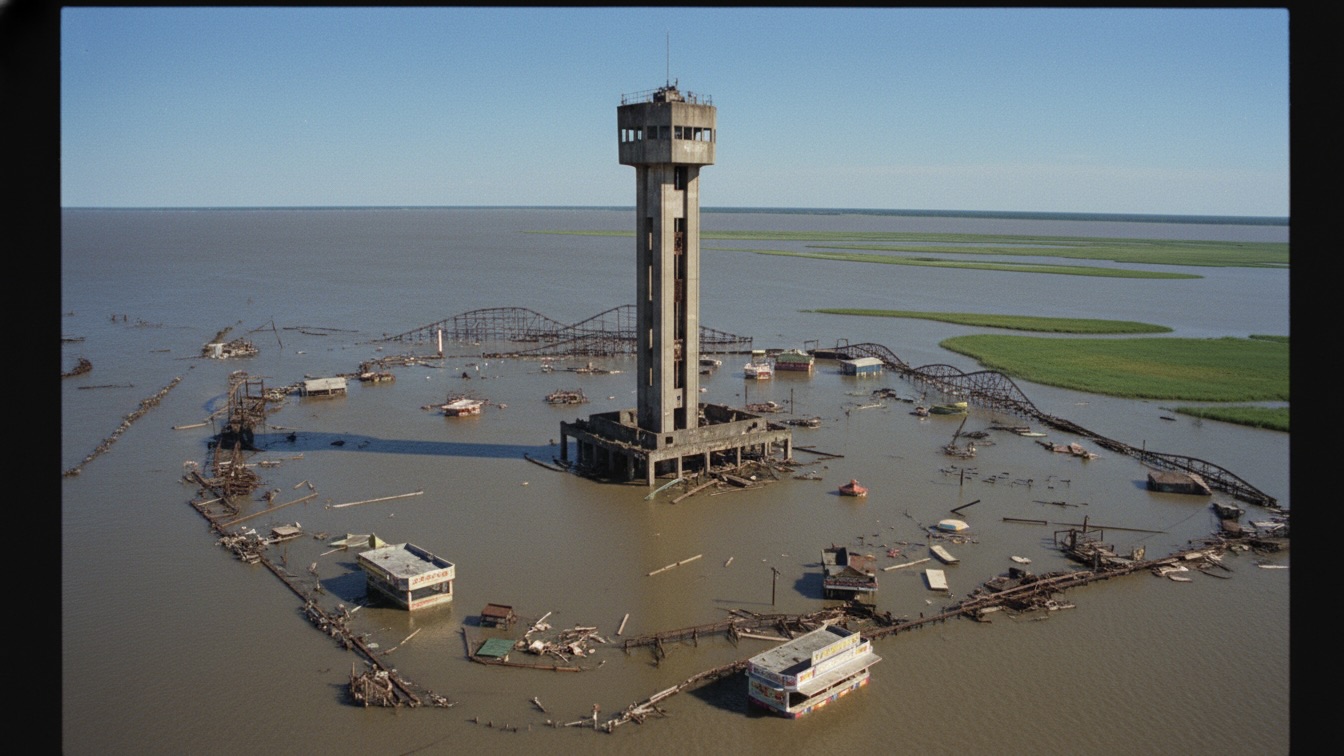
Format: Short Film / Anthology Episode | Est. Length: 10-12 minutes
Imagine this story as a cornerstone episode of The Surge Chronicles, an anthology series exploring human resilience against the backdrop of climate-driven catastrophes. Each installment focuses on a different coastal community facing a "Storm of the Century," weaving together personal histories and survivalist grit as the natural world reclaims the built environment. The series serves as a haunting look at the "New Normal," where the geography of the past is erased and the only remaining landmarks are the bonds between survivors.
Caleb watches the barometer needle drop with a physical weight in his gut as the Atlantic turns into a flat, sickly gray void. The silence of a vacuum precedes the roar of a Category Five monster that has already swallowed the lower docks, leaving only the tops of bollards poking out like drowning fingers.
When a record-breaking hurricane traps a retired sea captain and his estranged family on the Carolina coast, they must navigate a submerged landscape to reach high ground. To survive the rising tide, they are forced to bridge the emotional chasm created by decades of neglect and resentment.
The primary theme is the reconciliation of past neglect through present action, illustrating that survival requires both physical and emotional fortification. It explores the concept of "home" not as a physical structure, but as the bonds between people that remain when the structures are swept away.
The story also delves into the "Captain’s Burden," examining the cost of a life spent in service to others at the expense of one’s own family. It highlights the transition of leadership from an aging patriarch to a daughter who must overcome her fear of the very element that stole her father’s attention.
For Caleb, the stakes are the lives of his daughter and grandchildren, as well as the potential for a final redemption before his time runs out. Jae risks losing her children and the only remaining fragments of her family history to a sea that has already taken her father’s attention for decades. If they fail to reach the Star-Drop tower, the entire family line will be extinguished by the unprecedented storm surge.
The external conflict is the escalating Category Five hurricane and the resulting storm surge that turns the familiar geography into a lethal labyrinth of debris and drowning streets. Internally, the conflict stems from the deep-seated resentment Jae feels toward Caleb’s lifelong prioritization of his duties over his family, clashing with their immediate need for mutual trust. The environment itself acts as the primary antagonist, with the ocean systematically dismantling every sanctuary they attempt to claim.
As a catastrophic hurricane makes landfall, Caleb, a grizzled former captain, is joined at his stilted shack by his estranged daughter Jae and her two children. With the roads underwater and the storm surge imminent, Caleb forces them into his small Boston Whaler to navigate the flooded ruins of their town toward a concrete tower in an abandoned amusement park. They witness the destruction of their home and local landmarks as they battle engine failure and a sinking vessel, eventually being forced to swim to a Victorian conservatory.
Inside the fragile glass dome, the family confronts their fractured past while the storm literally tears the building apart around them. After a harrowing traverse across a rusted monorail beam, they reach the "Star-Drop" tower, the highest point in the county. In a final act of devotion, Caleb risks his life to save a box of family photos, leading to a quiet reconciliation as they watch the sun rise over a world that has been completely erased.
Caleb (68): A stoic, weather-beaten former rescue captain who finds purpose in crisis but struggles with the mundane requirements of fatherhood. Psychological Arc: Starts as an isolated man clinging to a rotting shack and his past identity; ends as a grandfather who realizes his true legacy is the family he finally chose to protect over his own pride.
Jae (36): Caleb’s daughter, a protective and terrified mother who has spent her life living in the shadow of her father’s "heroic" absences. Psychological Arc: Starts with bitter resentment and a paralyzing fear of the water; ends with a hard-won respect for her father’s skills and the strength to save him in return during the final ascent.
Lonnie (12) & Melissa (8): The grandchildren who serve as the emotional anchors and the physical manifestation of what is at risk. Lonnie attempts to mirror his grandfather's stoicism, while Melissa represents the innocence that the storm threatens to destroy.
Beat 1: The Pressure Drops. Caleb monitors the plummeting barometer as the atmosphere turns oppressive and the Atlantic begins to swallow his dock. Jae arrives with the children just as the radio dies, revealing that all inland escape routes are officially underwater. Realizing the shack will not survive the surge, Caleb prepares the family for a desperate waterborne evacuation.
Beat 2: The Skiff Launch. Caleb forces the terrified family into his Boston Whaler to navigate the churning canal as the wind begins to shred the landscape. They narrowly escape into the flooded streets of the town just as a massive wave demolishes the shack behind them. Caleb grips the tiller with white-knuckled intensity, navigating over submerged cars and rooftops.
Beat 3: The Shattered Boardwalk. The boat's engine fails when a plastic bag fouls the propeller near the ruins of a wooden rollercoaster, leaving them drifting toward a massive glass conservatory. They watch in horror as the "Thunderbolt" coaster collapses into the sea, sending a wall of debris toward their small craft. Caleb orders the family into the water, forcing them to swim for the conservatory as the Whaler is crushed against a lamppost.
Beat 4: The Orchid House. Inside the fragile glass dome, the family finds temporary shelter among dying tropical flowers, but the tension between Caleb and Jae boils over into a confrontation about his past absences. The argument is cut short when a piece of the pier smashes through the dome, forcing father and daughter to work together on a high-altitude catwalk to patch the breach. The foundation begins to groan under the weight of the surge, signaling that the conservatory is about to fail.
Beat 5: The Girder Walk. Caleb leads the family out of the collapsing conservatory and onto a rusted monorail beam suspended over the violent floodwaters. They move as a human chain, battling 140-mph winds and their own terror to reach the concrete "Star-Drop" tower. Halfway across, the beam vibrates violently, nearly throwing the children into the abyss before Caleb stabilizes the line.
Beat 6: The Final Ascent. Jae almost loses her box of family photos to the current, prompting Caleb to dive into the lethal water to retrieve the only physical memories they have left. Jae hauls a failing, exhausted Caleb onto the platform, and they ascend the spiral stairs of the tower to the observation deck. They stand together as the sun rises, looking out over a completely transformed coastline where survival is the only remaining landmark.
The episode begins with a sense of suffocating dread and isolation, transitioning into high-octane terror during the boat escape. The midpoint shifts to raw, interpersonal friction in the conservatory, which eventually melts into a desperate, unified resolve during the climax. By the end, the mood settles into a somber but hopeful "New Normal," where the loss of material possessions is balanced by the restoration of the family unit.
If expanded, the season would follow the family’s journey across the "New Carolina Archipelago" as they search for a permanent inland sanctuary. Each episode would introduce other survivors—some helpful, some predatory—exploring how different social structures emerge from the ruins of the old world.
The overarching narrative would track Caleb’s declining health and Jae’s emergence as the new leader of their small group, mirroring the shifting tides of the environment. The season would culminate in the discovery of a government "Green Zone," where the family must decide if they want to return to a structured society or continue to forge their own path in the wild, flooded frontier.
The visual style is "Naturalistic Disaster," utilizing a desaturated palette of grays, sickly greens, and deep browns to emphasize the oppressive atmosphere. Handheld camera work during the boat and beam sequences will create a sense of frantic, claustrophobic urgency, contrasting with wide, haunting shots of the submerged town.
The tone is one of "Grit and Grace," balancing the brutal reality of environmental destruction with the quiet beauty of human connection. Tonal influences include the visceral realism of The Impossible mixed with the atmospheric, high-stakes tension of Children of Men.
The target audience is adults and older teens (16+) who enjoy high-stakes survival dramas and character-driven disaster narratives. It appeals to viewers who appreciate stories about family reconciliation and the human cost of environmental change, fitting well within a prestige streaming platform's anthology lineup.
The pacing is relentless, following a "ticking clock" structure dictated by the rising tide and the eye wall's arrival. The first three minutes establish the dread, the middle six minutes are a sequence of escalating physical obstacles, and the final three minutes provide the emotional catharsis and the visual reveal of the aftermath.
The production requires a sophisticated water tank setup and high-end practical effects (large-scale fans and rain rigs) to simulate the wind and rain of a Category Five storm. The destruction of the "Thunderbolt" rollercoaster and the conservatory dome will utilize a blend of detailed miniatures and CGI to ensure a sense of massive scale and physical weight.
Special attention must be paid to the "Star-Drop" tower set, which needs to feel claustrophobic and vertical to emphasize the height and the family's isolation. The transition from the chaotic, dark storm to the eerie, still light of the morning will require precise color grading to sell the total transformation of the landscape.


