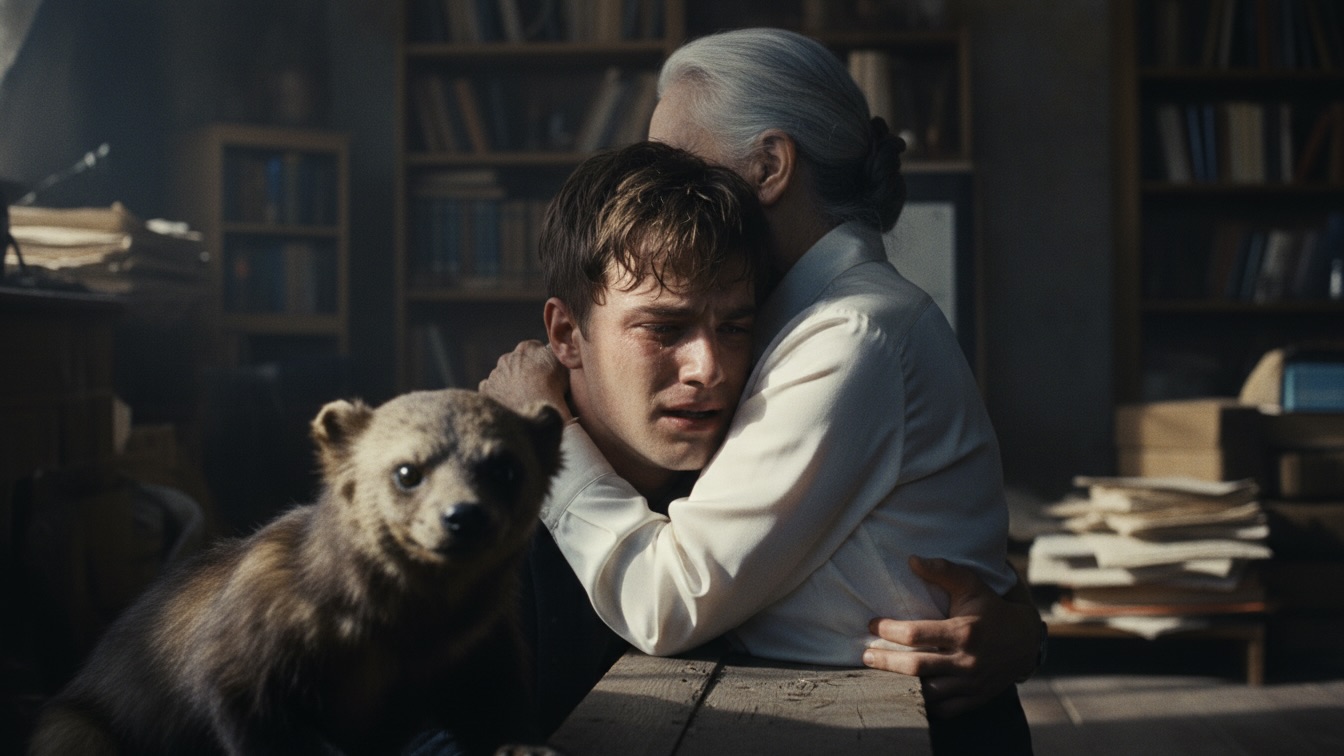
The story follows Harry and his Aunt Betty as they navigate the sweltering, cluttered apartment of Harry’s recently deceased father, Arthur. While clearing out the hoarded remains of Arthur's life, they stumble upon a grotesque taxidermy wolverine that contains a hidden compartment. Inside, they find a series of letters detailing a forty-thousand-dollar debt to an underground poker ring known as the Spades. This discovery initially confirms Harry’s deepest fears that his father was a degenerate gambler who left him with a legacy of danger and failure.
To uncover the full truth, the pair travels to a pawn shop on Spadina Avenue, following a lead from a ticket found with the letters. The shop clerk reveals that Arthur was not the one who gambled the money away but had instead taken on the debt of Harry’s Uncle Mark. Arthur had been making regular interest payments on a family heirloom watch to keep the debt collectors away from his son. This revelation reframes the father's life from one of negligence to one of desperate, silent sacrifice.
The narrative concludes back at the apartment, where Harry finally breaks down and confesses a long-held secret. He admits to finding a suicide note written by his father a week before he died, which Harry destroyed in a fit of rage and shame. Betty helps him understand that his father’s actions, though flawed, were motivated by a desire to protect him. Harry chooses to keep the ugly wolverine, symbolizing his acceptance of his father’s complex and broken reality.
The central theme of the narrative revolves around the weight of legacy and the psychological burden of inheritance. Harry views his father’s life as a blueprint for his own inevitable failure, a concept known as "magical thinking" where he believes he must inherit Arthur’s character flaws along with his physical traits. The junk filling the apartment serves as a physical manifestation of this emotional baggage. It represents the "walls" Arthur built to hide from a world that had become too dangerous and expensive to inhabit.
The story also explores the discrepancy between perception and reality, particularly regarding the nature of cowardice and heroism. Harry initially interprets his father’s silence and hoarding as the marks of a coward who chose to hide rather than face his problems. However, the revelation at the pawn shop shifts the thematic focus toward the idea of silent martyrdom. Arthur’s "failure" was actually a prolonged, grueling effort to shield his son from the consequences of another man’s sins, suggesting that truth is often buried beneath layers of shame.
Finally, the narrative touches upon the concept of the "blank slate" and the struggle for individual identity. Betty acts as the voice of psychological reason, challenging Harry’s belief that he is a "photocopy" of his father. She posits that identity is a daily choice rather than a genetic sentence. By the end of the story, the wolverine becomes a symbol of "truth over beauty," representing the idea that acknowledging a parent’s flaws is a necessary step in forging a separate, healthy identity.
Harry is a young man paralyzed by the fear of his own perceived destiny. He is deeply reactive, swinging between explosive anger and crushing despair as he attempts to reconcile his memories of his father with the evidence of Arthur's failures. Psychologically, Harry is suffering from a form of "disenfranchised grief," where his anger at his father’s perceived cowardice prevents him from mourning the loss properly. He views his father’s clutter not just as trash, but as a physical indictment of his own potential future.
His internal conflict reaches a breaking point when he reveals the destruction of the suicide note. This act was a defense mechanism intended to erase the shame he felt on his father’s behalf. By destroying the paper, Harry attempted to destroy the reality of his father's pain, which he mistook for weakness. His eventual decision to keep the wolverine signifies a major psychological shift, as he moves from a state of denial and projection to one of integration and acceptance.
Betty serves as the narrative’s grounding force, providing a sharp, objective contrast to Harry’s emotional volatility. She is characterized by her precision and order, evidenced by her "pristine white blouse" and "sharp black trousers" amidst the chaos of the apartment. She acts as a surrogate ego for Harry, pushing him to confront the facts of his father’s life rather than wallowing in his own assumptions. Her ability to look past the "junk" allows her to find the screwdriver and the pawn ticket that eventually lead to the truth.
Despite her stern exterior, Betty demonstrates significant emotional intelligence and empathy. She recognizes that Harry’s anger is a mask for his terror of being "rotten" like his father. Her "blank slate" speech is a pivotal moment where she provides Harry with the psychological permission he needs to separate his identity from Arthur’s. She does not sugarcoat the father's mistakes, but she provides the necessary context to transform Harry’s hatred into a more complex form of understanding.
Although Arthur is deceased before the story begins, his presence dominates the narrative through the objects he left behind. He is portrayed as a man who was overwhelmed by a sense of duty and a crushing secret. His decision to take on Mark’s debt suggests a character defined by a misguided but profound sense of family loyalty. He was a man who "collected broken things," a trait that applied both to the toasters in his living room and the people in his life.
Arthur’s psychological state in his final days was clearly one of extreme chronic stress, which ultimately led to his heart failure. The suicide note he wrote reveals a man who felt he was worth more to his son dead than alive, a tragic miscalculation common in those suffering from severe depression and debt-related trauma. His legacy is not one of gambling or laziness, but of a man who broke himself trying to fix things that were beyond his control.
The pacing of the story is expertly handled, moving from the claustrophobic, stagnant environment of the apartment to the frantic, sensory-heavy atmosphere of the Toronto streets. The heat is used as a recurring motif to heighten the tension, making the apartment feel like an "oven" and the outside world like a "physical wall." This environmental pressure mirrors Harry’s internal state, as he feels increasingly trapped by the revelations concerning his father’s past. The transition to the pawn shop provides a necessary shift in momentum, introducing new information that propels the plot toward its climax.
Sensory details are used to create a gritty, lived-in reality that enhances the emotional weight of the story. The "shrieking" plastic, the "hollow thwack" of the wood, and the "high-pitched electronic whine" of the neon sign create an auditory landscape that is consistently jarring and uncomfortable. These harsh sounds reflect the painful nature of the truths Harry and Betty are uncovering. The visual contrast between Betty’s "manicured fingernail" and the "patchy fur" of the wolverine highlights the clash between the organized present and the messy, unresolved past.
The narrative voice is a close third-person perspective that remains tightly focused on Harry’s visceral reactions. This allows the reader to experience his shame and anger firsthand, making the final catharsis more impactful. The dialogue is sharp and realistic, particularly in the interactions between Harry and the pawn shop clerk, which use contemporary slang to ground the story in a specific time and place. The story ends on a note of quiet resonance, using the "loud, final click" of the deadbolt to symbolize the closing of a painful chapter in Harry’s life.


