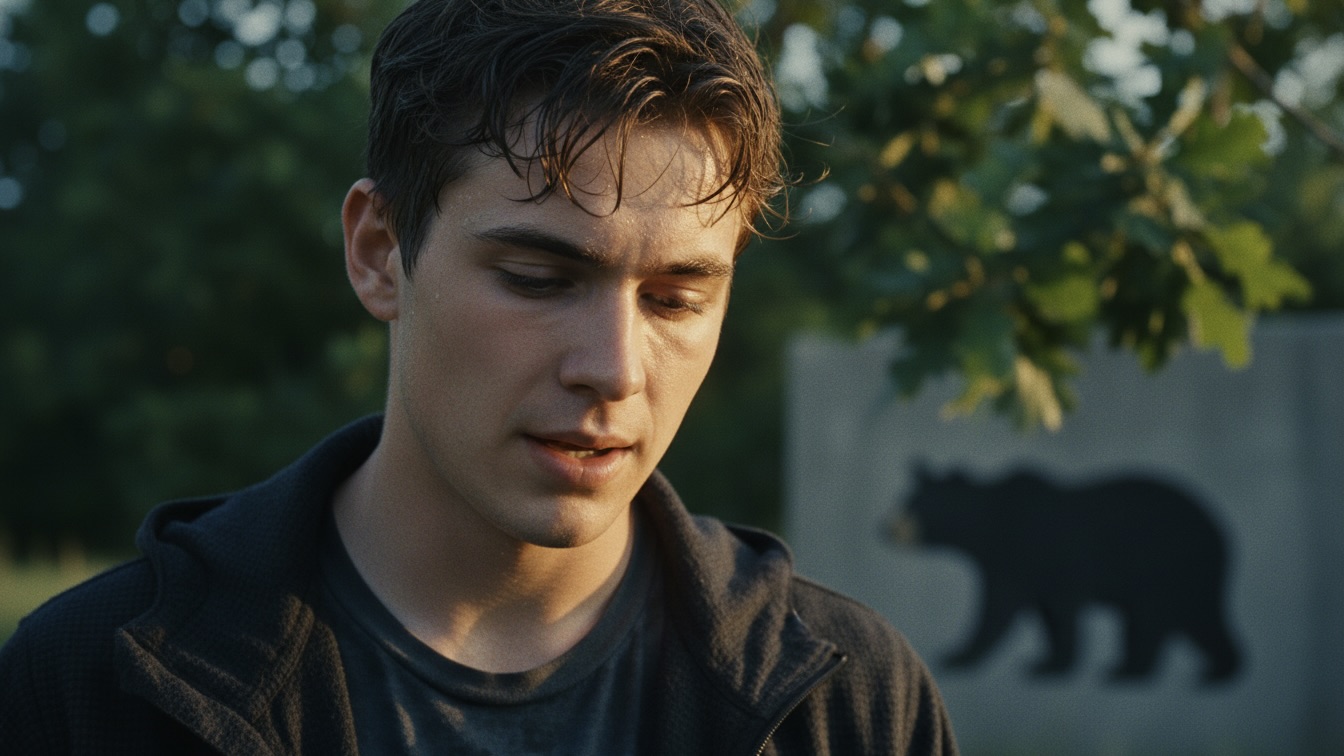
The story follows a young man struggling with a profound case of insomnia and the weight of unresolved grief. While cycling through a dark city park at two in the morning, he encounters Corey, a guerrilla botanist who is secretly planting indigenous switchgrass. Their meeting is interrupted by the arrival of a massive, living black bear, which forces them to retreat to the roof of a brutalist utility building.
While trapped on the roof, the two characters engage in a deep philosophical dialogue about the nature of existence and the indifference of the universe. The narrator reveals that he is carrying his mother’s ashes in his messenger bag, unable to find a location that feels "sacred" enough for her final rest. Corey challenges his paralysis, arguing that humans must manufacture their own meaning rather than waiting for the world to provide it.
Once the bear departs, the narrator experiences a psychological breakthrough. He chooses to scatter the ashes at the base of a magnificent, hyper-realistic bear mural painted on the utility block. This act of intentionality allows him to shed his physical and emotional burden. As dawn breaks over the city, the narrator finally feels the pull of genuine exhaustion, signaling the end of his long-term insomnia.
The central theme of the narrative is the tension between human-imposed order and the inherent chaos of the natural world. The narrator is obsessed with "logistics," "shortcuts," and "designated purposes," yet he is physically falling apart because he cannot control his grief. The bear serves as a visceral symbol of the "chaotic truth of the cosmos," an entity that exists entirely outside the narrator’s rigid schedules and routing apps.
Another significant theme is the construction of sacredness in a secular, indifferent universe. Corey posits that the universe is a "vast, uncaring void," a perspective that initially seems nihilistic. However, she refines this by suggesting that human agency is the only source of meaning. The act of scattering ashes becomes sacred not because of the geography, but because the narrator chooses to make it so, transforming a concrete utility block into a monument.
Finally, the story explores the somatic expression of psychological trauma through the lens of insomnia. The narrator describes his sleeplessness as a "physical rot" and a "vibrating" state of being. His inability to sleep is a direct manifestation of his refusal to process his mother’s death. Only when he performs the physical act of letting go do his biological systems begin to return to a state of equilibrium, allowing for the possibility of rest.
The protagonist is a man caught in the throes of a severe psychological crisis, characterized by a complete disconnection from his own body. He views his insomnia as an external parasite living in his jaw and eyes rather than a symptom of his internal mourning. His reliance on his bicycle and his "delivery" mission suggests a man who is literally trying to outrun his emotions. He uses irony and sarcasm as defensive shields to avoid facing the "heavy" reality of the cardboard box in his bag.
His internal conflict stems from a perfectionist approach to grief, as he believes there is a singular, "correct" coordinate for his mother’s remains. This indecision has paralyzed him, turning a gesture of love into a source of crushing weight. By the end of the story, he undergoes a significant transformation from a passive victim of his circumstances to an active participant in his own healing. His decision to scatter the ashes is his first authentic action in weeks, representing a reclamation of his own life.
Corey functions as a philosophical catalyst and a foil to the narrator’s rigid, anxiety-driven mindset. She is an eccentric rebel who finds purpose in "guerrilla botany," an act that mirrors the artist who painted the bear mural. She possesses a high degree of observational intelligence, quickly diagnosing the narrator’s psychological distress through his physical tics. While she initially presents a persona of detached nihilism, she eventually reveals a deeply empathetic understanding of the human need for ritual.
She serves as a bridge between the narrator’s world of "constructs" and the bear’s world of "reality." Her jacket, stained with dirt and filled with tools, marks her as someone who is comfortable with the messiness of the earth. By pushing the narrator to accept the indifference of the universe, she paradoxically gives him the permission he needs to create his own meaning. She does not offer traditional sympathy, but rather a new framework for existing in a world that she views as a "flawless biological machine."
The narrative voice is characterized by a visceral, sensory-heavy prose that reflects the narrator’s heightened, sleep-deprived state. The author uses sharp, jagged descriptions—such as "pixelated" vision and "brittle" voices—to convey the feeling of a mind on the verge of a breakdown. The contrast between the cold, industrial "steel rims" of the bike and the "wet reflection" in the bear’s eyes highlights the intersection of the urban and the wild. This sensory detail anchors the reader in the narrator’s immediate, frantic reality.
Pacing is expertly managed, shifting from the slow, atmospheric tension of the initial encounter to the high-stakes adrenaline of the bear’s arrival. The "horrific, screeching crash" of the trash can lids serves as a sonic punctuation mark that breaks the philosophical stillness of the clearing. The author then slows the pace back down during the conversation on the roof, allowing the emotional weight of the narrator’s confession to resonate. This rhythmic fluctuation mirrors the narrator’s own heart rate, which spikes with panic and eventually settles into clarity.
The use of color and light is particularly effective in establishing the story's tone. The "absolute darkness" of the park is punctuated by the "blinding" beam of a headlamp and the "hyper-pigmented" acrylics of the mural. These flashes of light represent moments of intrusive truth in the narrator’s dark night of the soul. The transition to the "bruised purple light" of dawn at the end of the story provides a visual resolution to the narrative, suggesting that while the narrator is not fully healed, the darkest part of his journey has concluded.


