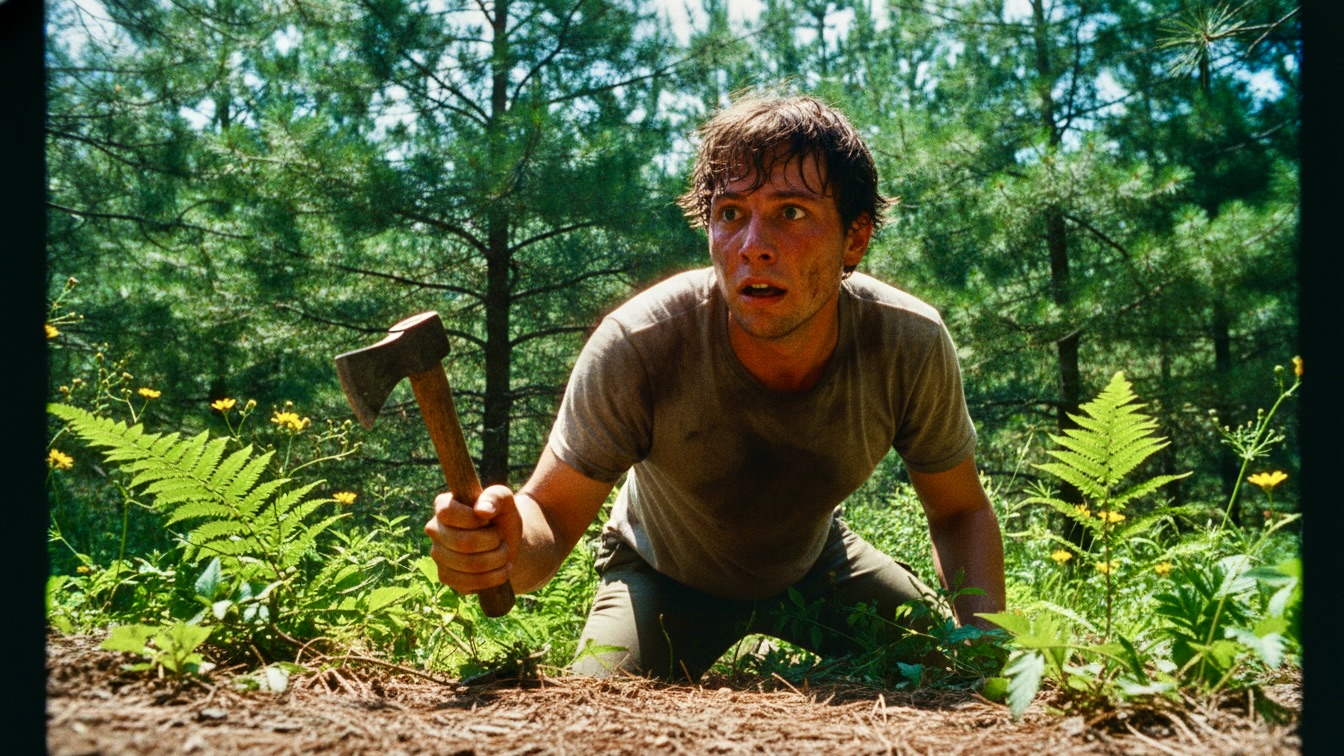
The story follows four recent high school graduates—Henry, Stefan, Barbie, and Cassie—as they embark on a celebratory camping trip to Blackwood Creek. What begins as a tense journey fueled by the heat and the unspoken anxiety of their impending separation quickly devolves into a nightmare. After discovering a ransacked campsite and a dying, aggressive squirrel that bites Barbie, the group realizes something is horribly wrong with the local wildlife.
As night falls, the situation escalates when an infected park ranger attacks the group, leaking a mysterious black fluid. They manage to trap him in a latrine, but Barbie soon displays symptoms of the same violent infection, which turns her necrotic and paranoid. While attempting to flee to their car, they encounter a group of infected hikers cannibalizing a bear. The group is forced into a desperate scramble through a ravine where Henry is forced to kill Barbie to save Stefan.
The chapter concludes with a devastating realization at the edge of the woods. Upon reaching the highway, the survivors find the area cordoned off by a military blockade. The soldiers offer no rescue, instead firing upon them to enforce a strict containment zone. With Stefan already showing signs of the black-veined infection, Henry is forced back into the wilderness, trapped between a relentless biological horror and a government willing to sacrifice them to contain it.
The central theme of the story is the violent dissolution of innocence and the transition into adulthood. The setting of a post-graduation camping trip serves as a liminal space where the characters are neither children nor fully realized adults. The "reset" they seek is ironically granted through a horrific survival scenario that strips away their social masks and forces them into brutal, life-altering decisions.
The infection itself serves as a metaphor for the "rot" of unspoken resentments and the decay of long-term relationships. When Barbie becomes infected, her dialogue shifts from casual annoyance to a venomous airing of grievances. The black fluid represents a physical manifestation of the toxicity that often lies beneath the surface of fading friendships, proving that the fear of "not being friends in five years" was a premonition of a much darker severance.
Furthermore, the story explores the theme of institutional betrayal and the cold reality of utilitarianism. The military’s presence at the end of the chapter shifts the conflict from a struggle against nature to a struggle against a system. The soldiers do not see the protagonists as victims to be saved, but as biological threats to be neutralized. This reflects a cynical worldview where the individual is expendable in the face of a larger crisis.
Finally, the motif of the "Deep Woods" acts as a psychological landscape of the subconscious. The further the characters venture from the "asphalt line" of civilization, the more primal and unrecognizable they become. Henry’s transition from a passive observer to a killer highlights the theme of survival at the cost of one's humanity. By the end of the chapter, the woods are no longer a place of recreation, but a permanent cage where the laws of society have been replaced by the laws of infection and violence.
Henry serves as the grounded, observant protagonist who undergoes the most significant psychological transformation. At the beginning of the journey, he is passive, reacting to the discomfort of the heat and the friction between his friends with a sense of weary endurance. He is the one who notices the subtle shifts in the environment, suggesting a high level of empathy and situational awareness that eventually keeps him alive.
His internal conflict reaches a breaking point when he is forced to kill Barbie. This act represents the death of his former self and the severing of his ties to a shared childhood. Though he acts out of love for Stefan, the clinical, "dead" quality of his voice afterward suggests a permanent psychological fracture. He has moved beyond the realm of teenage anxiety and into a state of cold, survivalist pragmatism.
Stefan is characterized by his desire for control and his sense of responsibility toward the group. His "ten and two" grip on the steering wheel and his insistence on cleaning Barbie’s wound show a young man trying to maintain order in an increasingly chaotic environment. He acts as the traditional protector of the group, a role that makes his eventual infection and injury particularly tragic.
As the story progresses, Stefan’s physical decline mirrors the collapse of the group's safety. His broken ankle and the creeping black veins under his collar signify his transition from the leader to the liability. By the end of the chapter, he represents the lingering hope that Henry cannot quite abandon, even though Stefan’s fate is effectively sealed by the very infection they fought to escape.
Barbie begins the story as the provocateur, using her physical presence and loud music to mask the underlying tension of the trip. She is the first to fall victim to the infection, and her transformation provides a window into the psychological effects of the pathogen. The infection does not just change her body; it strips away her social filters, allowing her hidden insecurities and jealousies to surface with violent intensity.
Her death at Henry's hands is the narrative's emotional climax. Before she turns, she is a symbol of the group's shared past, but as the black veins take over, she becomes a mirror reflecting the group's impending dissolution. Her descent into "paranoid rage" highlights the story's suggestion that there is a fine line between the social friction of adolescence and literal, bloodthirsty madness.
Cassie represents the attachment to a civilization that no longer exists for the group. Her constant scrolling through a phone with no service is a poignant defense mechanism, an attempt to cling to the digital world while the physical world turns into a charnel house. She is the most outwardly emotive member of the group, her sobbing and shaking providing a sharp contrast to Henry’s growing numbness.
Despite her fear, she remains a functional part of the survival unit, helping Henry drag Stefan through the ravine. However, her encounter with the soldiers at the highway shatters her last vestige of hope. She is the one who screams for help, still believing in the fundamental goodness of authority, only to be met with a warning shot that forces her back into the "green rot."
The narrative voice is characterized by a gritty, visceral realism that heightens the horror of the supernatural elements. The author uses sensory details—the "clicking" of teeth against a pothole, the "smell of rotten meat and sulfur," and the "wet snapping" of a broken bone—to ground the story in a physical reality. This tactile approach ensures that the "black tar" infection feels like a biological reality rather than a mere trope.
Pacing is expertly handled through the use of environmental shifts. The story begins with a slow, sweltering heat that creates a sense of lethargy and irritability, mirroring the characters' emotional states. This slow burn rapidly accelerates once the first scream is heard, shifting the prose into a frantic, high-stakes rhythm. The transition from the "relentless drone of cicadas" to an "absolute silence" serves as a brilliant auditory cue for the approaching danger.
The tone of the chapter is one of mounting claustrophobia. Even though the characters are in the "Deep Woods," the density of the trees and the oppressive humidity create a feeling of being trapped. This atmospheric pressure culminates in the final scene at the highway, where the literal barrier of the military blockade mirrors the psychological barrier the characters have hit. The use of short, punchy sentences during the action sequences reflects the characters' narrowed focus and heightened adrenaline.
Finally, the narrative employs a "biological horror" aesthetic that is both clinical and grotesque. Descriptions of the "necrotic black" veins and the "black fluid" leaking from the ranger’s mouth create a sense of profound wrongness. By focusing on the corruption of the human body and the natural world, the style reinforces the story's broader themes of decay and the loss of the familiar.


