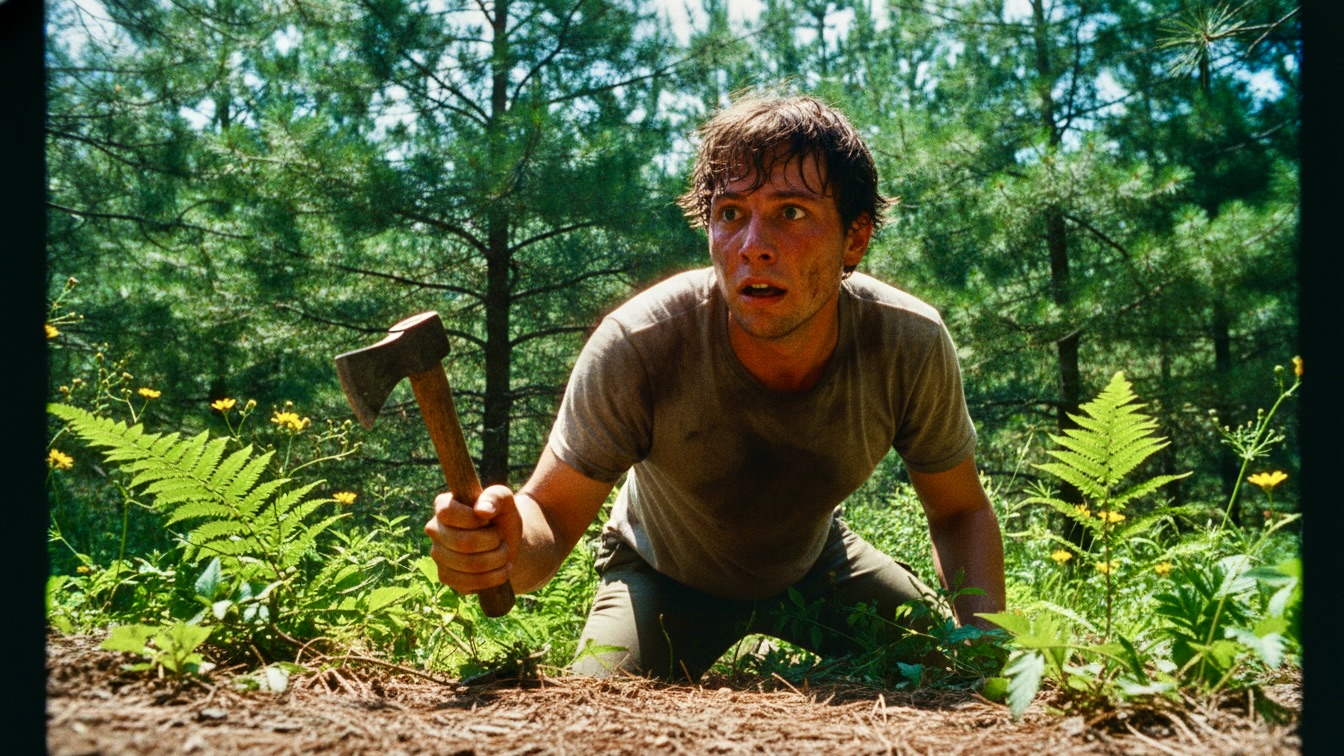
Format: Short Film / Anthology Episode | Est. Length: 10-12 minutes
Imagine this story as the claustrophobic pilot for a prestige horror anthology titled The Blackwood Protocol, where each episode explores a different localized biological collapse within the American wilderness. The series would utilize a "ground-zero" perspective to showcase the rapid breakdown of social and biological order, focusing on the visceral horror of nature turning against humanity. This specific episode establishes the series' core threat: a black, necrotic contagion that strips away human filters and replaces them with predatory rage, all while the state enforces a cold, lethal quarantine.
A celebratory post-graduation camping trip turns into a visceral nightmare when a rabid squirrel bite introduces a black, necrotic infection that transforms a group of lifelong friends into mindless, black-veined predators.
Four recent high school graduates must survive a night in the dense Blackwood Creek wilderness after a biological contagion begins turning the local wildlife and hikers into violent, black-veined monsters. As the infection spreads within their own group, they discover that the government’s solution to the outbreak is far more lethal than the virus itself.
The primary theme is the "death of innocence" and the abrupt end of childhood, mirrored by the literal physical decay of the characters. The transition from high school to the "real world" is dramatized as a violent survival struggle where the characters' fears about their drifting friendships are realized through the literal consumption of one another, suggesting that some bonds are broken long before the blood starts spilling.
The secondary theme explores the "indifference of systems," contrasting the raw, emotional panic of the teenagers with the cold, mechanical efficiency of the military blockade. It examines the horror of being "dehumanized" twice: first by a virus that turns you into an animal, and second by a government that views you only as a biological hazard to be contained or eliminated.
For Henry, the stakes are both physical survival and the preservation of his moral soul as he is forced to commit horrific acts to protect what remains of his friends. The group faces total biological erasure from the infection and extrajudicial execution by a military containment unit that views them as collateral damage. Failure means not just death, but becoming part of the "black rot" that consumes the forest.
The external conflict is a dual-threat survival scenario: dodging infected, high-speed predators in the woods while evading a cold, militarized quarantine that uses lethal force against civilians. Internally, the group is fractured by pre-existing resentments—infidelity, jealousy, and the anxiety of separation—which the infection amplifies into murderous paranoia. The primary antagonist shifts from the infected Barbie to the faceless, gas-masked soldiers who represent an insurmountable wall between the survivors and safety.
Henry, Stefan, Barbie, and Cassie arrive at Blackwood Creek for a final summer getaway, but the oppressive heat and a broken air conditioner set a tone of simmering tension and physical discomfort. While fetching water, Barbie is bitten by a black-fluid-leaking squirrel near an abandoned, blood-stained campsite, sparking a rapid physical and mental deterioration that the group initially mistakes for heatstroke. As night falls, the woods go silent before a mutated park ranger attacks their camp, forcing the group to realize they are trapped in a zone of biological horror where the infected display predatory rage and black necrotic veins.
The survivors attempt to flee to their car but find the main trail occupied by infected hikers feasting on a grizzly bear, forcing them into a treacherous ravine. In the chaos, Stefan is injured and Barbie fully succumbs to the infection, forcing Henry to kill his best friend with a camp hatchet to save the others. At dawn, Henry and Cassie reach the highway only to find a military blockade that refuses to let them pass, firing upon them and forcing them back into the infected woods. The episode ends with the realization that the "containment zone" is a death sentence, and the infection has already taken root in the surviving members of the group.
Henry: The pragmatic but emotionally burdened leader who starts the story trying to maintain the group's fragile peace and ends as a hardened survivor forced to kill his best friend. His psychological arc is one of rapid maturation, moving from a boy worried about college loans to a man who understands the cold calculus of survival in a world that has abandoned him.
Stefan: A cautious, high-strung driver whose white-knuckle anxiety at the start evolves into physical agony and eventual infection after he is mauled by Barbie. He represents the physical vulnerability of the group, and his slow transformation in the final act serves as the ticking clock for Henry’s remaining humanity.
Barbie: The impulsive, confrontational life of the party who serves as the primary tragic figure, transforming from a sweating, joking teenager into a black-veined monster. Her arc is purely biological and horrific, as the infection strips away her personality and replaces it with the raw, suppressed grievances she held against her friends.
Cassie: The detached, phone-obsessed observer who is forced into a state of raw, vibrating terror as her social world and safety net are violently dismantled. By the end, she is a shell-shocked witness to the brutality of both the infection and the state, representing the audience's horror at the total collapse of the status quo.
Beat 1: The group arrives at the clearing in a rattling Subaru, the oppressive 92-degree heat and dead AC establishing a sense of physical discomfort and mounting group friction. They unpack in a silence heavy with the dread of their upcoming college separation, oblivious to the unnatural quiet of the surrounding pines. Stefan’s strained focus on the road and his white-knuckled grip on the wheel foreshadow the total loss of control that defines the night ahead.
Beat 2: Henry and Barbie discover a decimated campsite by the creek where a leaking propane stove and blood-smeared sleeping bags signal a recent, violent struggle. A mutated, twitching squirrel lunges from the trees and bites Barbie’s thumb, injecting a black, oily substance that immediately begins to fester and spread through her veins. Henry’s attempt to rationalize the scene as a bear attack fails to mask the growing sense of wrongness permeating the woods as they retreat to their own camp.
Beat 3: Back at camp, the infection accelerates as Barbie becomes paranoid and aggressive, her blood turning a necrotic black as the sun sets and the cicadas abruptly stop their drone. A mutilated park ranger emerges from the darkness, leaking black bile and speaking in tongues, before launching a feral attack on Stefan. The teenagers manage to overpower the man and lock him in a concrete latrine, but the sound of him throwing his body against the steel door marks the end of their safety.
Beat 4: Attempting to flee to the car, the trio encounters a group of infected hikers feasting on a grizzly bear carcass, their eyes reflecting yellow in the flashlight beams. The realization that the infection is widespread triggers a blind flight into a muddy ravine, where Stefan breaks his ankle and becomes a sitting duck for the approaching predators. Barbie finally loses her humanity entirely, her jaw unhinging as she attacks Stefan, forcing Henry to make a soul-shattering choice to save his own life.
Beat 5: Henry uses a camp hatchet to kill the transformed Barbie, a moment of visceral finality that strips away his remaining innocence as he hauls the injured Stefan toward the highway. They emerge from the brush at dawn, expecting rescue from the military blockade stationed on Interstate 90, only to find themselves staring down the barrels of assault rifles. A megaphone orders them back into the "containment zone," revealing that the government views the survivors as nothing more than biological waste.
Beat 6: The episode ends with a chilling display of state-sanctioned violence as a soldier fires at Cassie’s feet, making it clear that no one is allowed to leave the woods alive. Henry sees the black veins beginning to crawl up Stefan’s neck and realizes the military is not there to save them, but to wait for them to die. He pulls his remaining friends back into the dark tree line, trapped between a biological monster and a mechanical one as the screen fades to black.
The mood begins with a "slow-burn" discomfort characterized by heat and social awkwardness, quickly escalating into "body horror" and "visceral panic." The audience experience transitions from the relatable anxiety of a fading friendship to the cosmic, nihilistic horror of being hunted by both nature and the state. The final emotional beat is one of total abandonment, leaving the viewer with a sense of cold, vibrating hopelessness.
If expanded, the season would follow Henry and Cassie as they navigate the "Containment Zone," discovering other pockets of survivors and the origin of the black tar pathogen. They would eventually encounter a resistance group of former park rangers and scientists who are attempting to leak evidence of the outbreak to the outside world while avoiding "clean-up" squads.
The overarching narrative would explore the ethics of the military's "scorched earth" policy and the possibility that the infection is an ecological immune response to human encroachment. The season finale would culminate in a desperate attempt to breach the blockade, forcing Henry to decide if he will save himself or sacrifice everything to expose the truth of what happened in Blackwood Creek.
The visual style utilizes a "sweaty," high-contrast palette in the first act, using long lenses to create a sense of being watched from the dense foliage. Once night falls, the cinematography shifts to "claustrophobic," flashlight-driven lighting with high-shutter-speed action sequences to emphasize the unnatural, jerky movements of the infected.
Tonal influences include the gritty realism of The Last of Us and the nihilistic, environmental dread of Annihilation. The sound design is crucial, transitioning from the overwhelming drone of cicadas to an unnatural, heavy silence that is punctured only by the "wet" sounds of the infection and the mechanical roar of military hardware.
This series targets fans of "elevated horror" and "survival thrillers," specifically the 18-35 demographic that appreciates character-driven drama mixed with extreme practical effects. It appeals to viewers who enjoy dark, socially relevant genre fiction like Black Mirror or 28 Days Later, where the monsters are a catalyst for exploring human fragility.
The pacing is relentless, utilizing a "ticking clock" structure where the infection's rapid onset dictates the speed of the narrative. The first three minutes establish the social stakes, while the remaining nine minutes are a continuous, escalating descent into chaos, ensuring the 10-12 minute runtime feels like a breathless, single-take experience.
Production requires high-quality practical makeup for the "black vein" and "necrotic" effects to maintain a sense of grounded realism; CGI should be used sparingly for the black bile and eye reflections. The use of a real forest location is essential to capture the oppressive density of the pines, which serves as a character in itself.
The military blockade in the final scene requires a significant shift in production scale, utilizing authentic tactical gear and heavy vehicles to create a jarring contrast with the natural setting. Coordination with a stunt team is necessary for the high-speed "animalistic" movements of the infected hikers and the visceral struggle in the ravine.


