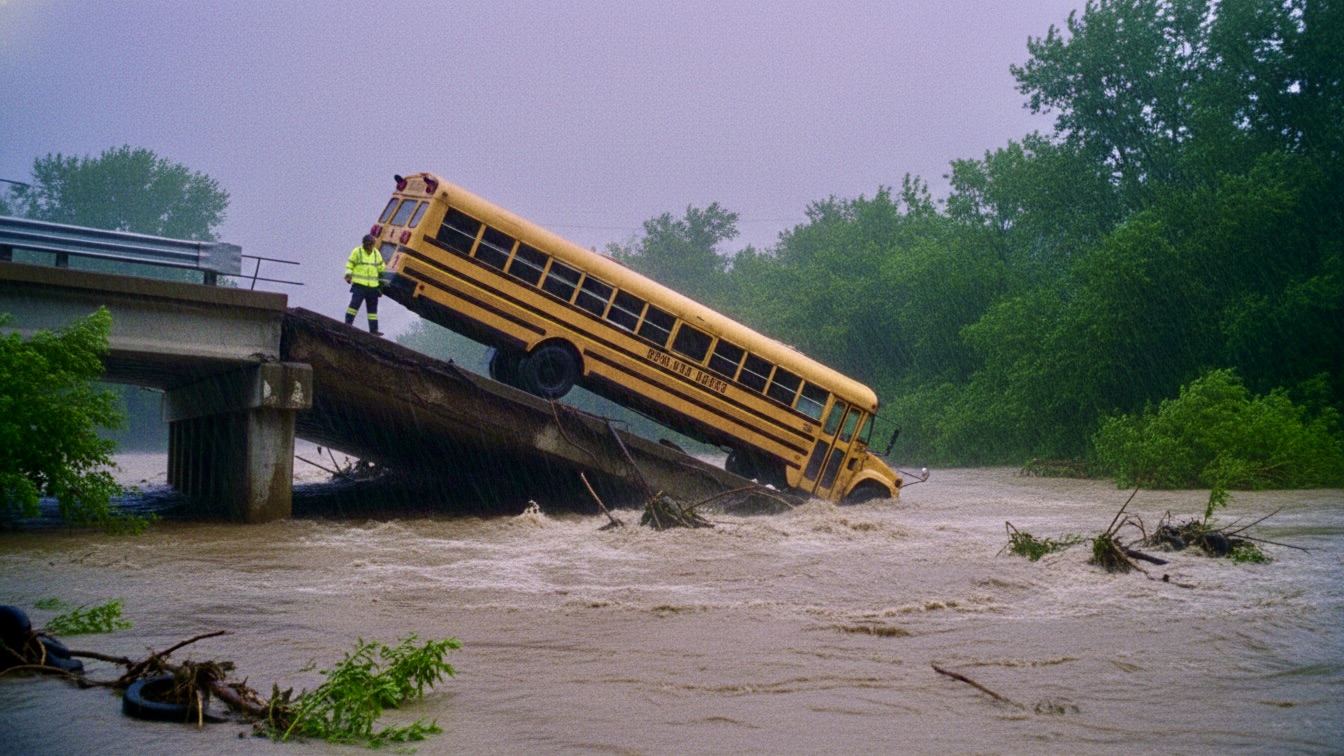
The story follows Taylor, an emergency coordinator tasked with managing a catastrophic flood in Melgund Creek. As the waters rise beyond the limits of the town’s infrastructure, she finds herself caught between a literal deluge and a figurative wall of bureaucratic indifference. Taylor is forced to make high-stakes decisions, including closing a swaying bridge and rescuing a bus full of children when the provincial government refuses to declare a state of emergency.
The tension escalates when Taylor realizes the town's dam is being battered by debris and is likely to fail. After being denied aerial support by Director Morton, a cost-conscious provincial official, she takes matters into her own hands by commandeering a search and rescue helicopter. She successfully rescues an elderly couple from their roof moments before the dam breaches and the house is swept away. Despite her heroics, the chapter concludes with a grim realization that a secondary surge is threatening the town's last remaining refuge.
The primary theme of the narrative is the conflict between human infrastructure and the indifferent power of nature. The author portrays the flood not as a sentient enemy, but as a "monster" reclaiming space that was never truly conquered by zoning laws or property taxes. This theme is highlighted by the "Fifty Percent Dam," a structure built for a world that no longer exists. The failure of the bridge and the dam serves as a metaphor for the fragility of the systems humans rely on for a sense of permanence.
Another central theme is the failure of institutional bureaucracy in the face of immediate human crisis. Director Morton represents a system that prioritizes "fiscal responsibility" and "optics" over the preservation of life. This creates a moral vacuum that Taylor is forced to fill through individual action and defiance of protocol. The story suggests that in times of unprecedented disaster, the "chain of command" often becomes a noose rather than a safety net.
Finally, the story explores the psychology of trauma and the necessity of emotional suppression during a crisis. Taylor’s recurring memories of the 2018 flood indicate a deep-seated post-traumatic stress that she must actively "push down" to function. The narrative posits that in a disaster, there is no room for the luxury of processing trauma. Survival requires a cold, clinical pragmatism that can only be unpacked once the water recedes and the feet are dry.
Taylor is a deeply pragmatic leader who utilizes cynicism as a psychological shield against the overwhelming weight of her responsibilities. She is haunted by past failures, specifically the 2018 flood, which informs her urgent and often aggressive decision-making style. Her refusal to wait for provincial approval demonstrates a moral compass that is calibrated toward immediate life-saving rather than career preservation. She views herself not as a hero, but as a necessary friction against a broken system.
Psychologically, she exhibits signs of high-functioning stress, evidenced by her physical reactions to small irritants like Riley’s gum-chewing or her pinching headset. These minor pains serve as anchors, preventing her from being swallowed by the "pure, unadulterated anxiety" that surrounds her. Her willingness to risk her life on the roof of a collapsing house suggests a level of self-sacrifice that borders on the reckless. She is a woman who would rather be fired or killed than stand by and watch a preventable tragedy unfold.
Riley serves as the narrative’s emotional ballast, providing a contrast to Taylor’s high-strung intensity. He is twenty-two years old and appears to have adopted a persona of detached nonchalance, likely as a coping mechanism for the chaos around him. His focus on "low blood sugar" and "faded anime characters" suggests a generational comfort with absurdity. He is the only person in the room not "vibrating" with anxiety, which makes him an invaluable asset to Taylor’s command.
Despite his laid-back demeanor, he is highly competent and loyal to Taylor’s mission. He navigates the digital and bureaucratic landscape with an ease that Taylor lacks, acting as her filter for the outside world. He understands the "rancid vibes" of the situation but remains functional, showing that his youth does not equate to a lack of seriousness. He is the modern assistant who recognizes the world is ending but still finds time to pop a piece of gum.
Director Morton functions as the personification of systemic rot and the banality of administrative evil. He is a man who views a catastrophic flood through the lens of "resource optimization" and "fuel scarcity." His concern for the "optics" of over-responding reveals a character who is more afraid of a budget deficit than a loss of life. He is the ultimate antagonist because his weapon is not malice, but a rigid adherence to a protocol that is no longer applicable.
His interaction with Taylor reveals a deep-seated insecurity and a need to maintain power through threats of credential revocation. He attempts to gaslight Taylor by claiming she is "overreacting" to a bridge collapse, showing a complete disconnection from the reality on the ground. When the rescue is successful, his immediate pivot to taking credit on the news highlights his opportunistic nature. He is a man who survives by navigating the political currents while others drown in the literal ones.
The pacing of the story is relentless, mirroring the rising water levels of Melgund Creek. The narrative begins with a sense of "musty" stagnation in the basement and rapidly accelerates into a high-stakes aerial rescue. This shift in momentum effectively captures the "unprecedented" nature of the disaster, where a situation can go from managed to catastrophic in a matter of minutes. The author uses short, punchy sentences during the action sequences to heighten the reader's pulse.
Sensory details are used with surgical precision to create a visceral atmosphere of decay and danger. The smell of "ozone and panic," the "rhythmic, heavy thud" of rain, and the "chocolate-colored" river provide a grim, monochromatic aesthetic. These details do more than set the scene; they evoke a sense of physical discomfort that aligns the reader with Taylor’s perspective. The recurring motif of "damp socks" and "pinching headsets" grounds the epic disaster in the mundane reality of human irritation.
The narrative voice is characterized by a sharp, dark humor that serves as a necessary relief from the tension. Taylor’s internal monologue is filled with biting observations about "expensive bathtubs" and "concrete jump ropes." This tonal choice prevents the story from becoming a generic disaster trope and instead gives it a grounded, human heart. The irony of a boy playing a block-building game while his real world dissolves is a poignant example of the story’s focus on the absurdities of modern life during a crisis.


