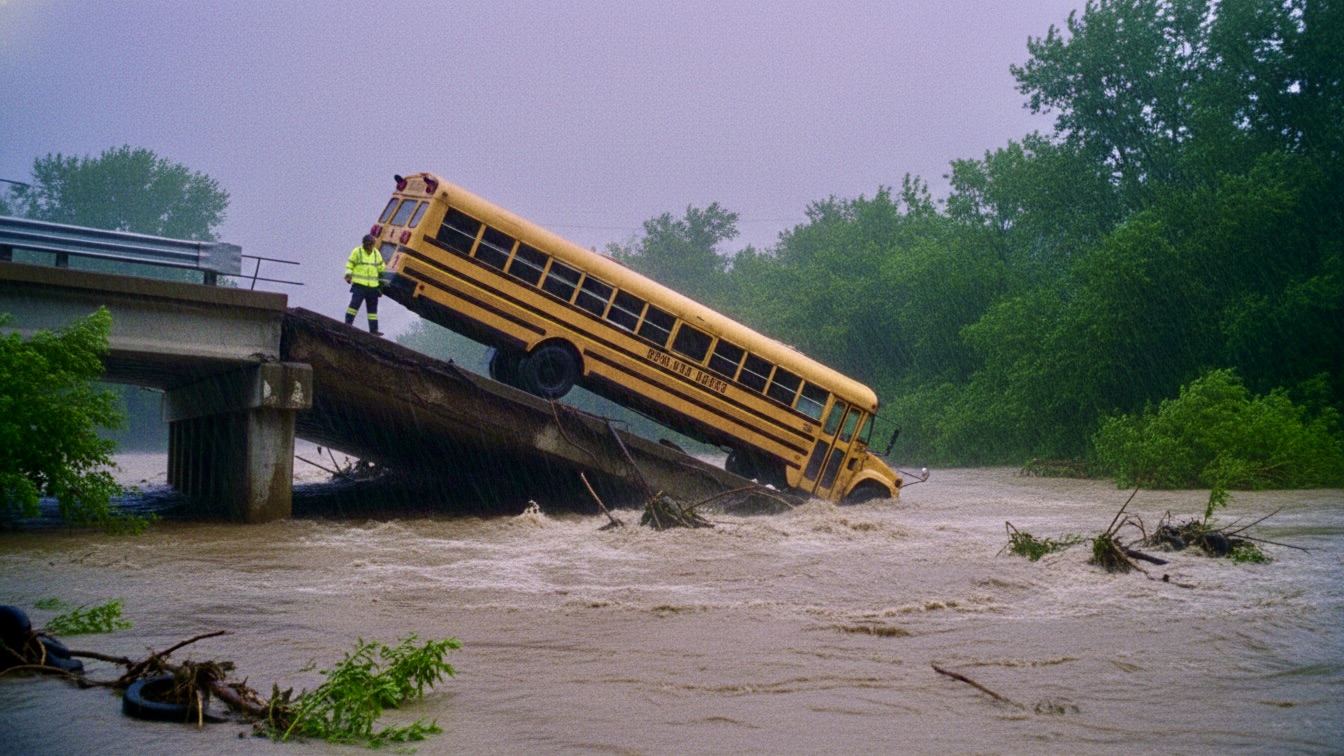
A massive flash flood turns Melgund Creek into a muddy graveyard as Taylor Brooks fights bureaucracy and rising water.
Maybe the universe just has a really dark sense of humor, Taylor thought, staring at the muddy water swirling around the legs of their desk. It was July. It was supposed to be a season of humidity, overpriced iced coffee, and the occasional lawn mower drone. Instead, Melgund Creek looked like a poorly rendered disaster movie.
The basement of the town hall—now the 'Emergency Coordination Center'—smelled musty. Taylor adjusted their headset, which was pinching the skin behind their left ear. It was the kind of sharp, nagging pain that made it hard to care about the 'unprecedented' rainfall totals. People loved that word. Unprecedented. It was a fancy way of saying we didn't plan for this and now everyone’s car is a submarine.
"The river is at twelve meters," Riley said, leaning over the console. Riley was twenty-two, wore a shirt with a faded anime character on it, and was currently the only person in the room who hadn't started vibrating with pure, unadulterated anxiety. "Which is cool, considering the levee is rated for ten."
"Super cool," Taylor muttered. Their socks were damp. There was nothing more demoralizing than damp socks when you were trying to prevent a municipal collapse. "Did the provincial office pick up?"
"They’re in a meeting," Riley said, popping a piece of gum. "Something about the fuel tax. Apparently, a flood doesn’t qualify as a fiscal priority until the water reaches the capital. Which is uphill. So, we’re on our own for the next, uh, forever."
Taylor looked at the map. The red lines representing the creek were bleeding into the green zones representing people’s lives. It was messy. It was stupid. The creek was usually a trickle where teenagers drank cheap beer and complained about their parents. Now it was a monster eating the north side of town. The sound of the rain on the basement windows was a rhythmic, heavy thud—like someone was throwing wet towels against the glass over and over again.
"I need to move the command center to the high school," Taylor said, standing up. Their knees popped. "The basement is a death trap. If the power goes, we’re just sitting in a very expensive bathtub."
"The high school is on the ridge," Riley agreed. "Better Wi-Fi too. I can’t even get a signal down here to check the radar. The satellite is doing this thing where it just shows me a picture of a cloud and then crashes."
Taylor grabbed their jacket. It was a bright neon yellow thing that made them look like a highlighter. "Tell the fire chief we’re relocating. And Riley?"
"Yeah?"
"Stop chewing that gum. It’s making me want to scream."
"Low blood sugar, Taylor. Don't hate the player."
Taylor stepped out into the main hall. The air was thick with the scent of ozone and panic. Volunteers were carrying boxes of bottled water that would probably be gone in an hour. Outside, the world was a monochromatic wash of gray and brown. The sun was up there somewhere, hidden behind a ceiling of clouds that looked like dirty wool. This wasn't a 'spring melt' situation anymore. This was the sky falling. Every time Taylor closed their eyes, they saw the 2018 flood. The smell of the silt. The sound of the sirens that didn't stop for three days. They pushed the memory down. There wasn't room for trauma today. Trauma was for people who had dry feet and time to talk to a therapist.
"Taylor!" a voice barked. It was Mayor Hanson. He was wearing a suit that cost more than Taylor’s car, and he looked like he was about to have a stroke. "The bridge. The main bridge on 4th. People are saying it’s swaying."
"It’s a suspension bridge, Bill. It’s supposed to move," Taylor said, not stopping.
"Not like this! It looks like a jump rope!" Hanson followed them, his expensive shoes splashing through the inch of water on the floor. "We need to close it. If we close it, the west side is cut off. The grocery store is on the west side. The pharmacy is on the west side."
"If it collapses while a car is on it, the grocery store won’t matter much to those people, will it?" Taylor stopped and turned. Hanson was shorter than they remembered. Or maybe the stress was just shrinking him. "I’m closing it. Get the barricades out there. Use the salt trucks if you have to."
"The province hasn't signed off on an emergency declaration yet," Hanson whispered, his face turning a dangerous shade of purple. "The costs, Taylor. The liability."
"Bill, look at the floor. You’re standing in the liability. Call me when you find your spine."
Taylor pushed through the heavy double doors and stepped into the deluge. The wind caught the door, nearly ripping it from their hand. The rain wasn't falling; it was attacking. It hit the skin with a stinging, needle-like precision. Taylor waded toward their truck, the water already up to their shins. A plastic trash can floated past, bobbing rhythmically like a buoy. The absurdity of it hit them—a tiny, plastic piece of civilization being reclaimed by a river that didn't give a damn about zoning laws or property taxes. They hopped into the cab, the engine groaning as it turned over. The radio crackled to life, a burst of static that sounded like a scream.
"Dispatch to Taylor. We have a situation at the bridge. A bus. A school bus is stalled at the mid-point."
Taylor’s heart did a slow, heavy roll in their chest. "The bridge I just said to close?"
"The barricades weren't up yet, Taylor. The driver thought he could make it. The water hit the deck and the engine died. There are kids on there."
Taylor gripped the steering wheel so hard their knuckles turned white. "I'm on my way."
The drive to the 4th Street bridge should have taken three minutes. It took ten. The roads were no longer roads; they were shallow canals filled with the debris of a thousand lives. A soaked mattress leaned against a stop sign. A child’s tricycle lay overturned in a gutter, its wheels spinning aimlessly in the current. Taylor drove the truck onto the sidewalk twice to bypass stalled sedans whose owners had abandoned them in a panic. The hum of the engine was the only thing keeping the silence of the storm at bay. Every time a branch hit the windshield, Taylor flinched. The adrenaline was starting to wear off, replaced by a cold, buzzing dread.
When the bridge finally came into view, Taylor’s stomach dropped. Hanson hadn't been exaggerating. The structure was vibrating. The steel cables were humming a low, dissonant chord that Taylor could feel in their teeth. The river below was no longer a river; it was a churning, chocolate-colored monster, carrying entire trees like toothpicks. The water was lapping at the bottom of the bridge deck, sending plumes of spray into the air every time a piece of debris slammed into the pylons.
And there it was. The yellow bus. It looked toy-like against the scale of the destruction. It was tilted slightly to the left, the front tires submerged in a foot of rushing water that was sweeping across the asphalt.
Taylor slammed the truck into park and jumped out. The wind nearly knocked them over. They fought their way to the edge of the bridge approach, where a few bystanders were standing, filming the scene on their phones.
"Get back!" Taylor screamed over the roar of the water. "Clear the area!"
"Is there someone in there?" a girl in a drenched hoodie asked, her eyes wide with a mix of horror and morbid curiosity.
Taylor didn't answer. They grabbed a heavy-duty rope from the back of the truck and a pair of bolt cutters. Their hands were shaking, not from fear, but from the sheer physical effort of existing in this weather. They looked out at the bus. A face appeared in the back window. A small hand pressed against the glass.
"Radio!" Taylor barked into their shoulder mic. "Riley, I need the heavy rescue team here now. And tell the helicopter unit to stop checking their hair and get in the air. We have a bus on the 4th Street bridge. It’s moving."
"The wind is too high for the bird, Taylor," Riley’s voice crackled through. "They’re saying thirty knots. They won’t fly."
"Tell them I don't care about their flight manual!" Taylor yelled. "If that bridge goes, those kids are gone!"
Taylor started walking onto the bridge. The sensation was sickening. The ground didn't feel like concrete; it felt like a living thing, bucking and swaying. Every few seconds, a heavy 'thump' vibrated through the soles of their boots—the sound of the river's battering rams hitting the foundations. They reached the bus. The water was slick with oil and mud, making every step a gamble.
Taylor hammered on the folding doors. They were jammed. Through the glass, they saw the driver—a man in his sixties named Arthur. He looked paralyzed. His hands were frozen on the wheel, his eyes staring straight ahead at the rising water.
"Arthur! Open the door!" Taylor shouted, slamming their fist against the frame.
Arthur turned slowly. He looked like he was underwater already. He shook his head. "It won't open. The frame shifted. We’re stuck, Taylor. We’re stuck."
Behind him, ten or twelve kids were huddled in the middle of the bus. They weren't crying. That was the weird part. They were just silent, staring at Taylor with a terrifying level of expectation. One boy was holding a tablet, the screen glowing with a game about building blocks. The digital world was stable; the real one was dissolving.
Taylor took the bolt cutters and smashed the glass of the door. The sound was a sharp, high-pitched crack that seemed to silence the storm for a fraction of a second. They reached in, fumbling for the manual release. The metal was cold and jagged. When the door finally hissed open, a surge of water rushed into the bus, soaking Arthur’s legs.
"Okay, everyone!" Taylor said, trying to keep their voice steady. "One at a time. Move to the back. We’re going to use the emergency exit. It’s higher up."
"The bridge is moving," a girl whispered. She was clutching a backpack decorated with glittery patches.
"I know," Taylor said, forcing a smile that felt like a mask. "It’s like a ride at the fair. Just much wetter. Come on, move!"
They hustled the kids toward the back. The bus groaned. A sharp, metallic 'twang' echoed from somewhere beneath them—a bolt snapping. The bridge tilted another three degrees. Taylor felt the shift in their inner ear. They grabbed the girl with the backpack and shoved her toward the rear door.
"Arthur, help them out!" Taylor commanded.
Arthur finally moved, his survival instinct kicking in. He scrambled to the back and began lifting the kids down onto the bridge deck. Taylor stood in the aisle, watching the front of the bus. The water was now pouring over the dashboard. The smell of burning electronics filled the cabin.
"Last one!" Arthur yelled.
Taylor turned to follow, but a sudden jolt threw them against the seats. The bridge had dropped. The pylons on the north side were failing. The bus began to slide sideways, its tires screeching against the wet concrete.
"Taylor! Jump!" Arthur screamed from the deck.
Taylor lunged for the back door, their fingers catching the edge of the metal frame. They hauled themselves out just as the front of the bus dipped into the gap where the road used to be. The bus hung there, balanced on its belly, its headlights cutting through the murky water like twin searchlights into the abyss.
Taylor rolled onto the vibrating concrete, their lungs burning. They looked back. The bridge approach was still holding, but the central span was a wreck. The kids were huddled twenty yards away, Arthur standing over them like a drenched shepherd.
"Keep moving!" Taylor yelled, scrambling to their feet. "Get to the land!"
They didn't look back until they felt the solid, unmoving earth of the riverbank beneath their feet. A second later, a sound like a freight train filled the air. The 4th Street bridge didn't just fall; it vanished. One moment it was there, a gray line in the storm, and the next, it was swallowed by the brown surge. The bus went with it, a flash of yellow quickly lost in the debris.
Taylor stood there, chest heaving, the rain washing the salt from their face. They looked at their hands. They were covered in small, bloody nicks from the broken glass.
"Is the bus okay?" the boy with the tablet asked, looking up from his game.
Taylor looked at him, then at the empty space where the bridge had been. "The bus is taking a nap, kid. It’s had a long day."
The high school gym smelled like sweaty socks and bleach—the universal scent of public education. Now, it was also the scent of a refugee camp. Two hundred people were sprawled across blue wrestling mats, wrapped in thin wool blankets that looked like they hadn't been washed since the Reagan administration. Taylor stood in the corner of the 'command center'—actually just the principal's office—staring at a laptop screen that refused to load the latest hydrological data.
"The dam," Taylor said, more to themselves than anyone else. "If the bridge went, the dam is taking the full force of the debris. All those trees, the cars, the pieces of the 4th Street bridge... they’re all hitting the spillway right now."
Riley was sitting on the principal’s desk, swinging their legs. "I finally got through to the province. They sent an email."
"An email? We’re drowning and they sent a ‘per our last conversation’?"
"Worse," Riley said, handing Taylor a tablet. "It’s a memo on 'Resource Optimization during Fuel Scarcity.' Basically, they aren't sending helicopters or heavy machinery because the cost of fuel is too high and they’re worried about the optics of 'over-responding' to a localized event."
Taylor felt a hot flash of rage that had nothing to do with the humidity. "Localized? The entire valley is a lake! Did you tell them about the bridge?"
"I did. They asked if we had a permit for the demolition."
Taylor leaned back, their head hitting the wall with a dull thud. The absurdity of it was starting to feel heavy. Somewhere, in a dry office with a functioning espresso machine, a bureaucrat was checking boxes and worrying about a budget. Here, Taylor was trying to figure out how to tell two hundred people they might have to evacuate the 'safe' zone if the dam failed.
"The dam is sixty years old, Riley. It was built for a world that didn't have this kind of rain. It was built for 'normal' summers. Not... this."
"The 'this' is the problem," Riley agreed. "Hey, Taylor? The sewage system just backed up in the locker rooms. It’s, uh, it’s not great. The vibes are officially rancid."
Taylor rubbed their eyes. "Get the janitor. Tell him to sandbag the drains. I don't care if he has to use the kids' gym bags."
"He already is. He’s using the lost and found. There are a lot of abandoned hoodies keeping the poop at bay right now."
Taylor stood up and walked to the window. From the second floor of the high school, they could see the town. Or what was left of it. The lights were out, making the valley a dark, jagged void. The only movement was the occasional flash of a flashlight or the pulse of an emergency light. The rain had slowed to a steady drizzle, but the water wasn't receding. It was pooling, turning the town into a series of stagnant islands.
There was a knock on the door. It was Sarah, the local vet. She was covered in mud up to her waist and was carrying a crate that was currently emitting a very angry meow.
"Taylor, the north levee is soft," she said, her voice cracking. "I was out there trying to get the Morton’s horses. The ground is like pudding. One more surge and the whole north side is going to be buried in three feet of silt."
"I know, Sarah. I’m trying to get the province to move, but they’re playing accounting games."
"Well, tell them to account for this," she said, gesturing to the window. "The Mortons stayed. They wouldn't leave the barn. They’re on their roof now. I saw them when I was heading back. They were waving a white sheet."
Taylor’s heart sank. The Mortons were in their eighties. "Riley, call the air unit again. Tell them we have civilians on a roof in the north quadrant. If they don't fly, I’m calling the local news and telling them the province is letting seniors drown to save forty bucks on jet fuel."
"On it," Riley said, already typing.
Taylor turned back to Sarah. "Go get some dry clothes. There’s a box of donated stuff in the cafeteria. Try to find something that doesn't smell like mothballs."
"I’ll take mothballs over manure right now," Sarah said, heading back out into the hall.
Taylor sat back down. Their phone buzzed. It was a private number.
"Brooks?" a gravelly voice asked. It was Morton, the provincial emergency director. A man who prided himself on his 'fiscal responsibility.'
"Director Morton. Glad you could join the party. How’s the weather in the capital?"
"Don't get cute with me, Taylor. I saw your report. You’re overreacting. Bridges fail in floods. It’s part of the cycle. We can’t authorize a full-scale deployment based on a single bridge collapse and some wet basements."
"A school bus almost went into the river, Director. I have seniors on a roof. The dam is being hammered by debris. This isn't 'some wet basements.' This is a systematic failure of the infrastructure you neglected for twenty years."
"The dams were inspected three years ago," Morton snapped. "They were rated as 'sufficient.'"
"Sufficient for what? A heavy dew? Because they aren't sufficient for a river that’s currently eating my town!"
"Listen to me carefully," Morton’s voice dropped. "If you bypass the chain of command again and call the media, I will have your credentials revoked before the water goes down. You are an emergency coordinator, not a revolutionary. Follow the protocol. Wait for the formal assessment."
"The formal assessment is currently floating past my window in the form of a Honda Civic," Taylor said, their voice low and dangerous. "If you don't send the birds, I’m going to do something we’ll both regret."
"Is that a threat?"
"It’s a forecast, Director. And unlike yours, mine is accurate."
Taylor hung up and threw the phone onto the desk. It bounced and skidded across the laminate surface.
"So, I’m guessing the birds aren't coming?" Riley asked.
"The birds are coming," Taylor said, grabbing their keys. "They just don't know it yet."
"Where are you going?"
"The municipal airport. It’s on the south ridge. It’s still dry."
"Taylor, the airport is under provincial jurisdiction. You can’t just go there and take a helicopter."
Taylor paused at the door, a grim smirk touching their lips. "Watch me. If the system is broken, I might as well use the pieces to build something useful."
"You’re going to get fired," Riley said, though they sounded more impressed than worried.
"I’m already standing in sewage, Riley. How much worse can it get?"
The municipal airport was a lonely stretch of asphalt surrounded by dark pines. The rain had turned into a fine mist that clung to everything, making the world look like it was viewed through a dirty lens. The gate was locked, but Taylor didn't bother with the keypad. They simply drove their truck through the chain-link fence, the metal groaning and snapping as it gave way.
They pulled up to Hangar 4. This was where the regional search and rescue helicopter was kept. It was a sleek, twin-engine machine that looked entirely too clean for the current circumstances. Beside it stood a pilot named Jack—one of the few people Taylor actually trusted. Jack was leaning against the hangar door, smoking a cigarette and looking at the sky with a bored expression.
"I figured you’d show up," Jack said, not moving. "The Director called. Said if I touched the controls, I’d be looking for a job as a crop duster in Saskatchewan."
"Saskatchewan is nice this time of year," Taylor said, stepping out of the truck. "Flat. Predictable. No floods."
"I hate flat," Jack said, flicking the cigarette into a puddle. "And I hate being told I can’t fly when people are on their roofs. But I also like being able to pay my rent."
"I’m not asking you to fly, Jack. I’m telling you that the Mortons are on their roof. And they’re eighty. And the water is rising."
Jack looked at Taylor. His eyes were tired, mirroring Taylor’s own exhaustion. "You got a harness?"
"I have a rope and a lot of spite. Will that work?"
"It’ll have to. Get in the back. And Taylor? If we crash, I’m telling the investigators you held me at gunpoint with a very sharp pencil."
"Deal."
The startup sequence of the helicopter was a series of high-pitched whines and mechanical clicks. The blades began to turn, slowly at first, then faster until the sound was a physical weight pressing down on Taylor’s chest. They buckled into the rear seat, the vibrations rattling their teeth. As the machine lifted off, the ground fell away, revealing the true scale of the disaster.
From the air, Melgund Creek was unrecognizable. It was a massive, dark stain on the landscape. The houses looked like Monopoly pieces scattered by a frustrated child. The river was a jagged, silver vein that had burst, bleeding into every corner of the valley.
"Heading north!" Jack’s voice crackled through the headset. "Wind is gusty. Hold on to your lunch!"
Taylor looked out the side window. They could see the dam now. It was a wall of gray concrete, and the water was pouring over the top in a chaotic, frothing curtain. Huge logs were jammed against the spillway, creating a pressure cooker of force. It looked like it was screaming.
"There!" Taylor pointed.
In the middle of a swirling vortex of brown water, a small red roof was barely visible. Two figures were huddled near the chimney, a white sheet draped over them like a shroud. The water was only inches from the peak.
"I can’t hover long!" Jack yelled. "The wind is bouncing off the ridge! You have to be fast!"
Taylor slid the side door open. The blast of cold air and spray was deafening. They hooked the rescue cable to their harness and stepped out onto the skid. The world was a spinning blur of gray and brown. Below, the Mortons looked up, their faces pale circles of terror.
Taylor lowered themselves down, the cable vibrating in their hands. The helicopter bucked as a gust of wind hit it, sending Taylor swinging like a pendulum over the churning water. For a second, they were staring directly into the maw of the flood—a chaotic mess of chairs, branches, and unidentifiable debris.
They touched down on the roof. It was slick with moss and silt. Taylor scrambled toward the Mortons, the wind trying to peel them off the shingles.
"Grab on!" Taylor shouted, reaching for Mrs. Morton.
She looked at them, her eyes glassy. "The horses," she whispered. "The horses are gone."
"I know," Taylor said, their heart breaking. "But you aren't. Let's go!"
They managed to get Mrs. Morton into the rescue sling. Taylor gave the signal, and she was winched up into the belly of the machine. Then it was Mr. Morton’s turn. He was stubborn, his hands clamped onto the chimney.
"Go on!" he yelled. "I’m not leaving my house!"
"The house is gone, Arthur!" Taylor screamed, using his first name. "Look at the water!"
He looked down, and for the first time, the reality seemed to hit him. The chimney groaned. A crack appeared in the masonry. Taylor didn't wait for him to agree; they shoved him into the sling and locked the carabiner.
As Mr. Morton was pulled up, Taylor stood alone on the roof. The house felt like it was dissolving beneath their feet. The sound of the dam failing—a deep, earth-shaking boom—echoed across the valley. A wall of water, ten feet high, was surging toward them from the south.
"Taylor! Get the line!" Jack’s voice was a frantic scream in the headset.
Taylor reached for the cable, but the house gave a sudden, violent lurch. The roof split in two. Taylor fell backward, their hands scrambling for a grip on the wet shingles. The cable was dangling five feet away, dancing in the wind.
They lunged. Their fingers brushed the cold steel of the hook, but then the roof submerged, and the freezing water of the creek closed over their head. Taylor was pulled under, the current a solid wall of force that didn't care about their plans or their spite.
They kicked, their lungs screaming for air, their vision turning a dark, muddy red. Just as they thought the river was going to win, something hard slammed into their chest. The cable. They grabbed it with both hands, wrapping their arms around it in a death grip.
They felt the sudden, upward jerk of the winch. They were pulled from the water, dripping and gasping, as the red roof disappeared into the surge behind them.
Inside the helicopter, Taylor collapsed onto the floor. Mrs. Morton was crying, her hand on Taylor’s shoulder. Mr. Morton was staring out the door, silent.
"You okay?" Jack asked, his voice shaking slightly.
Taylor sat up, wiping the mud from their eyes. They looked out at the valley. The dam had breached. A massive wave was currently rolling through the town, erasing everything in its path.
"The high school," Taylor gasped. "Jack, the high school is on the ridge, right?"
"Yeah, it’s high enough. It’ll hold."
Taylor leaned back against the bulkhead. Their phone, miraculously still in their pocket, buzzed. It was a text from Riley.
Director Morton is on the news. He’s taking credit for the rescue. He’s calling it a 'coordinated success.'
Taylor looked at the screen, then at the destruction below. They felt a laugh bubble up in their chest—a jagged, hysterical sound that they couldn't stop.
"Of course he is," Taylor muttered.
"What now?" Jack asked, banking the helicopter toward the ridge.
Taylor looked at the horizon. The clouds were finally starting to break, a sliver of pale summer light cutting through the gray.
"Now?" Taylor said, their voice hardening. "Now we go to the high school, we get everyone fed, and then I’m going to find a camera. If the Director wants to talk about coordination, let's talk about the dam."
But as they approached the high school, Taylor saw something that made their breath hitch. The water wasn't just hitting the town. It was circling back. A secondary surge, triggered by a landslide on the eastern ridge, was heading straight for the only bridge left standing—the one connecting the high school to the mainland.
“The secondary surge slammed into the ridge's base, and Taylor watched the only remaining escape route crumble into the muck.”


