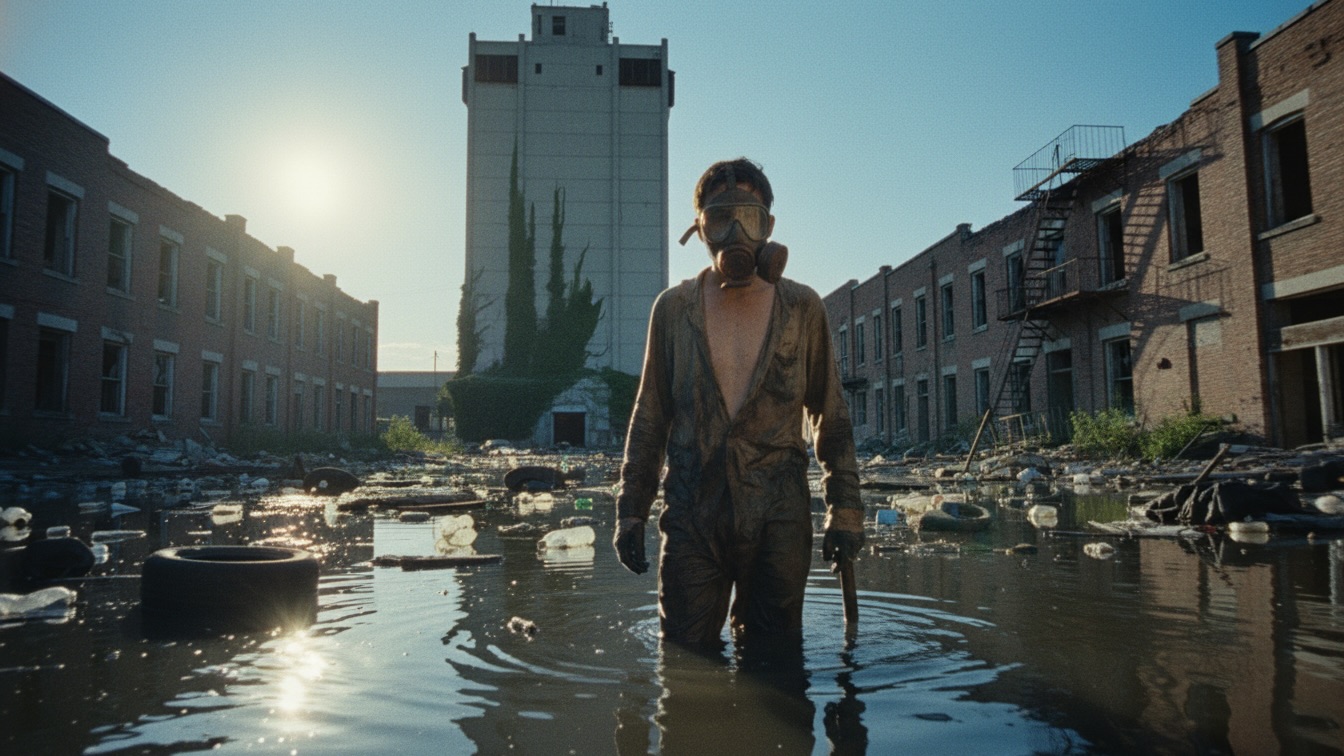
The story unfolds in a submerged, dystopian version of Winnipeg in 2026, where the climate has collapsed and air has become a tiered subscription service. Jay, a desperate young man motivated by his sister Mia's failing health, leads a small team consisting of the tech-savvy Stan and the physically imposing Kyle on a high-stakes heist. Their objective is to intercept a corporate drone carrying high-grade filters, which are essential for survival in the polluted "Wet Zone." As the mission progresses, they discover that the city’s air is being laced with a sedative called L-S-55 to keep the impoverished population compliant and docile.
The heist takes a turn toward the revolutionary when Stan reveals he has been coerced into working for the Aethelgard Corporation to sabotage the city's infrastructure. In a climactic confrontation within the "Main Lung" filtration facility, Kyle sacrifices his life to allow Jay to flush the sedatives from the system, effectively waking the citizens from their chemical stupor. Jay escapes the facility only to be cornered by Director Victor, a corporate executive who attempts to recruit him by demanding a cold-blooded execution. Rejecting the corporate path, Jay triggers a massive explosion that destroys the elite's private air reserves, choosing a path of violent liberation over personal safety.
The central theme of the narrative is the commodification of biological necessities and the subsequent erosion of human rights. By transforming breathable air into a subscription service, the ruling class exerts a totalizing form of control that transcends traditional political boundaries. This reflects a hyper-capitalist nightmare where the environment is so degraded that even the act of breathing becomes a financial transaction. The story posits that when nature is destroyed, the vacuum is filled by corporate structures that view human life only in terms of its "subscription status."
Another profound theme is the psychological manipulation of a populace through chemical intervention. The revelation of the L-S-55 sedative explores the concept of "manufactured peace," where social stability is achieved not through justice or equity, but through the suppression of the human will. The "social stability aerosol" serves as a metaphor for the various ways modern societies use distractions or medications to numb the pain of systemic inequality. Jay’s decision to flush the system represents the painful but necessary return to reality, suggesting that a violent, conscious existence is superior to a peaceful, drugged one.
Finally, the story examines the nature of sacrifice and the cost of revolution. Each character represents a different response to oppression: Stan chooses self-serving collaboration, Kyle chooses selfless martyrdom, and Jay chooses the burden of leadership. The narrative suggests that true change cannot be achieved without the loss of innocence and the destruction of the old world’s infrastructure. Jay’s final act is not one of simple survival but a calculated strike against the hierarchy, proving that the spirit of resistance survives even when the world is literally drowning.
Jay functions as the narrative’s moral compass, driven by a powerful "savior complex" centered on his sister, Mia. His psychological profile is defined by hyper-vigilance and a pragmatic approach to survival, yet he possesses an underlying idealism that he attempts to suppress. He views himself as a protector, a role that forces him to make agonizing decisions under extreme pressure. This burden of responsibility is what ultimately pushes him from being a mere scavenger to becoming a revolutionary figurehead.
Throughout the chapter, Jay undergoes a transformation from a man focused on individual survival to one who accepts the consequences of a wider social awakening. His refusal to kill the Peacekeeper at the end of the story highlights his rejection of the nihilistic worldview offered by Director Victor. He understands that to become a murderer in the name of the revolution would make him no better than the corporate entities he opposes. His final leap into the river symbolizes a baptism into a new, uncertain world where he is no longer just a brother, but a catalyst for change.
Stan represents the archetype of the "desperate collaborator," a man whose intelligence is undermined by his overwhelming fear. Psychologically, he is driven by an avoidant personality, seeking the path of least resistance even if it means betraying those closest to him. His betrayal is not born of malice but of a profound sense of hopelessness regarding the state of the world. He believes the "world is already over," a mindset that he uses to justify his complicity with the Aethelgard Corporation.
However, Stan’s character arc reaches a moment of redemption when he witnesses Kyle’s bravery. The flicker of "grim, desperate resolve" in his eyes suggests that his cowardice was a protective shell that cracked under the weight of his friends' sacrifices. By choosing to stay with Kyle and face the security guards, he finally asserts his agency against the corporate masters who owned his signal. He moves from being a tool of the elite to a participant in the city's awakening, even if it costs him his life.
Kyle serves as the emotional and physical anchor of the group, embodying a rugged, unpretentious loyalty. While he is initially presented as the "muscle" of the operation, his observations about the "corporate air scam" reveal a deep-seated class consciousness. He possesses a stoic acceptance of his environment, evidenced by his "Winnipeg soft" philosophy, which find humor even in the midst of a drowning city. His psychological makeup is defined by a lack of pretension and a direct, honest engagement with his surroundings.
His ultimate sacrifice is the narrative's turning point, providing the necessary distraction for Jay to complete the mission. Kyle’s death is not portrayed as a tragedy of failure, but as a triumph of the human spirit over mechanical and corporate oppression. He dies with a "steady voice," indicating that he has found a sense of purpose that transcends his own physical existence. His final words to Jay are a mandate to continue the fight, cementing his role as the martyr whose blood fuels the fire of the coming riot.
Director Victor is the personification of the "corporate psychopath," characterized by a complete lack of empathy and a strictly utilitarian view of human life. He speaks in terms of "PR nightmares" and "assets," revealing a mind that has completely internalized the logic of the market. To him, the citizens are not people but a "mob" that needs to be "managed" through either chemistry or violence. He represents the ultimate evolution of the subscription model, where even morality is something to be bought or sold.
His attempt to manipulate Jay into killing the Peacekeeper is a psychological test designed to break Jay’s spirit and bring him into the corporate fold. Victor believes that everyone has a price and that the reality of the world is inherently cruel. When Jay rejects this premise, Victor’s calm exterior masks a fundamental inability to understand a motive that isn't rooted in self-interest. He is the ghost in the machine, a man who has traded his humanity for a "crisp, dry uniform" in a world that is rotting beneath him.
The pacing of the story is masterfully handled, beginning with a slow, atmospheric build-up that emphasizes the oppressive heat and filth of the basement. This initial stagnation mirrors the lethargy of the drugged population, creating a sense of claustrophobia that heightens the tension. As the heist commences, the rhythm shifts into a rapid, kinetic sequence of actions, with the prose becoming sharper and more focused. The transition from the "Submerged Exchange" to the "Main Lung" increases the stakes, moving the reader from a localized struggle to a city-wide crisis.
Sensory details are used with visceral effectiveness to ground the science fiction elements in a tangible reality. The smell of "wet dog that had been dead for three days" and the sensation of air feeling like a "thick wool blanket" create a revoltingly vivid picture of environmental decay. These descriptions serve a psychological purpose, making the reader feel the same physical desperation as the characters. The contrast between the "brown, stagnant sea" of the streets and the "sweet, floral" scent of the sedated air in the facility highlights the deceptive nature of the city’s control mechanisms.
The narrative voice is gritty and cynical, yet it allows for moments of stark, poetic beauty, particularly during the climax. The use of industrial metaphors—such as the filtration towers standing like "tombstones"—reinforces the theme of a dead world being kept on life support. The dialogue is snappy and grounded in the specific "Winnipeg" setting, which adds a layer of authenticity to the speculative elements. Ultimately, the style reflects the story's arc: it begins in the muck of survival and ends with a "brilliant, blinding white" explosion of clarity and hope.


