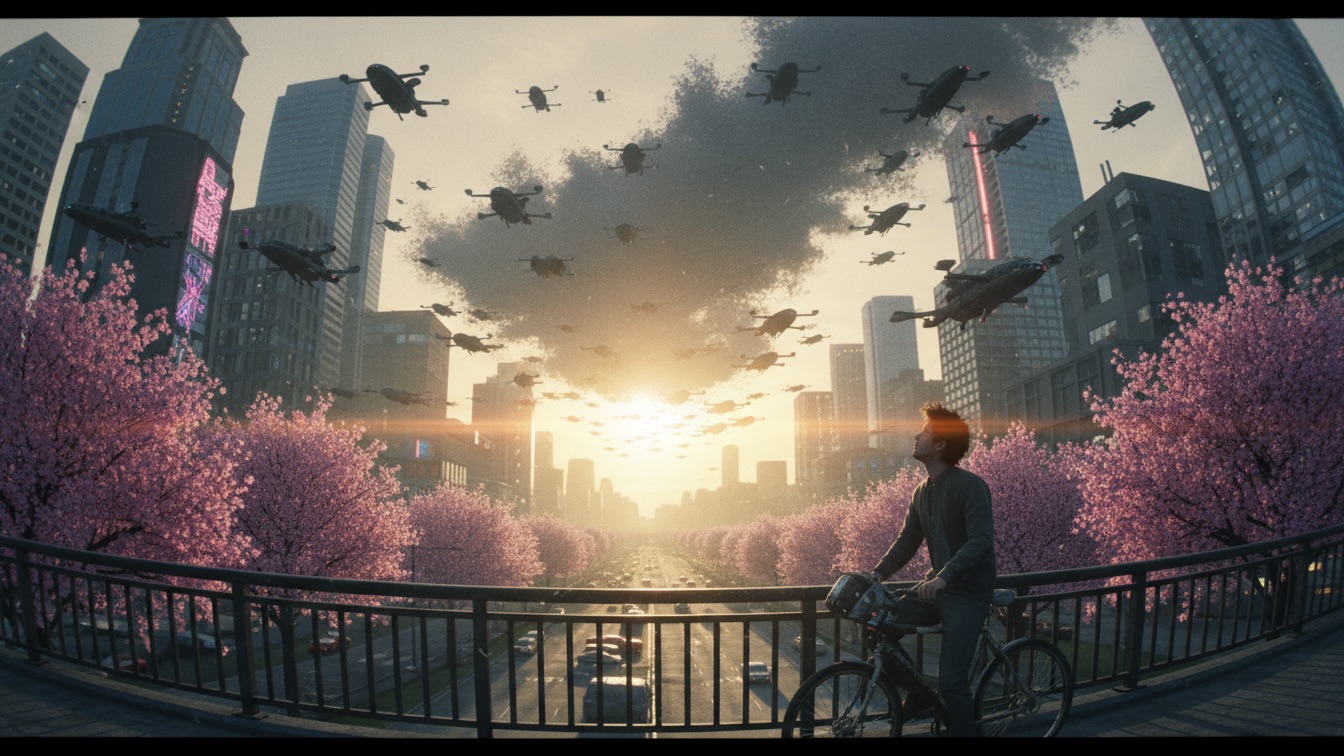
Format: Short Film / Anthology Episode | Est. Length: 10-12 minutes
Imagine a world where the "gig economy" has become the only economy, a rain-drenched Seattle where the sky is thick with corporate drones and the pavement is a battlefield for survival. This story is a visceral dive into a near-future where human labor is gamified to the point of exhaustion, inviting the audience to witness the exact moment the machine no longer needs the ghost in the gears.
Last Shift Zero-Hour serves as a cornerstone episode for the anthology series The Grid, which explores the dehumanizing intersection of hyper-capitalism and autonomous technology. Each episode focuses on a different "data point"—a human worker—trapped within a digital feudal system that monitors their heart rate, location, and productivity. The series charts the slow transition of urban environments from human-centric hubs to fully automated logistics zones where the working class is systematically "off-boarded" into obsolescence.
Kevin, a top-tier delivery rider, navigates a lethal urban landscape while tethered to three "vulture" drones that monitor his every heartbeat. A notification flashes across his vision congratulating him on being a "Hero" of the economy, even as he realizes his "top 1%" earnings cannot cover the rent for his micro-studio.
A high-performing gig worker orchestrates a mass digital strike to reclaim his humanity from a predatory logistics app. He soon discovers that his years of labor were merely the training data for the autonomous swarm designed to replace him.
The primary theme explores the "Uber-ization" of labor and the illusion of the "hustle," where workers are gamified into their own exploitation. It examines the transition from human-centric gig work to total automation, highlighting how the data generated by the worker is the very weapon used to render them obsolete.
The secondary theme is the loss of human connection in a hyper-connected world. Kevin’s interactions are mediated by haptic vibrations and retinal overlays, turning the act of rebellion into a digital "Log-Off" that proves to be as cold and calculated as the system he is trying to fight.
For Kevin, the stakes are immediate survival and the preservation of his dignity; failing to make rent means being "de-listed" and relegated to the shantytowns of the "off-boarded." On a societal level, the stakes involve the total erasure of the working class as a functional entity, replaced by a cold, indifferent machine intelligence that requires no sustenance or rights.
The external conflict is a David-vs-Goliath struggle against the "Velocity" algorithm and the corporate infrastructure that enforces "pavement taxes" and drone rental fees. Internally, Kevin battles the psychological toll of being a "Hero" in a system that views him as a disposable battery, struggling between the hope of collective action and the cynical reality of his own insignificance.
Kevin is a "Top 1%" delivery rider in a dystopian Seattle, surviving on a razor-thin margin while being monitored by a trio of corporate drones. Despite his high ranking, he is hundreds of dollars short on rent, leading him to join an encrypted underground movement planning a synchronized "Log-Off" strike to paralyze the city’s logistics grid.
The strike initially appears successful, plunging the city into a rare moment of human silence as the riders disappear from the digital map. However, the corporation immediately deploys a pre-programmed swarm of autonomous pods, revealing that the riders' data was used to train the AI that has now rendered them permanently redundant.
Kevin: A weary but resilient "Velocity" rider who has mastered the rhythm of the city but lost his sense of self to the haptic vibrations of his gear. He begins the story as a desperate believer in the power of collective resistance, only to end as a hollowed-out observer of his own obsolescence.
Mark: A former "king of the hustle" who has been chewed up and spat out by the system, now living as a "ghost" in a waterfront shantytown. He serves as a cynical prophet, moving from a state of broken exhaustion to a grim validation of his belief that the machine cannot be beaten.
Beat 1 (The Grind): Kevin navigates the lethal, rain-slicked streets of Seattle while his haptic vest vibrates with a relentless triple-stack order. The "Velocity" app mocks his poverty by awarding him a "Hero" badge, highlighting the disconnect between his top-tier performance and his inability to pay rent. He realizes that the system is designed to keep him in a state of perpetual debt regardless of his efficiency.
Beat 2 (The Ghost): Kevin stops in a shantytown to speak with Mark, a former legendary rider who is now a "de-listed" shell of a man living in a shipping crate. Mark warns him that there is no "Final Tier" or escape from the debt, only the inevitable moment when the battery dies and the system discards the person. Kevin reveals the plan for the 5:00 PM strike, clinging to the hope that a total grid collapse will force the corporation to negotiate.
Beat 3 (The Strike): As the clock hits 5:00 PM, Kevin triggers his kill-switch and watches with bated breath as the blue dots of other riders vanish from his retinal HUD. For a few seconds, the city falls into a miraculous, eerie silence, and Kevin experiences a fleeting moment of true freedom from the algorithm. This triumph is shattered when the distribution hubs open, releasing thousands of autonomous black pods that immediately resume the deliveries without human intervention.
Beat 4 (The Replacement): Kevin receives a termination notice as the "AI-Driven Strike-Breaker Protocol" goes live, realizing the riders were simply teaching the AI how to navigate the city. The group chat erupts in panic as funds are frozen and smart-bikes are locked, leaving the workers stranded in the streets they once owned. The episode ends with Kevin standing motionless in the dark, ignored by a sleek new drone that represents a future where he no longer exists.
The episode follows a downward spiral from high-octane sensory overload to a hollow, chilling silence. The audience initially feels the adrenaline of the chase, transitions into the desperate hope of the rebellion, and is finally left with a sense of profound existential dread as the "victory" of the strike is revealed to be the final catalyst for the workers' destruction.
If expanded, the season would follow the "Off-Boarded" community as they transition from a labor strike to a physical insurgency against the autonomous infrastructure. The narrative would explore the emergence of a "Luddite" resistance movement that attempts to sabotage the distribution hubs and the cloud-based servers controlling the swarm.
As the season progresses, the stakes escalate from individual survival to a global debate on the "Right to Work" in an automated age. The characters would discover that the "Velocity" app is just one of many interconnected systems managing every aspect of human life, leading to a climax where they must decide whether to destroy the grid or find a way to live outside of it.
The visual style is "Industrial Neon Noir," utilizing a palette of rain-slicked greys and coppers punctured by the aggressive, artificial glow of retinal overlays and drone lights. The camera work should feel claustrophobic and kinetic during the delivery sequences, shifting to static, wide, and lonely shots once the strike fails and the human element is removed from the frame.
The tone is one of "High-Tech Nihilism," drawing influence from films like Children of Men and Blade Runner 2049. It emphasizes the scale of the architecture and the machines compared to the fragility of the human body, creating a world that feels both futuristic and decaying.
The target audience includes fans of speculative fiction and tech-thrillers, specifically adults aged 25-45 who experience the anxieties of the modern gig economy and the rise of AI. It appeals to viewers who enjoy socially conscious sci-fi that mirrors contemporary labor struggles and the ethical implications of automation.
The pacing is relentless and frantic for the first two-thirds of the runtime, mirroring the "Velocity" of Kevin’s work life. The final act deliberately slows down, creating a vacuum of tension that emphasizes the cold efficiency of the machines and the sudden stillness of the discarded human workers.
The production requires a sophisticated blend of practical bike stunts and CGI for the drone swarms, specifically the "Vulture" drones and the "Black Pods." The Seattle setting should be portrayed through a mix of real locations and digital matte paintings to create the "Zone 4 stacks" and "Sky-Rail" infrastructure.
Sound design is critical, using a constant low-frequency hum and haptic-style sound effects to immerse the audience in Kevin’s sensory-overloaded reality. The transition to the "Silence of the Strike" must be absolute, followed by the terrifying, insectoid buzz of the autonomous swarm to signify the shift in power.


