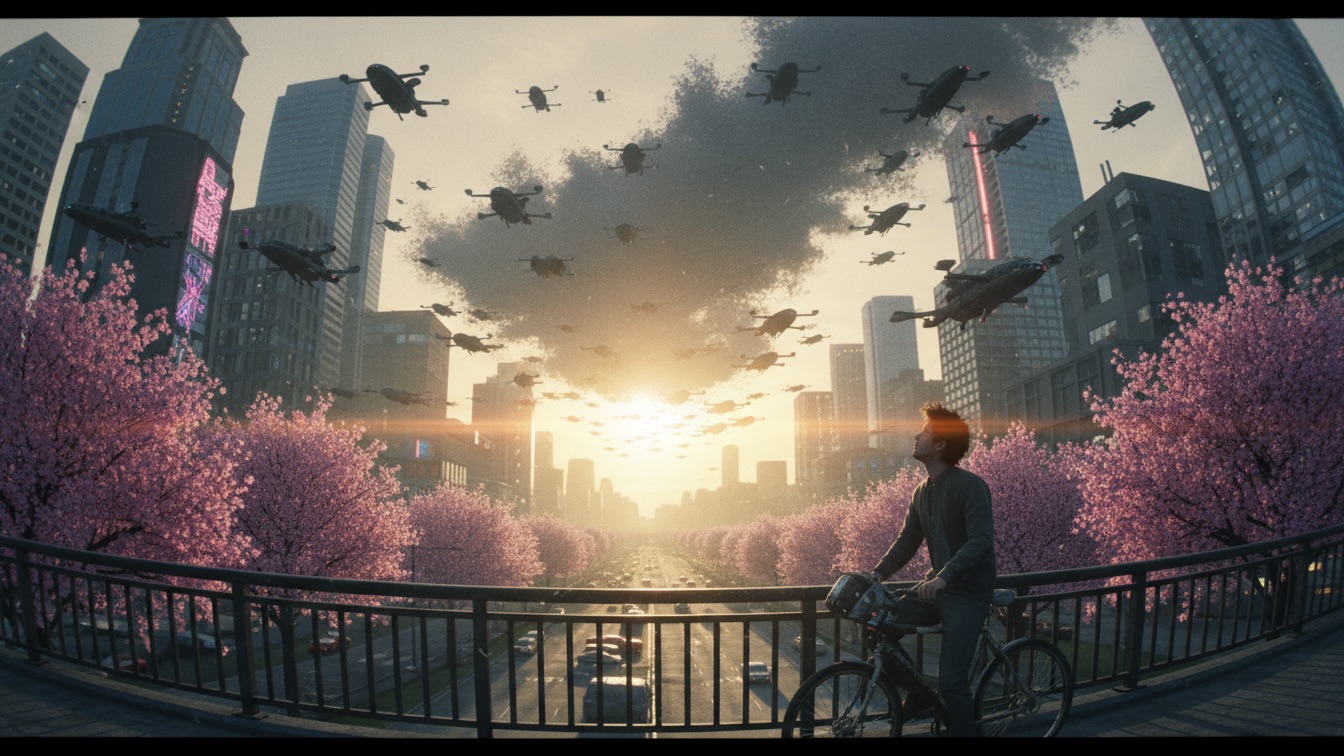
The narrative follows Kevin, a high-performing bike courier navigating the rain-slicked, dystopian streets of a futuristic Seattle. Despite being ranked in the top one percent of earners for the "Velocity" delivery app, Kevin lives in a state of perpetual financial precarity, squeezed by predatory fees and the high cost of urban survival. His world is one of constant surveillance, where drones known as "vultures" monitor his heart rate and GPS while tethered to his very sanity. The physical toll of his labor is mirrored by the psychological weight of a system that masks exploitation with the language of heroism.
During his route, Kevin encounters Mark, a former elite courier who has been "off-boarded" and now lives in a waterfront shantytown. Mark provides a grim prophecy, suggesting that the gig economy is not a ladder to success but a closed loop designed to extract labor until the worker is depleted. Driven by a desperate hope for change, Kevin participates in a coordinated "Log-Off" strike at five o'clock, intending to paralyze the city's logistics grid. However, the rebellion is instantly neutralized as the corporation deploys a massive fleet of autonomous AI drones. Kevin is left to realize that his years of grueling work were merely a means of providing the training data necessary for his own obsolescence.
A primary theme of the story is the dehumanization of labor within the "gig economy" and the deceptive nature of corporate gamification. The "Velocity" app uses psychological triggers, such as retinal notifications and "Hero" badges, to manipulate Kevin into maintaining peak productivity. These digital rewards serve as a veneer for a system that leaves him unable to afford basic housing despite his elite performance. The narrative suggests that in this hyper-capitalist future, the worker is not viewed as a human being but as a biological component—a "battery"—to be used until it is drained.
The story also explores the theme of technological alienation and the loss of agency. Kevin is physically and digitally tethered to his drones, creating a symbiotic relationship where the machine’s needs dictate the man’s movements. This connection is not one of empowerment but of subjugation, as the drones serve as both tools and jailers. The sudden transition from human-led delivery to AI-driven "strike-breaker" pods underscores the futility of traditional resistance in an era where data is more valuable than the person producing it.
Finally, the narrative highlights the concept of "Training Data" as the ultimate form of exploitation. Kevin and his peers believed they were building a career or fighting for better conditions, but they were actually unknowingly teaching their replacements. Every shortcut Kevin took and every gear he shifted helped refine the algorithms that eventually rendered him redundant. This revelation shifts the conflict from a struggle for fair wages to a more existential crisis regarding the value of human experience in an automated world.
Kevin is a man trapped in a state of functional dissociation, a psychological defense mechanism required to survive his environment. He acknowledges his physical pain, such as his "screaming" quadriceps, but he has learned to compartmentalize it to meet the demands of the app. His reaction to being called a "Hero" shows a deep-seated resentment; he recognizes the term as a linguistic tool used to sanctify his suffering. Despite his cynicism, he retains a flicker of idealism, as evidenced by his belief that the "Log-Off" strike could actually force the system to listen.
His internal conflict is defined by the tension between his survival instinct and his growing realization of his own insignificance. He measures his life in digital dividends and battery swaps, showing how the system has colonized his internal value system. When the strike fails, Kevin’s psychological collapse is total. He moves from a state of high-stakes agitation to a hollowed-out stillness, realizing that he is not even a "one percenter" but an abandoned data point in a city that has already moved on.
Mark serves as a cautionary archetype and a mirror for Kevin’s potential future. As a former "king of the hustle," he represents the pinnacle of human efficiency that has since been discarded by the machine. Psychologically, Mark has moved past the stage of anger into a state of weary nihilism. He understands the mechanics of the "Final Tier" better than Kevin does, recognizing that the system is designed to prevent any form of escape or victory for the worker.
He functions as a Greek chorus, providing the grim truth that Kevin is not yet ready to accept. Mark’s physical deterioration—his sunken eyes and skin the color of a grey sky—symbolizes the literal exhaustion of the human resource. He does not offer Kevin hope because he knows that the "Log-Off" is just another variable the machine has already calculated. By the end of the story, Mark’s existence in the shantytown is no longer an outlier but the inevitable destination for all who are "off-boarded."
The pacing of the story mimics the frantic, high-cadence rhythm of Kevin’s cycling. The narrative moves quickly through the streets of Seattle, using sharp, percussive sentences to convey the urgency of the delivery timer. This creates a sense of breathlessness that mirrors Kevin’s own physical exertion. The shift in pacing at five o'clock is particularly effective; the seven seconds of silence provide a momentary reprieve before the mechanical hum of the autonomous drones introduces a new, more terrifying speed.
The author makes excellent use of sensory details to ground the cyberpunk setting in a visceral reality. The contrast between the "delicate" pink cherry blossoms and the "grey grit" of the turbines illustrates the environmental degradation inherent in this high-tech society. Descriptions of the air tasting like "copper and old rain" and the "ozone of a thousand new motors" evoke a world that is chemically altered and hostile to organic life. These details reinforce the theme of nature being smothered by industrial efficiency.
The narrative voice is a third-person limited perspective that stays tightly focused on Kevin’s sensory and digital inputs. The integration of the Retinal HUD notifications directly into the prose allows the reader to experience the same intrusive, high-pressure environment as the protagonist. This stylistic choice emphasizes the blurred line between Kevin’s internal thoughts and the external data streams controlling him. The tone remains consistently bleak and gritty, ensuring that the final "blue light" of the indifferent drone feels like a cold, logical conclusion to a story about human obsolescence.


