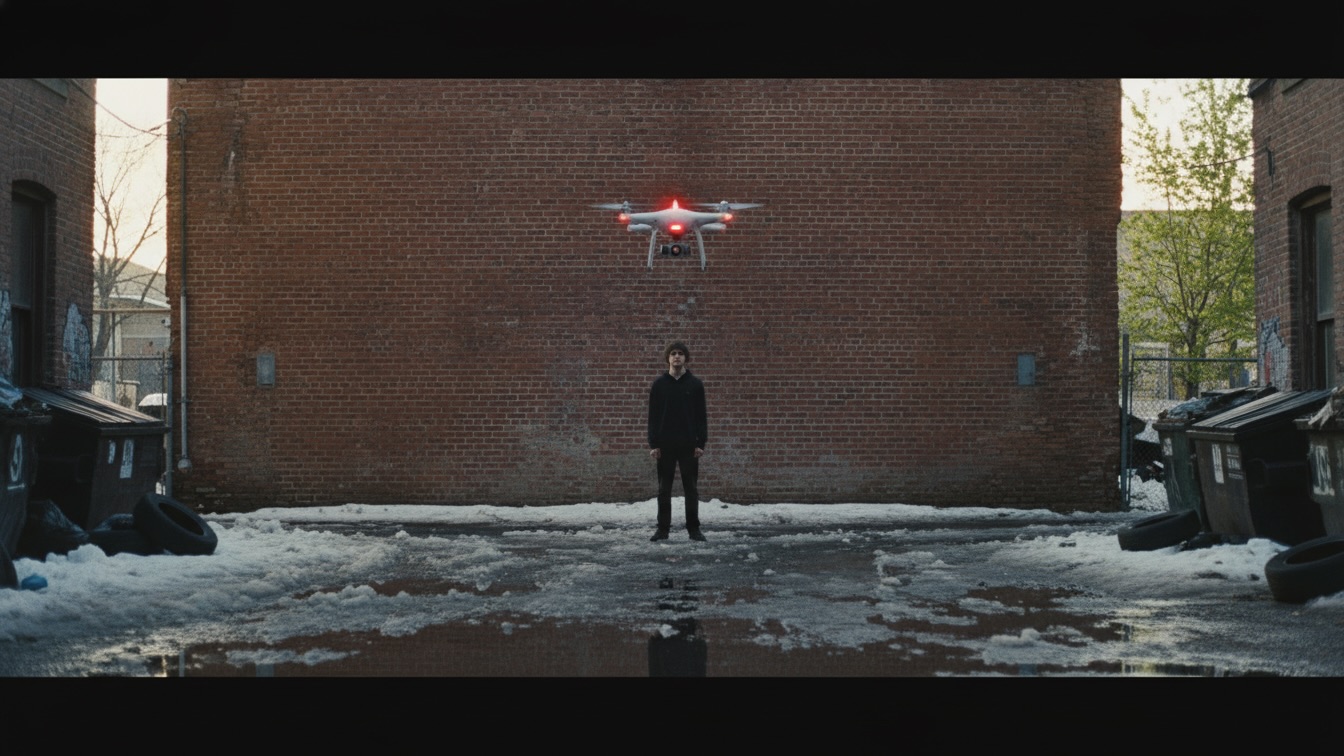
Format: Short Film / Anthology Episode | Est. Length: 10-12 minutes
This episode serves as a standalone entry in a gritty, near-future anthology series titled Analog Ghosts, which explores the friction between human expression and hyper-automated urban environments. Set in a decaying, tech-saturated Winnipeg, the series focuses on individuals struggling to maintain identity in a world where every square inch of public space is monitored, monetized, or optimized by algorithms.
Moe stands before a decaying, scab-colored brick wall in a rain-slicked alley, paralyzed by creative block while his friend Leo mocks his analog sensibilities. The silence is broken only by the hum of the city, until a chance encounter with a tech-obsessed passerby forces Moe to confront the obsolescence of his own existence.
In a hyper-monitored city where public art is treated as a software glitch, a struggling graffiti artist fights to leave a permanent mark on the physical world. He must decide if his act of rebellion is a meaningful reclamation of humanity or a futile gesture against an unstoppable digital tide.
The episode explores the tension between "meat-space" reality and digital abstraction, questioning whether art retains value when it is disconnected from commerce or engagement metrics. It touches on the alienation of the gig economy, where human labor is reduced to a series of tasks, and the encroaching loss of privacy in a world governed by predictive maintenance and automated policing.
Beneath the surface, the narrative examines the universal human need for legacy and the fear of being erased by time or technology. It posits that the act of creation is a fundamental immune response to a society that prioritizes efficiency over soul, highlighting the struggle to remain visible in an increasingly automated landscape.
For Moe, the stakes are existential: if he cannot create something that resonates, he risks losing his sense of self to the "brain-rot" of the city. For the city’s automated systems, Moe represents a "virus" that must be purged to maintain the aesthetic and commercial purity of the urban environment, leading to a direct, high-stakes confrontation with the cleanup drones.
The primary conflict is the Man vs. Machine struggle between Moe’s desperate, tactile need for expression and the city’s "Art Cleanup" drones, which represent an indifferent, efficient, and omnipresent authority. Internally, Moe battles the paralyzing fear that his art is indeed irrelevant, fueled by the cynical, tech-dependent perspectives of his peers and the harsh reality of his own socioeconomic instability.
Moe, a graffiti artist in a near-future Winnipeg, struggles to find inspiration on a city wall that has been scrubbed clean by automated drones. After a dismissive encounter with a young woman immersed in an AR-filtered reality, Moe is forced to defend the importance of physical, "un-optimized" art against the crushing weight of a society that views his work as a nuisance.
Driven by a sudden, visceral need to prove his existence, Moe begins a jagged, aggressive piece of graffiti that ignores the city's digital demands. As he pours his frustration into the brickwork, he is interrupted by a cleanup drone, leading to a tense standoff between his analog rebellion and the cold, clinical efficiency of the machine.
Moe is a disillusioned artist living on the margins of the gig economy, defined by his tactile connection to the world and his growing alienation. His arc moves from a state of creative paralysis and self-doubt to a moment of defiant, singular purpose, culminating in a confrontation that forces him to accept the transience of his work.
Leo is a weary delivery worker who has fully surrendered to the "efficiency" of the digital age, acting as the voice of cynical pragmatism. He represents the common person who has traded passion for survival, serving as a mirror for the life Moe is trying to avoid.
The Girl in AR is a representative of the next generation, fully integrated into the digital overlay of the city and incapable of perceiving the "meat-space" as anything other than a low-engagement zone. She serves as the catalyst for Moe’s realization that the world has moved on from his form of expression.
Moe stands in the alley, wallowing in his creative block while Leo pushes him to abandon his analog methods for digital trends. The tension rises as they debate the value of the physical world versus the "server-based" reality, culminating in the girl’s arrival, which highlights the vast, unbridgeable gap between Moe’s perspective and the city’s new status quo.
Moe, fueled by the girl’s dismissal, begins to paint, finding a flow state that allows him to channel his frustration into a raw, geometric scream of color. The midpoint shift occurs when the rhythmic clack-clack-clack of the paint can transforms from a sign of anxiety into a heartbeat, signaling his total commitment to the act of creation.
The climax arrives as the drone descends, its mechanical precision contrasting sharply with the messy, human imperfection of Moe’s mural. The final beat captures the moment of inevitable collision, leaving the audience to wonder if the art—or the artist—can survive the encounter.
The episode begins with a cold, damp, and stagnant mood, reflecting Moe’s internal paralysis and the grey, oppressive atmosphere of the alley. As he begins to paint, the mood shifts to one of frantic, high-energy defiance, culminating in a sharp, clinical tension when the drone appears, leaving the viewer with a lingering sense of melancholy and unresolved urgency.
If expanded, the series would follow Moe as he joins a loose underground collective of "Analogists" who attempt to create permanent, non-digital art installations across the city. Each episode would focus on a different character’s attempt to reclaim a specific, high-tech space, building toward a city-wide blackout or a massive, coordinated act of physical defiance.
The overarching narrative would track the escalation of the city’s "autoimmune" response, as the drones become more aggressive and the human population begins to wake up to the loss of their physical environment. The final arc would explore the possibility of a total system failure, forcing the characters to choose between the safety of the digital grid and the dangerous, messy reality of the physical world.
The visual style is grounded in "Dirty Sci-Fi," utilizing a desaturated, high-contrast palette of wet concrete, rusted metal, and the vibrant, jarring neon of AR overlays. The cinematography should emphasize the texture of the environment—the grit of the brick, the slickness of the mud, and the sterile, smooth plastic of the drones—to create a tactile, immersive experience.
The tone is somber and observational, drawing influence from the slow-burn tension of Children of Men and the urban alienation found in Blade Runner. It avoids stylized action in favor of intimate, claustrophobic framing that keeps the viewer trapped within the alley with the protagonist.
The target audience is adults aged 18–40 who are interested in speculative fiction, urban sociology, and the intersection of technology and creativity. It is designed for viewers who appreciate character-driven, atmospheric storytelling that challenges the viewer to reflect on their own relationship with digital consumption and public space.
The pacing is deliberately slow and rhythmic in the first act to establish the weight of the city, accelerating into a faster, more frantic tempo once Moe begins to paint. The final act maintains a high level of tension, utilizing the drone’s mechanical movements to dictate the rhythm of the scene until the abrupt, open-ended conclusion.
The production should prioritize practical effects for the graffiti and the alley environment to maintain the "meat-space" aesthetic, while the drones should be rendered with clean, sharp CGI to emphasize their alien, corporate nature. The sound design is critical; the contrast between the organic sounds of the alley and the high-pitched, synthetic whine of the drones should be used to heighten the audience's sense of unease.
Special attention should be paid to the AR glasses’ visual overlays, which should be subtle and integrated into the frame rather than flashy, ensuring they feel like a natural, mundane part of the characters' daily lives. The "scab-red" wall should be a physical set piece, allowing the actor to interact with the texture of the brick in a way that feels authentic and tactile.


