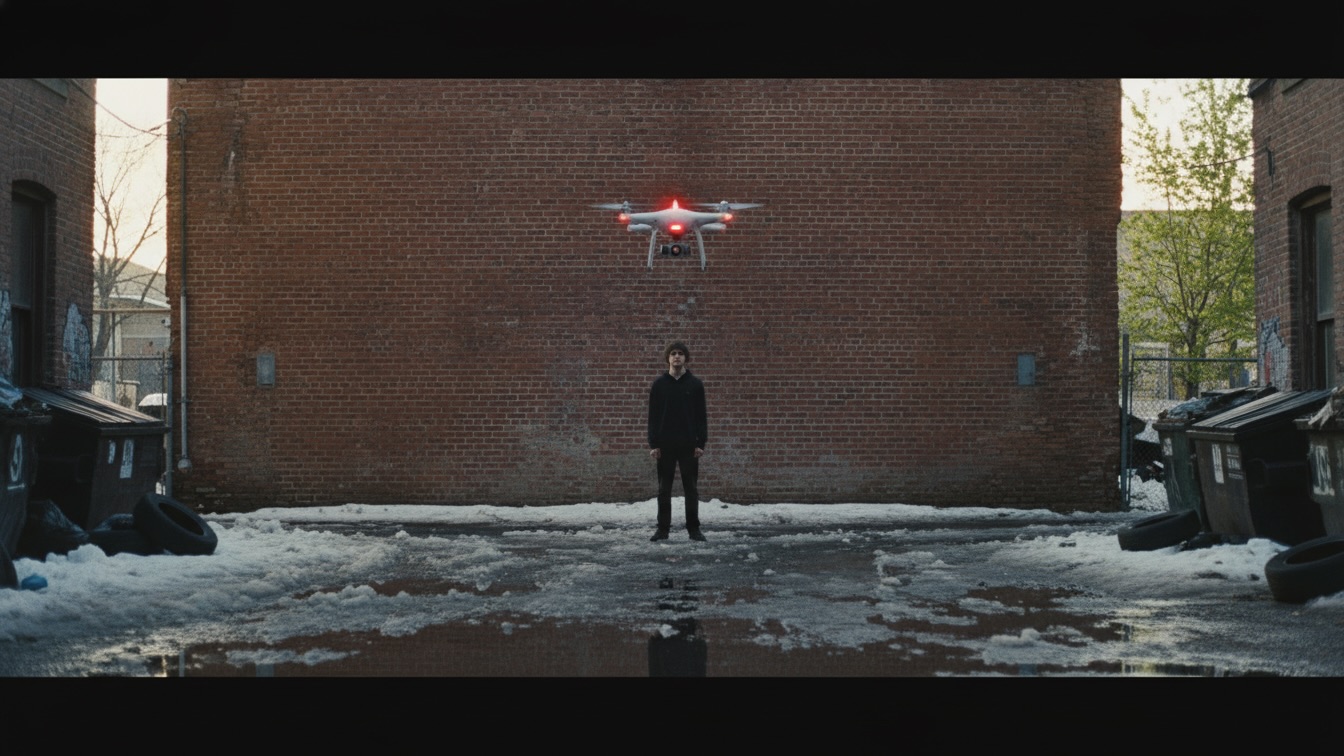
The story follows Moe, a disillusioned artist living in a grim, futuristic version of Winnipeg, as he stands before a weathered brick wall in an alleyway. He is struggling with creative stagnation and existential malaise, feeling alienated by a world obsessed with digital efficiency and augmented reality. After a brief, dismissive encounter with a delivery worker named Leo and a technologically detached young woman, Moe decides to paint despite the looming threat of city-sanctioned cleanup drones. He manages to create a raw, aggressive piece of art before his work is inevitably detected by a patrolling drone, setting the stage for an immediate confrontation between his physical expression and the city’s automated censorship.
The central conflict of the narrative pits the visceral reality of physical existence against the encroaching tide of digital abstraction. Moe views the world through the lens of texture and tactile experience, finding meaning in the crumbling brick and the cold mud of the alley. In contrast, the other characters represent a society that has moved into a virtual layer of engagement, where the physical world is merely a background for data streams and economic transactions. The concept of the "low-engagement corridor" highlights how the city has been reclassified by its inhabitants, stripping away the inherent value of space until it only serves as a vessel for advertisements or utility.
This theme of alienation is underscored by the presence of the drones, which act as the city's immune system against unauthorized expression. The narrative suggests that in this future, any act of creation that does not serve a commercial purpose is viewed as a viral infection. Moe’s struggle is not just about art, but about his desperate need to assert his presence in a world that seeks to digitize and sanitize human experience. By painting, he attempts to reclaim a sense of agency, transforming a forgotten wall into a site of resistance that challenges the prevailing culture of efficiency and apathy.
Moe is a man defined by his stubborn attachment to the tangible world. As the protagonist, he embodies the archetype of the last romantic, clinging to the grit and honesty of analog art in an environment that has rendered it obsolete. His internal state is one of profound exhaustion, characterized by a feeling of being "hard-stuck" and intellectually depleted. He views the digital advancements of 2026 not as progress, but as a systematic erasure of the human experience. His motivation for painting is not fame or money, but a primal need to verify his own existence through a physical, permanent mark.
His conflict is primarily internal, as he battles the temptation to succumb to the "brain-rot" that Leo describes. Moe feels a deep-seated resentment toward the girl with the AR glasses because she represents the very future he fears—one where the physical world is filtered through a screen and valued only for its engagement metrics. When he finally begins to paint, his movement is described as a "scream," indicating that his art is a coping mechanism for his psychological pain. He is a man fighting a losing battle against a technological tide, yet he persists because the act of creating is the only thing that makes him feel alive.
Leo serves as a pragmatic foil to Moe, representing the soul-crushing reality of the gig economy. He is physically and mentally exhausted, defined by his subservience to an app-based rating system that dictates his survival. While he understands Moe’s desire for artistic expression, he views it through the lens of risk and inefficiency. Leo is not a villain, but a fellow victim of the city’s relentless pace, forced to prioritize his survival over his own potential interests. His cynicism acts as a mirror for the reader, showing how the pressures of modern life can strip away the capacity for wonder.
The narrative voice is gritty and grounded, utilizing sensory details to emphasize the physical reality of the setting. The author’s choice to describe Winnipeg as "The Great Mud Season" immediately establishes a tone of bleak, uncomfortable realism that contrasts with the sterile, high-tech nature of the drones and AR interfaces. The pacing is deliberate, mirroring Moe’s hesitation before he finally commits to the act of painting. By focusing on the texture of the wall and the rattle of the spray can, the prose heightens the reader's awareness of the physical world, making the eventual intrusion of the digital drone feel all the more jarring.
The dialogue is sharp and reflects the cynical, shorthand language of a society accustomed to rapid communication and algorithmic influence. Terms like "mid," "meat-space," and "low-engagement corridor" effectively anchor the story in a specific, lived-in future without relying on heavy-handed exposition. The transition from the slow, contemplative atmosphere of the alley to the sudden, high-pitched whirring of the drone creates a powerful shift in tension. This stylistic choice effectively captures the protagonist's vulnerability, leaving the reader with a sense of impending loss as the clinical machine prepares to erase the only thing Moe has managed to build.


