Format: Short Film / Anthology Episode | Est. Length: 10-12 minutes
Imagine this story as a cornerstone entry in a speculative anthology series titled The Last Transmission, where each episode explores the final moments of various human colonies across the galaxy as they face inexplicable cosmic phenomena. This specific installment serves as a haunting, grounded character study that uses high-concept sci-fi to examine the universal human experience of retirement, obsolescence, and the ultimate surrender to mortality.
The Last Transmission is an anthology series set in a future where humanity has overextended itself across the stars, inhabiting fragile "sky-canopy" colonies that are beginning to fail. Each episode follows a different individual—from engineers to outcasts—witnessing the slow, surreal decay of their artificial worlds as a phenomenon known as "The Mass" reclaims reality. The series explores themes of environmental hubris and existential acceptance, linked by the recurring visual motif of a violet, "bruised" sky and the presence of featureless grey entities that act as harbingers of the end.
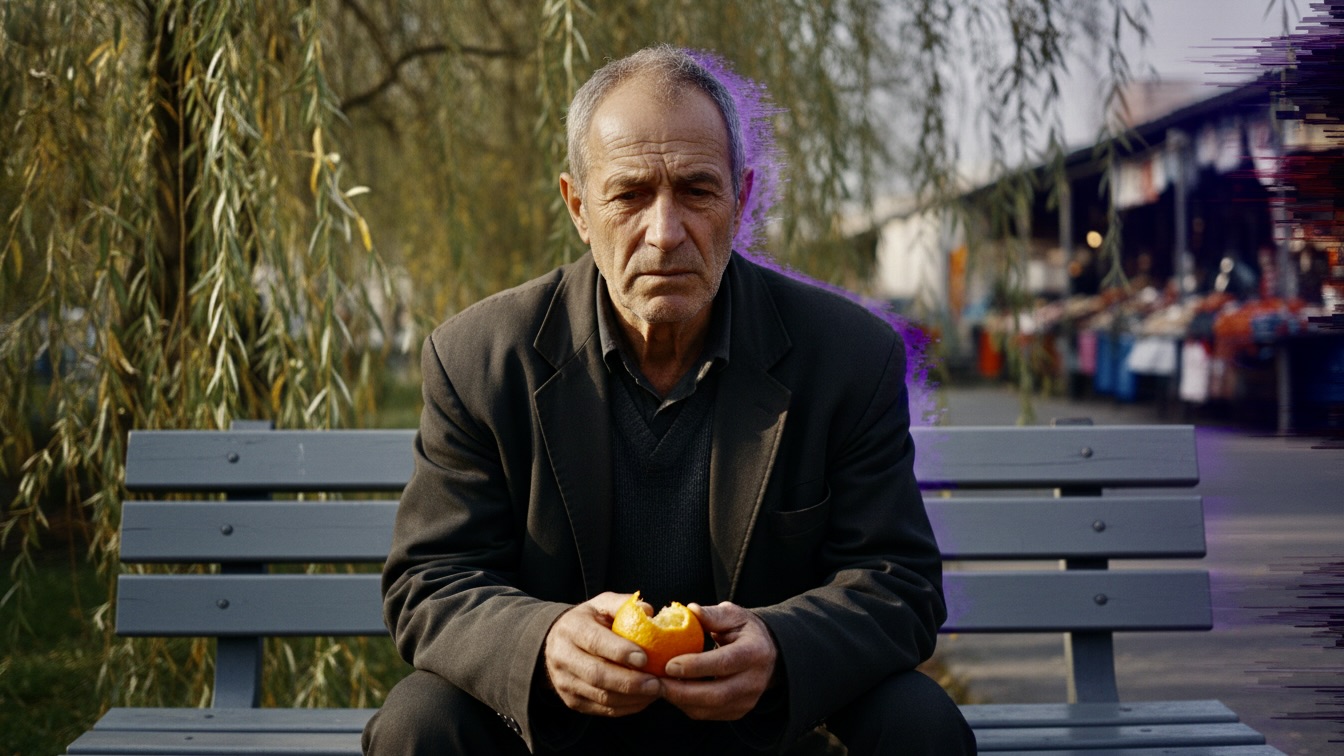
The artificial sun over a distant rock colony glitches into a bruised violet hue while a silent, edge-less smear of "nothing" begins to erase the central spire of the city. Tom, a diplomat with "gravel in his joints," ignores the panic of the market to find a specific grey bench, choosing to face the end of the world with a piece of contraband fruit rather than a final mission.
On the day of his forced retirement, a weary diplomat refuses to help the government stop a reality-warping void that is consuming his colony. As the world dissolves into a silent, geometric abstraction, he finds a final, defiant peace in the simple act of eating an orange.
The primary theme is the dignity of surrender and the rejection of a "duty" that has lost its meaning. Tom has spent thirty years negotiating peace for a civilization that is ultimately temporary, and his choice to sit on the bench represents a shift from the frantic preservation of the "system" to the quiet appreciation of the "self." It explores the idea that the end of the world is not always a cacophony of terror, but can be a silent, orderly closing of a book.
The episode also delves into the genre of "Cosmic Existentialism," where the horror of the unknown is replaced by a profound sense of relief. The breakdown of physics—geometric water, lagging shadows, and silver leaves—serves as a metaphor for the fragility of human constructs. By focusing on the sensory details of the orange against the backdrop of a dissolving universe, the narrative highlights the value of tangible reality over bureaucratic abstraction.
For Tom, the stakes are entirely internal; he risks losing his final moments of peace to the demands of a government that has already discarded him. For Mason and the Ministry, the stakes are existential, as they face the total erasure of their colony and the "Mass" that threatens to consume their history. Ultimately, the episode posits that the survival of the soul’s autonomy is more critical than the futile survival of a collapsing physical structure.
The primary external conflict is the "Mass," an entropic force that erases matter and distorts time, creating a ticking clock for the colony’s existence. This is personified by Mason, a high-strung bureaucrat who represents the antagonistic pressure of the "Ministry," attempting to drag Tom back into service for a hopeless cause. Internally, Tom battles his own exhaustion and the ingrained habit of being a "fixer," eventually overcoming the urge to be useful in favor of being present.
Tom, a diplomat whose body is failing after decades of interstellar travel, walks through a malfunctioning colony market where the sky has turned a sickly violet. He observes reality beginning to fray—a woman staring at vibrating copper, a "smear" in the sky where the central spire should be, and shadows that no longer align with their owners. Ignoring the growing atmospheric dread, Tom makes his way to a park of genetically modified silver trees to sit on a recycled plastic bench for his final hour before retirement.
He is interrupted by Mason, a younger, ambitious official who reveals that "The Mass" is expanding and the Ministry believes Tom holds the key to communicating with the survivors of the first expedition. Tom refuses to help, choosing to stay on his bench and watch the world stutter and freeze into geometric shapes. As Mason flees and the colony dissolves into a grey void, Tom eats a real, black-market orange, savoring its acidity as his final connection to the physical world. A featureless grey figure eventually approaches him, and Tom, finally free of his joints' pain and his life's burdens, takes its hand and steps into the nothingness.
Tom (Protagonist): A 60-year-old diplomat characterized by physical weariness and a sharp, cynical intellect. At the start, he is a man going through the motions of a "gold watch" retirement, feeling the weight of thirty years of "gravity-hopping." By the end, he achieves a state of transcendental calm, shedding his identity and physical pain to embrace the void.
Mason (Supporting): A thirty-two-year-old Ministry official who embodies the anxiety of the status quo. He is well-dressed, ambitious, and terrified, serving as a foil to Tom’s resignation. He represents the desperate human urge to control the uncontrollable, eventually fleeing into a world that no longer has a place for him.
The Grey Figure (Supporting): A featureless, oval-faced entity that appears as the world finishes dissolving. It is not a traditional character but a personification of the end—non-threatening, silent, and patient. It serves as the final guide for Tom, offering a "hand" that is merely a suggestion of shape.
The episode opens with Tom navigating a market where the artificial sun is a "bruised peach" and the sky is being erased by a literal smear of nothingness. He encounters a vendor who refuses to sell regulators because "the light is bad," establishing a world where the breakdown of physics is becoming a mundane, albeit terrifying, reality. Tom’s internal monologue emphasizes his physical decay, grounding the cosmic horror in the relatable pain of "wet gravel" joints.
Tom reaches the grey bench under silver willows and is confronted by Mason, who begs him to return to the Ministry because "The Mass" is consuming residential sectors. The tension peaks as they watch a child’s ball vanish into a shadow and reappear seconds late, proving that time and space are no longer synchronized. Tom’s refusal to leave the bench marks the midpoint, where he chooses personal autonomy over the Ministry's desperate, futile mission.
As the world turns grey and the fountain’s water freezes into cubes, Tom peels a black-market orange, the scent and sting of the juice serving as his final anchor to reality. The "Mass" ripples through the park, turning the silver grass to ash and blurring Tom’s boots into the plastic of the bench itself. The climax occurs when Tom closes his eyes against the "bruised sun" and wakes to find the market gone, replaced by a featureless grey figure who invites him into the final silence.
The episode begins with a sense of "Sensory Discomfort," characterized by the low-frequency hum and the "bruised" lighting. This transitions into "Bureaucratic Dread" during the encounter with Mason, where the audience feels the claustrophobia of a dying world. The final act shifts into "Transcendental Serenity," where the terror of the void is replaced by the vibrant, sharp sensation of the orange and the relief of Tom’s physical pain vanishing, leaving the audience with a feeling of quiet, inevitable peace.
If expanded, the season would follow the "Mass" as it moves from the outer rim colonies toward Earth, with each episode focusing on a different character's reaction to the encroaching void. The overarching narrative would reveal that the "Mass" is not an invasion, but a natural "reboot" of a universe exhausted by human exploitation.
The season would escalate from minor glitches—like the lagging shadows in Tom's story—to the total collapse of planetary systems. Characters from earlier episodes might reappear as the "grey figures," suggesting that those who "surrender" to the Mass become the guides for those who follow. The finale would involve the last remnants of the Ministry attempting a catastrophic weaponization of the void, contrasted against a protagonist who, like Tom, chooses a simple, human moment of acceptance.
The visual style is "Glitched Pastoral," blending the organic beauty of the silver trees with harsh, digital-inspired anomalies. The color palette should be dominated by the "bruised peach" and violet of the sky, contrasting with the stark, monochromatic grey of the bench and the eventual void. Cinematic influences include the slow, atmospheric pacing of Stalker and the surreal, clean-lined isolation found in 2001: A Space Odyssey.
The tone is somber and elegiac, avoiding jump scares in favor of "unsettling stillness." The camera should use long, static takes to emphasize the "jerky cadence" of the background characters and the geometric freezing of the environment. Tonal comparables include the "San Junipero" episode of Black Mirror for its emotional resonance and Arrival for its grounded approach to high-concept sci-fi.
The target audience is adults (25-55) who gravitate toward "prestige" science fiction and philosophical dramas. It appeals to viewers who enjoy slow-burn narratives that prioritize character psychology and atmosphere over action-heavy spectacle. This is intended for a streaming platform audience that appreciates anthology formats like Love, Death & Robots or The Twilight Zone.
The pacing is "Deliberate and Rhythmic," mimicking Tom’s slow walk and heavy breathing. The first five minutes establish the environmental decay, the next four focus on the dialogue-heavy confrontation with Mason, and the final three minutes are nearly silent, focusing on the sensory experience of the orange and the final transition. The 10-12 minute runtime ensures that the surreal elements don't overstay their welcome, maintaining a tight focus on Tom’s internal shift.
The "Smear" in the sky and the "Mass" ripple require sophisticated VFX that avoid looking like smoke or fire; they should appear as "missing data" or "refractive distortions" that make the viewer’s eyes want to slide away. The "geometric water" in the fountain and the "lagging shadows" are critical visual cues that must be executed with precision to maintain the internal logic of a failing reality.
Practical production should focus on the tactile elements: the "worn smooth" leather of the bag, the "silver" texture of the modified willow leaves, and the vibrant, real orange. Sound design is paramount, specifically the "low-frequency hum" that vibrates through the soles of boots and the "metallic hiss" of the leaves. These practical and auditory details will ground the surreal VFX, making the eventual "dissolve" of the world feel like a physical loss to the audience.


