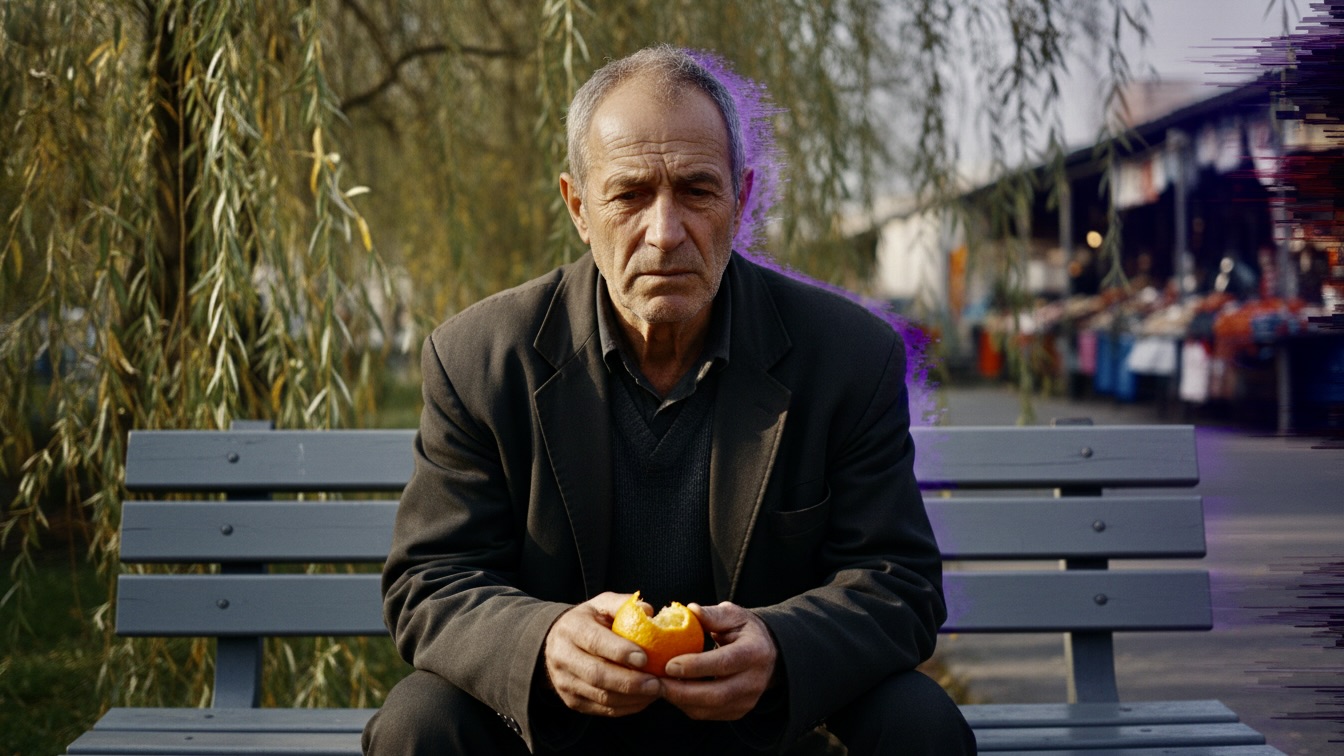
A tired diplomat seeks quiet in a bustling market but finds a flickering void instead of peace and rest.
The sun wasn't right. It was April, or what passed for April on a rock three hundred light-years from Earth, and the artificial sky-canopy was pumping out a spectrum meant to mimic a Mediterranean spring. It was supposed to be gold. Instead, it was the color of a bruised peach, slightly too heavy on the violet. I felt it in my teeth. A low-frequency hum vibrated through the soles of my boots, the kind of sound you don't hear so much as endure. My knees hurt. Thirty years of gravity-hopping and bad embassy food had turned my joints into bags of wet gravel. I adjusted the strap of my bag, the leather worn smooth and dark where my thumb always rested, and kept walking.
The market was a mess of noise and smells. It was the good kind of mess, usually. A vendor to my left was frying something in vat-grown oil that smelled like old socks and heaven. Another was shouting about fresh synth-melons, their green rinds glowing under the flickering neon of his stall. I liked the grit of it. I liked that the pavement was cracked and that someone had scrawled a profanity in the dust of a cleaning drone. It felt real. Or it used to. Today, the crowd seemed thin, or maybe just distracted. People were moving with a strange, jerky cadence, their shadows stretching out at angles that didn't match the overhead emitters. I stopped by a stall selling mechanical parts. The owner, a woman with grease under her fingernails and a permanent scowl, didn't even look up. She was staring at a pile of copper wiring that seemed to be vibrating in place.
"Price on the regulators?" I asked. My voice sounded thin to my own ears, like paper tearing.
She didn't blink. "Not selling today, Tom. The light's bad."
"The light?" I looked up. There was a patch of sky near the central spire that looked like it had been rubbed out with an eraser. It wasn't a cloud. It was a smear. A lack of anything. It didn't have edges. If you looked at it directly, your eyes slid away, focusing on the scaffolding behind it instead. It was a gap in the world.
"Yeah," she said, finally looking at me. Her eyes were bloodshot. "Everything's soft. Go home."
I didn't go home. I couldn't. I had a meeting at the Ministry in an hour—my final exit interview. The big goodbye. The gold watch moment, though they didn't give out watches anymore. They gave you a pension and a quiet shove toward the transport hubs. I kept moving toward the park, my heart doing a slow, heavy thud against my ribs. I found my bench. It was a grey, recycled plastic thing tucked under a row of weeping willows that had been genetically modified to grow in silver instead of green. The leaves hissed when the wind caught them, a metallic sound like a thousand tiny knives rubbing together.
I sat down. The plastic was cold. I let out a breath I felt like I'd been holding since the Treaty of Vesta. It was over. The lies, the late-night cables, the pretending that we weren't all just clinging to a cold rock in the middle of nowhere. I looked at my hands. They were spotted with age, the skin translucent and mapped with blue veins. I'd spent my life talking people out of wars, and for what? So they could sit in a market where the light was breaking and the air tasted like copper.
"You're late," a voice said.
I didn't turn. I knew the cadence. Mason. He was thirty-two, wore suits that cost more than my first ship, and had the kind of ambition that made you want to check your pockets after he shook your hand. He sat down next to me, leaving a respectful but pointed two feet of space between us. He smelled like expensive soap and panic.
"I'm retired," I said. "A retired man can't be late. He's just early for the next day."
Mason didn't laugh. He was staring at the fountain in the center of the plaza. The water was jumping. Not splashing, but hopping in discrete, geometric cubes. "The Office is losing it, Tom. Have you seen the feeds?"
"I turned mine off this morning. Tossed the tablet in the recycler."
Mason finally looked at me. His face was pale. "You can't do that. Not today. The Mass is expanding. It hit the residential sector in District 4 ten minutes ago. People are... they aren't gone, exactly. They're just quiet. You talk to them and they look through you."
I watched a child chase a ball near the fountain. The ball rolled into a shadow cast by a statue of the First Governor. When the ball hit the dark patch, it didn't slow down. It didn't stop. It just ceased to be visible, then popped out the other side three seconds later than it should have. The child stopped, confused, rubbing his eyes. My stomach turned over.
"What do you want, Mason?" I asked. "I signed the papers. I'm done."
"The Secretary thinks you have a relationship with the survivors from the first expedition. He thinks they knew this was coming."
"The survivors are all dead or senile, Mason. Like me."
"You aren't senile," he snapped. He leaned in closer. I could see the sweat beads on his upper lip. "You're the only one who doesn't look terrified. Why aren't you terrified?"
I looked at the silver leaves above us. One of them fell, drifting down in a jagged, stuttering motion, as if the air was made of thick syrup. It landed on my knee. It didn't feel like a leaf. It felt like a piece of cold glass. "Maybe I'm just tired. When you get to a certain age, the end of the world just feels like another deadline you can't meet."
"That's a hell of a thing to say."
"It's an honest thing to say. You should try it sometime. It's liberating."
Mason stood up. He smoothed his jacket, a nervous, repetitive motion. "They want you at the spire. Now. It's not a request."
"Everything is a request if you're willing to say no."
I stayed on the bench. I watched him walk away. He moved fast, his polished shoes clicking on the stone, but his shadow didn't follow him. It stayed behind for a heartbeat, anchored to the spot where he'd been sitting, before snapping back to his heels like a piece of elastic. I felt a chill that had nothing to do with the spring breeze. The silence was getting louder. It was a physical weight, a pressure in the ears that made the world feel small and cramped.
I reached into my pocket and pulled out a real orange. I'd bought it from a black-market trader a week ago. It was shriveled and expensive. I started to peel it. The scent of citrus burst out, sharp and acidic, a defiant streak of reality in the middle of the fading park. I focused on the texture of the rind, the way the juice stung a small cut on my finger. This was real. This was the only thing that mattered.
Behind the fountain, a group of tourists was standing still. They weren't taking pictures anymore. They were just standing, heads tilted at the same unnatural angle, watching the sky. The violet light was deepening. The smear near the spire had grown. It looked like a tear in a curtain now, showing the black nothingness behind the stage. I took a bite of the orange. It was sour. I chewed slowly, savoring the sting.
I thought about my wife. She'd been gone five years. She would have hated this. She liked things to be in their proper place—the dishes, the books, the stars. She used to say that the universe was just a very large house and we were the guests who never cleaned up after ourselves. I wondered if the house was finally being demolished to make way for something else.
I saw it then. A ripple in the air, moving across the grass toward me. It wasn't a wind. It was a distortion, like heat haze on a highway, but cold. Where it passed, the silver grass turned grey and stopped moving. The sound of the fountain cut out abruptly, though the water was still hanging in mid-air, frozen in those weird cubes.
I didn't move. My legs felt heavy, like they were sinking into the plastic of the bench. I looked down. My boots were blurring at the edges. The black leather was softening into the grey of the seat. I wasn't scared. That was the strangest part. I just felt a profound sense of relief. No more meetings. No more treaties. No more pretending that we were anything more than a flicker of light in a very dark room.
I finished the orange and dropped the peels on the ground. They didn't hit the dirt. They hovered an inch above it, suspended in the thickening silence. I leaned back and closed my eyes. The sun—that fake, bruised sun—was finally going down. Or maybe it was just being turned off. I could feel the cold shadow moving up my chest, a slow, deliberate shroud. It felt like sleep. It felt like the long-delayed paycheck for a life spent waiting for the other shoe to drop.
When I opened my eyes, the market was gone. There were no stalls, no screaming vendors, no synth-melons. There was only the bench, the silver tree, and the man standing ten feet away. He wasn't Mason. He wasn't anyone I knew. He was wearing a suit made of the same grey plastic as the bench, and his face was a smooth, featureless oval. He didn't have eyes, but I knew he was looking at me.
"Is it time?" I asked. My voice didn't make a sound, but he heard me anyway.
He nodded once. He held out a hand. It wasn't a hand, really. It was a suggestion of a hand, a shape formed by the absence of the air around it. I looked back at the spire. It was leaning now, the metal groaning as it began to fold in on itself like wet cardboard. The sky was almost entirely black. The stars were gone. Not covered by clouds, but simply extinguished, one by one, like candles in a drafty hallway.
I stood up. My knees didn't hurt anymore. That should have been a sign, I suppose. I walked toward the figure, my feet making no sound on the ground that was no longer stone. I looked back at my bench one last time. There was a small piece of orange peel stuck to the seat, a tiny, vibrant spark of color in a world that was rapidly turning to ash.
"I forgot my bag," I said.
The figure didn't move. The bag was gone. The bench was starting to dissolve, the molecules drifting apart like smoke. There was no more spring. There was no more April. There was only the shadow mass, and the long, quiet walk into the center of it. I reached out and took the shape's hand. It felt like nothing. It felt like the end of a very long day.
We walked together toward the place where the spire used to be. The ground was soft now, like walking on a sponge. I could see other figures in the distance, hundreds of them, all walking toward the same point. They moved in silence, a slow procession of ghosts in a dying city. I wondered if any of them were Mason. I hoped not. He would have hated the lack of decorum.
The light from the orange peel was the last thing to go. It flickered once, a tiny heartbeat of gold in the grey, and then the dark took it too. I didn't look back again. There was nothing left to see. The career was over. The retirement had begun. And as the final bit of the world folded into the void, I realized that the silence wasn't a weight at all. It was an invitation.
I stepped into the smear. The air didn't change. The temperature didn't drop. I just stopped being Tom, the diplomat with the bad knees and the tired heart. I became part of the shadow. I became the shift in the light. I became the unnatural silence that I had been watching all afternoon. It was peaceful. It was simple. It was exactly what I had signed up for, even if I hadn't known it at the time.
The last thing I felt was the thread on my sleeve. I reached for it, a habit I couldn't break, and pulled. The thread kept coming, unraveling my coat, my arm, my memory, until there was nothing left to pull on. The dark was complete, and for the first time in sixty years, I wasn't late for anything.
“As the last spark of color vanished, I realized the void wasn't an ending, but a doorway that was finally swinging shut behind me.”


