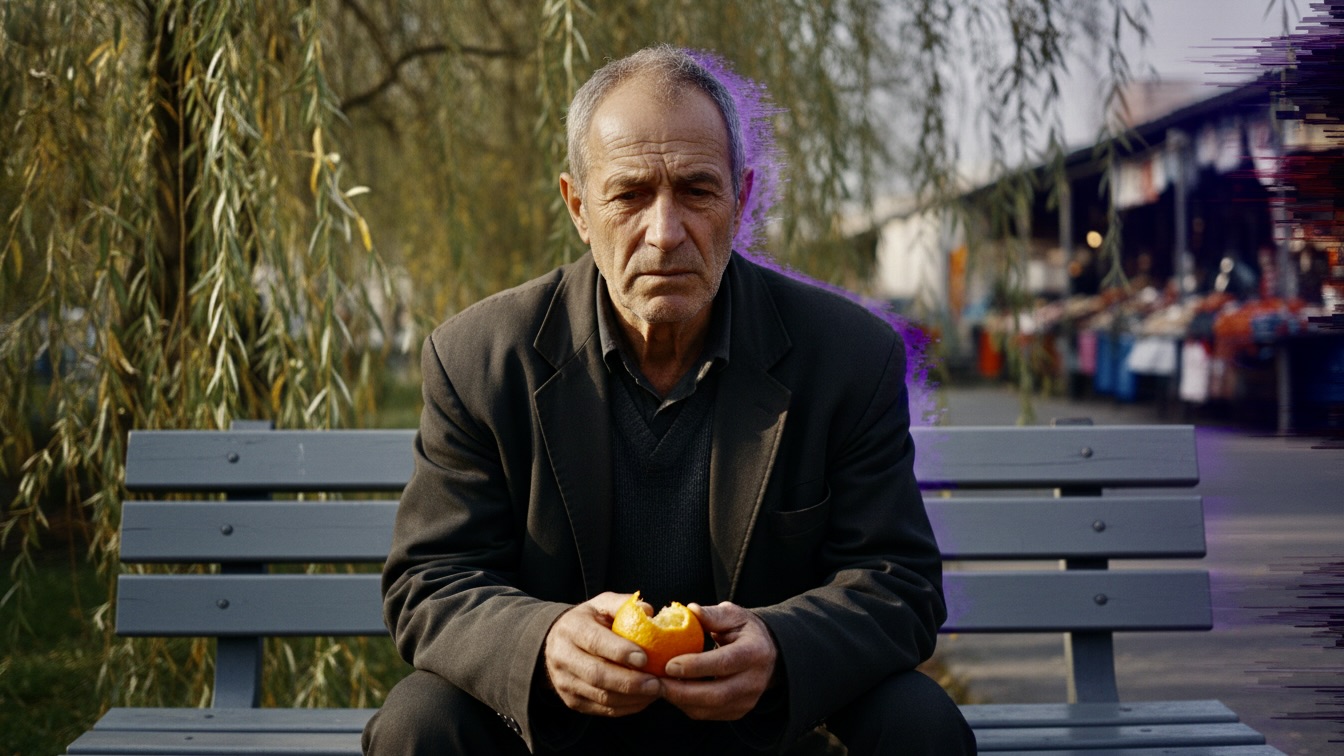
The story follows Tom, an aging diplomat on a distant colony planet, as he navigates his final day before retirement. The environment around him is physically deteriorating, characterized by a glitching artificial sky and a mysterious "Mass" that is erasing sections of reality. While his younger colleague, Mason, attempts to recruit him for a final crisis meeting at the Ministry, Tom remains steadfast in his resignation. He chooses to sit on a grey plastic bench, savoring a rare, real orange as the world dissolves into a surreal, silent void.
As the "Mass" consumes the colony, Tom experiences a profound sense of relief rather than terror. The physical laws of the universe break down, with shadows detaching from their owners and water freezing into geometric cubes. Eventually, Tom is approached by a featureless figure who leads him into the center of the distortion. He accepts the end of his life and the world with a sense of completion, finally unravelling from his physical form and finding peace in the absolute silence of the void.
The central theme of the narrative is the inevitability of entropy and the grace found in its acceptance. Tom’s personal retirement serves as a microcosm for the literal retirement of the universe. Throughout his career, he has been a man of words and treaties, attempting to maintain order in a chaotic galaxy. The "Mass" represents a force that cannot be negotiated with or managed by the Ministry, highlighting the futility of human structures when faced with cosmic finality.
Another significant theme is the tension between the artificial and the authentic. The colony is a place of "synth-melons" and "artificial sky-canopies," a manufactured existence that is literally fraying at the edges. Tom’s possession of a real orange provides a sharp, sensory contrast to the fading, plastic world. This small piece of fruit represents the last vestige of true reality, and his choice to savor its sour sting suggests that meaning is found in direct, sensory experience rather than in the grand political gestures of his past.
The story also explores the psychological transition from duty to liberation. For Tom, the end of the world is not a tragedy but a "long-delayed paycheck." He has spent decades "gravity-hopping" and "pretending," and the encroaching darkness offers him a release from the performance of diplomacy. The narrative suggests that true peace comes only when one stops trying to fix the unfixable and allows the "thread" of identity to finally unravel.
Tom is a man defined by his weariness and his profound sense of disillusionment. His physical ailments, such as his "bags of wet gravel" knees and spotted hands, mirror the decaying state of the colony. Psychologically, he has already moved past the point of fear, having spent his life witnessing the slow degradation of human ambition. He views the impending apocalypse with the detached curiosity of a man who has seen too many "deadlines he can't meet."
His refusal to join Mason at the spire demonstrates a final reclamation of his own agency. By choosing to stay on the bench, he rejects the bureaucratic machinery that has consumed his life. He is a pragmatic stoic, finding more value in the texture of a rind than in the survival of a failing colony. His internal journey concludes not with a struggle for life, but with a dignified surrender to the "invitation" of the silence.
Mason serves as the psychological foil to Tom, representing the frantic denial of the younger generation. He is described through his expensive suits and his "scent of expensive soap and panic," highlighting his attachment to status and order. Unlike Tom, who has accepted the breakdown of reality, Mason is still trying to use the language of the "Office" to solve a metaphysical crisis. He is tethered to a world that no longer exists, as evidenced by his shadow snapping back to him like elastic.
His character illustrates the terror that arises when ambition meets an immovable end. Mason’s repetitive motion of smoothing his jacket is a neurotic attempt to maintain decorum in the face of the void. He cannot understand Tom’s lack of fear because he still believes that there is a "request" or a "meeting" that can delay the inevitable. He represents the tragedy of those who are still "late" for a world that has already finished.
The figure who appears at the end of the story acts as a psychopomp, a guide for Tom’s transition into the afterlife or non-existence. He is described as having a "smooth, featureless oval" for a face and a suit made of the same grey plastic as the bench. This suggests that he is an extension of the environment itself, or perhaps a personification of the "Mass." He does not speak, yet he communicates a sense of timing and necessity that Tom immediately understands.
The figure’s presence is not threatening; rather, he offers a "suggestion of a hand" that provides Tom with a sense of direction. He represents the final stage of Tom’s journey, where individual identity is traded for a collective, silent procession. By taking the figure's hand, Tom moves from being a witness of the end to being a participant in it. The figure facilitates the ultimate "unraveling" of Tom’s coat, arm, and memory.
The narrative voice is characterized by a blend of noir-like cynicism and surrealist imagery. The author uses sensory details to ground the reader in a world that is becoming increasingly ungrounded. Descriptions like the "bruised peach" sky and the "metallic sound like a thousand tiny knives" create a sense of physical discomfort that mirrors Tom’s internal state. These vivid, often unpleasant sensations make the eventual transition into silence feel like a necessary relief.
Pacing is used effectively to mirror the "stuttering motion" of the collapsing world. The first half of the story moves with the slow, heavy thud of Tom’s heartbeat, focusing on the grit of the market and the weight of his history. As the "Mass" expands, the pacing becomes more dreamlike and fragmented. The transition from the "real" world to the grey void is seamless, reflecting Tom’s own psychological readiness to let go of his surroundings.
The metaphor of the "house being demolished" serves as a powerful anchor for the story’s conclusion. By framing the universe as a home that humans failed to clean, the author provides a domestic, almost mundane scale to a cosmic event. The final image of the "thread on my sleeve" being pulled until nothing remains is a masterstroke of minimalist prose. It effectively communicates the total dissolution of the self into the "complete" dark, ending the story on a note of absolute, quiet finality.


