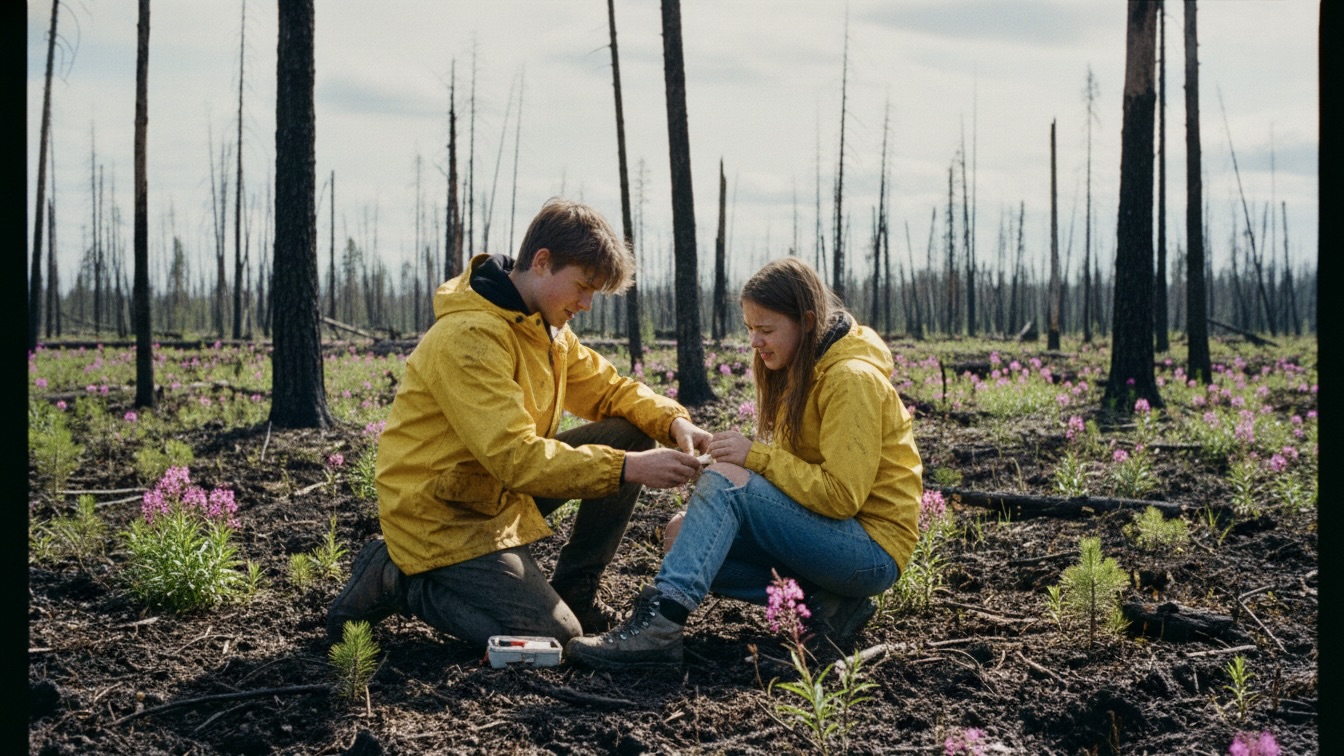
Format: Short Film / Anthology Episode | Est. Length: 10-12 minutes
Imagine this story as a standalone installment of an anthology series titled The Aftermath, which explores the intersection of environmental catastrophe and human resilience. Each episode centers on characters navigating "scarred" landscapes—from flooded cities to scorched earth—where the physical environment serves as a visceral manifestation of the protagonist's internal trauma. The series maintains a grounded, cinematic realism, focusing on the quiet, difficult process of rebuilding life after a definitive ending.
A deafening crack echoes through a skeletal forest of charred, black trees, freezing a young woman in the mud as she waits for a disaster that has already passed. The silence that follows is heavier than the sound, establishing a world where the only color is the neon yellow of a rain jacket and the suffocating grey of ash.
A grieving teenager struggling with survivor's guilt must navigate a desolate wildfire burn scar to complete a biology project with an estranged friend. As they track signs of life among the ruins, a sudden distress signal forces them to confront the reality that they aren't the only ones lost in the woods.
The central theme is the necessity of destruction for the sake of rebirth, mirrored through the ecological concept of "fireweed"—a plant that requires extreme heat to germinate. The story explores the paralyzing nature of grief and the "heavy rocks" of guilt that prevent survivors from moving forward, suggesting that healing is a messy, muddy, and often painful process that cannot be bypassed.
Secondary themes include the fallibility of memory and the importance of shared burden. Macey’s belief that she "missed" saving her friend Leo is contrasted with Emmond’s perspective, highlighting how trauma distorts self-perception and how community is the only antidote to the "prison bars" of isolation.
For Macey, the stakes are psychological and existential; she is "ghosting" her own life, and failure to reconnect with reality threatens to leave her permanently dissociated from her peers and her future. On a physical level, the harsh Ontario wilderness presents immediate dangers of infection and injury, escalating sharply when a red flare signals a potential life-or-death emergency in the valley below.
The primary conflict is internal, pitting Macey against her own crushing survivor's guilt and her desire to remain "dead" like the forest around her. Externally, the antagonistic force is the environment itself—the "sucking" mud, the freezing rain, and the jagged, burned timber that physically resists their progress. Interpersonal tension between Macey and Emmond provides the friction necessary to break Macey’s silence, as Emmond refuses to let her drown in her own apathy.
Macey and Emmond trek through a scorched Northwestern Ontario forest to tag Jack pine saplings for a senior biology project, a task Macey finds agonizingly symbolic of the life she lost. Haunted by the memory of their friend Leo, who fell to his death on wet rocks the previous autumn, Macey moves through the "pencil forest" like a zombie, her boots sinking into the mud as she struggles with the weight of her guilt. Emmond tries to maintain a facade of scientific focus and forced optimism, but the tension between them boils over when he accuses her of abandoning her own life.
The conflict reaches a breaking point when Macey, attempting to flee the conversation, slips on a wet root and suffers a violent fall that gashes her knee. While Emmond tends to the wound, the physical pain breaks Macey’s emotional dam, leading to a raw confrontation about the day Leo died. Through the discovery of fireweed blooming in the ash, Macey begins to accept that life can emerge from ruin. However, their moment of hard-won peace is shattered when they reach a ridge and witness a red distress flare erupting from the valley, signaling a new crisis.
Macey: Paralyzed by the "heavy rocks" of survivor’s guilt, Macey begins the episode as a shell of herself, viewing the world as a graveyard. Her psychological arc moves from total withdrawal and self-blame to a tentative, painful "re-entry" into the living world, catalyzed by physical injury and Emmond’s refusal to let her hide. By the end, she is no longer a passive observer of the dead forest but an active participant in a potential rescue.
Emmond: Emmond serves as the foil to Macey’s stillness, using activity and "fun science" to mask his own grief. His arc reveals that his optimism is a choice and a struggle, not a lack of caring; he moves from being a frustrated observer of Macey’s decline to a compassionate healer who shares the weight of their mutual loss.
Leo (Supporting/Flashback): Though deceased, Leo is a constant presence, characterized by his loud laugh and backward baseball cap. He represents the "ending" that Macey is unable to move past.
1. The Dead Zone: Macey and Emmond enter the burn scar, establishing the oppressive, monochromatic visual of the "black pencil" trees and the "shhh-wuck" sound of the mud that threatens to swallow Macey’s boots.
2. The First Tag: Emmond identifies a tiny Jack pine sapling, forcing Macey to use her frozen fingers to tie a neon orange ribbon, a task that highlights her lack of coordination and her internal resistance to the project.
3. The Breaking Point: As the terrain gets steeper and the mud deeper, Emmond confronts Macey about "ghosting" her life, finally speaking Leo’s name aloud and shattering the fragile silence between them.
4. The Fall: Macey attempts to stomp away in anger but slips on a hidden root, slamming into the jagged, burned wood and suffering a bloody gash that serves as a physical manifestation of her internal trauma.
5. The First Aid: While Emmond cleans the wound, the smell of the antiseptic wipes triggers a sensory flashback to the hospital, forcing Macey to finally confess her guilt over "missing" Leo’s hand during the accident.
6. The Fireweed Revelation: Emmond points out the bright pink fireweed growing from the ash, explaining that some things need the "worst thing to happen" before they can grow, which provides the episode’s thematic midpoint.
7. The Ridge Ascent: Choosing to move forward, the pair climbs a steep ridge of loose ash, a grueling physical effort that culminates in a panoramic view of the forest’s vast, green recovery.
8. The Flare: Just as Macey finds a moment of internal quiet, a screaming whistle and a blinding red flare shoot up from the valley below, ending the episode on a high-tension cliffhanger that demands immediate action.
The episode begins in a state of Cold Apathy, characterized by a slow, dragging pace and a sense of being "stuck." This shifts into Sharp Friction as the characters argue, peaking in Acute Pain and Vulnerability during the fall and the subsequent medical treatment. The mood then transitions into Somber Hope as they discover the fireweed and reach the ridge, before ending in a state of High-Adrenaline Urgency with the appearance of the flare.
In a full season, this episode would serve as the inciting incident for a larger survival narrative. The subsequent episodes would follow Macey and Emmond as they descend into the valley to find the source of the flare, discovering a group of stranded hikers or perhaps a secondary fire starting, forcing them to apply their biology knowledge and newfound resilience to a real-world crisis.
The season-long arc would track the town’s recovery from the wildfire alongside Macey’s recovery from grief. The "neon orange tape" would evolve from a school project tool to a survival marker, symbolizing how the characters are literally and figuratively mapping out a new path through the wreckage of their former lives.
The visual style is "Ecological Gothic," utilizing a desaturated color palette where the only pops of color are the neon yellow of Emmond’s jacket, the orange tape, and eventually the pink fireweed. The cinematography should use long, lingering shots of the skeletal trees to create a sense of being trapped in a "prison of bars," with handheld, shaky camera work during the fall and the flare to heighten the sense of chaos.
The tone is a blend of somber character drama and atmospheric survival thriller, comparable to the grounded realism of Winter’s Bone mixed with the environmental dread of The Road. The soundscape is vital, emphasizing the "sucking" mud, the whistling wind through hollow trees, and the sudden, violent intrusion of the flare’s whistle.
The target audience is Young Adults (16-24) and fans of "New Adult" drama who appreciate stories about mental health, environmental themes, and gritty, realistic coming-of-age narratives. It appeals to viewers who enjoy character-driven survival stories where the emotional stakes are as high as the physical ones.
The pacing is a deliberate "slow-burn" for the first eight minutes, mimicking the grueling, heavy movement of the characters through the mud. This creates a pressure-cooker effect that makes the sudden explosion of the flare in the final two minutes feel earned and shocking. The 10-12 minute runtime allows for a tight focus on a single emotional breakthrough followed by a plot-driven hook.
Production requires a "burn scar" location, which can be achieved through a combination of location scouting in post-fire regions and practical set dressing using charred logs and ash-colored mulch. The "neon orange tape" and "yellow jacket" are essential costume/prop elements that must be vibrant enough to stand out against a grey-scale background.
The red flare at the end is the primary special effect; for safety and consistency, this should be a combination of a practical light source on set and a VFX-enhanced projectile in post-production. The mud must be of a specific consistency—thick and "sucking"—to ensure the tactile nature of the environment is translated effectively to the screen.


