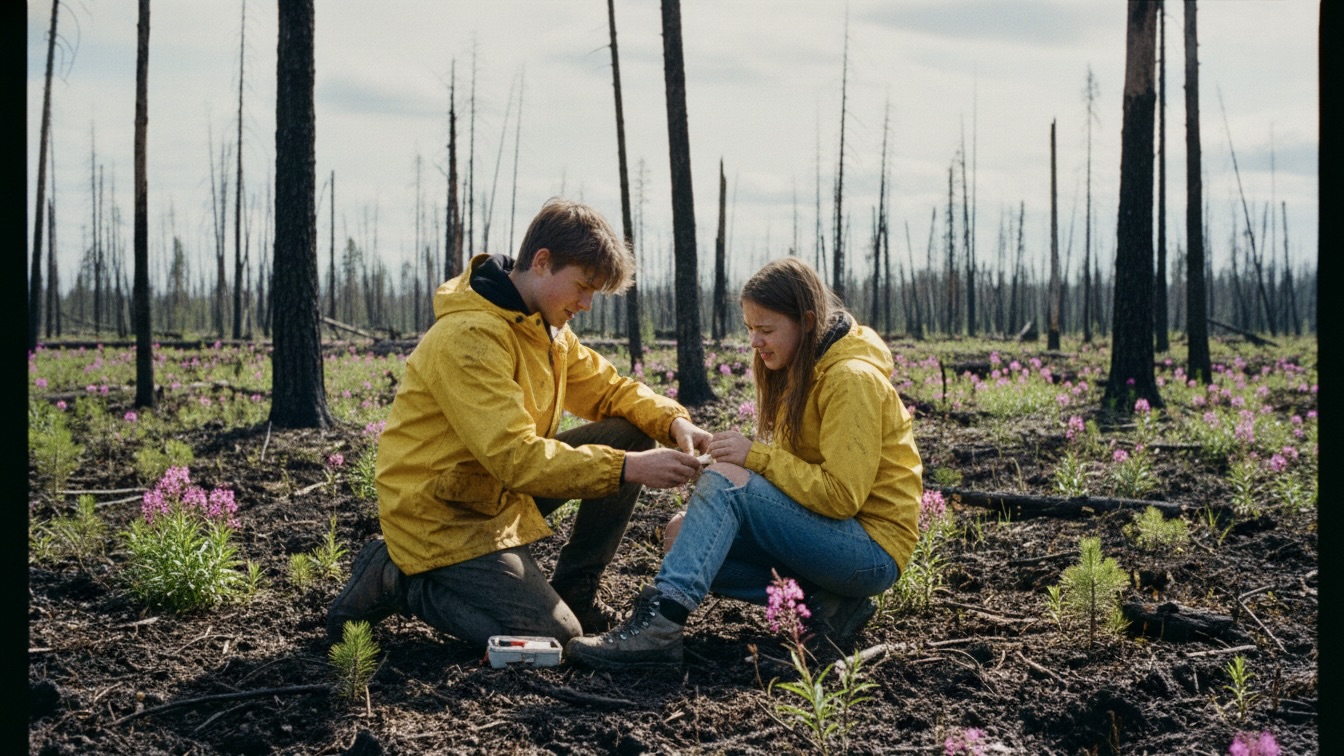
The story follows Macey and her classmate Emmond as they navigate a desolate burn scar in Northwestern Ontario to complete a senior biology project. The environment is a stark landscape of blackened trees and deep mud, serving as a physical manifestation of the emotional desolation Macey feels following the death of their friend, Leo. As they work to tag new Jack pine saplings with neon orange tape, the physical strain of the trek mirrors Macey’s internal struggle with survivor’s guilt. She feels responsible for Leo’s fatal fall, believing she failed to save him when she had the chance.
The narrative reaches a turning point when Macey suffers a fall of her own, injuring her knee and forcing a confrontation with her suppressed emotions. Emmond provides medical assistance and emotional clarity, revealing that he also carries the weight of grief but chooses to focus on the possibility of recovery. He points out the fireweed, a plant that requires the destruction of a fire to bloom, symbolizing their own potential for growth. The chapter concludes on a note of cautious optimism as the pair continues their work, only to be interrupted by a sudden, alarming red flare launched from the valley below.
The central theme of the narrative is the parallel between ecological succession and psychological healing. The "burn scar" of the forest serves as an extended metaphor for the trauma Macey has endured. Just as the forest appears dead but contains the seeds of new life, Macey’s internal world is currently dominated by the "black pencils" of her memories, yet she is beginning the slow process of "tagging" her own progress. The fireweed specifically highlights the idea that some forms of beauty and strength are only possible in the aftermath of total devastation.
Guilt and the weight of the past also serve as a foundational theme. Macey describes her grief as "heavy rocks" in her stomach, a physical sensation that makes every step in the mud a chore. This weight represents the psychological burden of survivor's guilt, where the survivor feels their continued existence is a failure of action. Her hands, which she views as "the hands that failed," become instruments of record-keeping and preservation by the end of the chapter, suggesting a shift from self-blame to constructive utility.
Furthermore, the story explores the necessity of human connection in the face of tragedy. Macey initially attempts to isolate herself, "ghosting" her life and treating her grief as a private prison. Emmond’s intervention breaks this isolation, forcing her to acknowledge that grief is a shared experience rather than a solitary one. His presence provides the "neon orange" contrast to her grey world, suggesting that social support is the primary catalyst for moving through the "mud" of depression.
Macey is a protagonist defined by her profound psychological stagnation and the symptoms of Post-Traumatic Stress Disorder. She exhibits classic avoidance behaviors, such as withdrawing from social circles and "ghosting" her peers to avoid the pain of shared memories. Her internal monologue is dominated by the intrusive memory of Leo’s fall, which she replays with a focus on her own perceived inadequacy. She views herself as a "zombie," suggesting a dissociation from her own life as a defense mechanism against the overwhelming "weight" of her reality.
From a psychological perspective, her fall in the mud acts as a somatic breakthrough. The physical pain of her scraped knee and the chemical smell of the antiseptic wipe trigger a sensory bridge to the hospital where Leo likely died. This moment forces her to stop running and finally articulate her guilt to Emmond. By the end of the chapter, she shows signs of moving from the "impact phase" of trauma into a period of "reconstruction." Her willingness to continue the project and her observation of the fireweed indicate a burgeoning resilience and a shift in her locus of control.
Emmond serves as the pragmatic foil to Macey’s emotional paralysis. While he is also grieving, he adopts a "task-oriented" coping strategy, focusing on the biology project as a way to maintain a sense of normalcy and purpose. He is observant and emotionally intelligent, recognizing that Macey is "ghosting her own life" and choosing to confront her rather than allowing her to remain isolated. His yellow rain jacket makes him a literal beacon of hope and activity in the drab, burnt landscape, marking him as a guide for Macey's recovery.
Despite his outward composure, the text reveals his vulnerability through his nervous habits, such as picking at his zipper and the dark circles under his eyes. He represents the "functional" mourner who understands that moving forward does not mean forgetting the past. By sharing his own struggle, he validates Macey’s feelings while simultaneously challenging her to look for the "green shoots" of her own life. He acts as both a medical first responder for her physical wound and a psychological anchor for her emotional one.
The author utilizes a stark, sensory-driven prose style to immerse the reader in the protagonist's bleak worldview. The use of onomatopoeia, specifically the repetitive "Shhh-wuck" of the mud, creates a rhythmic, dragging pace that mirrors Macey’s exhaustion. The color palette of the story is deliberately limited to browns, blacks, and greys, which makes the "neon orange" of the tape and the "bright pink" of the fireweed pop with symbolic intensity. These flashes of color represent life and human effort encroaching upon the stillness of death.
The pacing of the chapter is masterfully handled, moving from a slow, atmospheric crawl into a moment of sharp, kinetic action during Macey’s fall. This shift in speed mimics the unpredictable nature of trauma, where a quiet moment can suddenly be interrupted by a sharp reminder of pain. The dialogue is sparse but heavy with subtext, capturing the awkward but necessary communication between two teenagers dealing with adult-sized grief. The transition from the internal "heavy rocks" to the external beauty of the ridge-top view provides a much-needed breath of air for the reader.
The narrative voice is intimate and grounded in the physical body, focusing on cold skin, clenched jaws, and the taste of copper. This focus on bodily sensations anchors the abstract concept of grief in a tangible reality. The ending of the chapter employs a sudden tonal shift, moving from a moment of hard-won peace to a high-stakes cliffhanger. The "blinding red flare" serves as a jarring disruption of the newfound quiet, effectively hooking the reader and suggesting that the characters' journey toward safety—both physical and emotional—is far from over.


