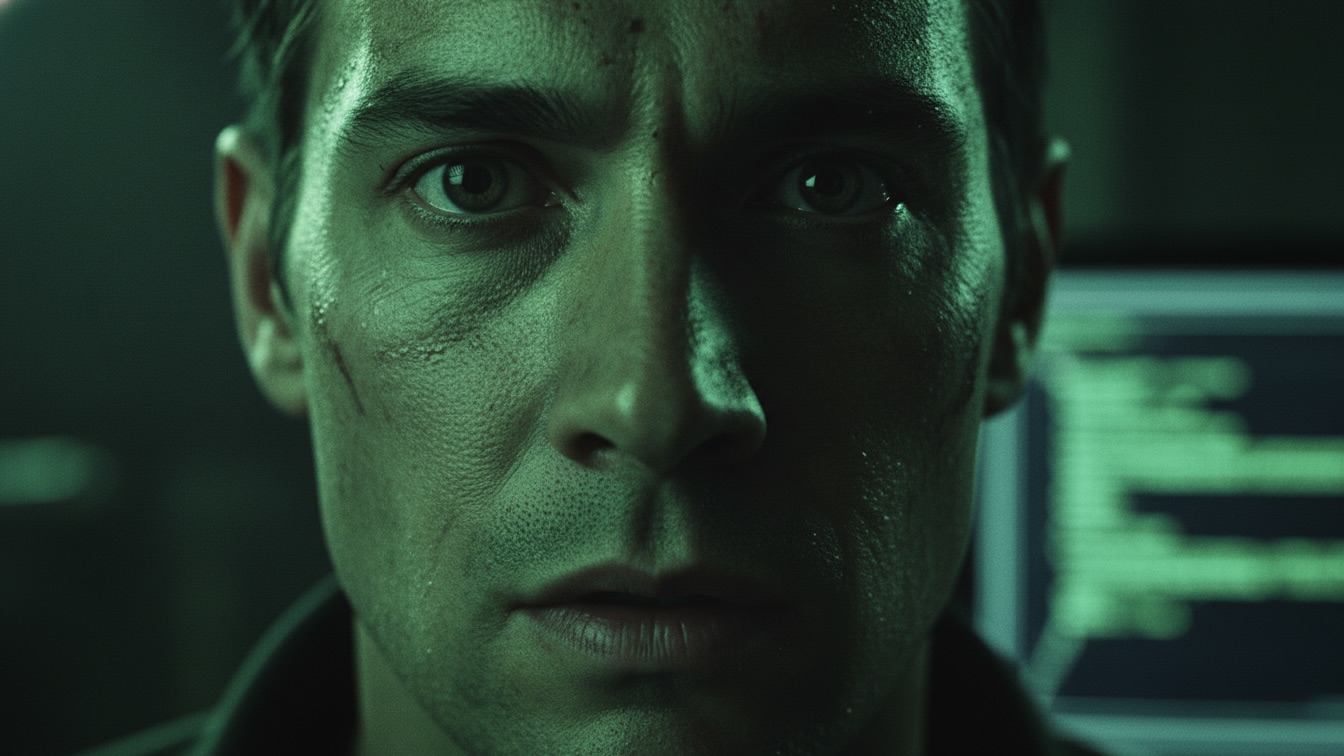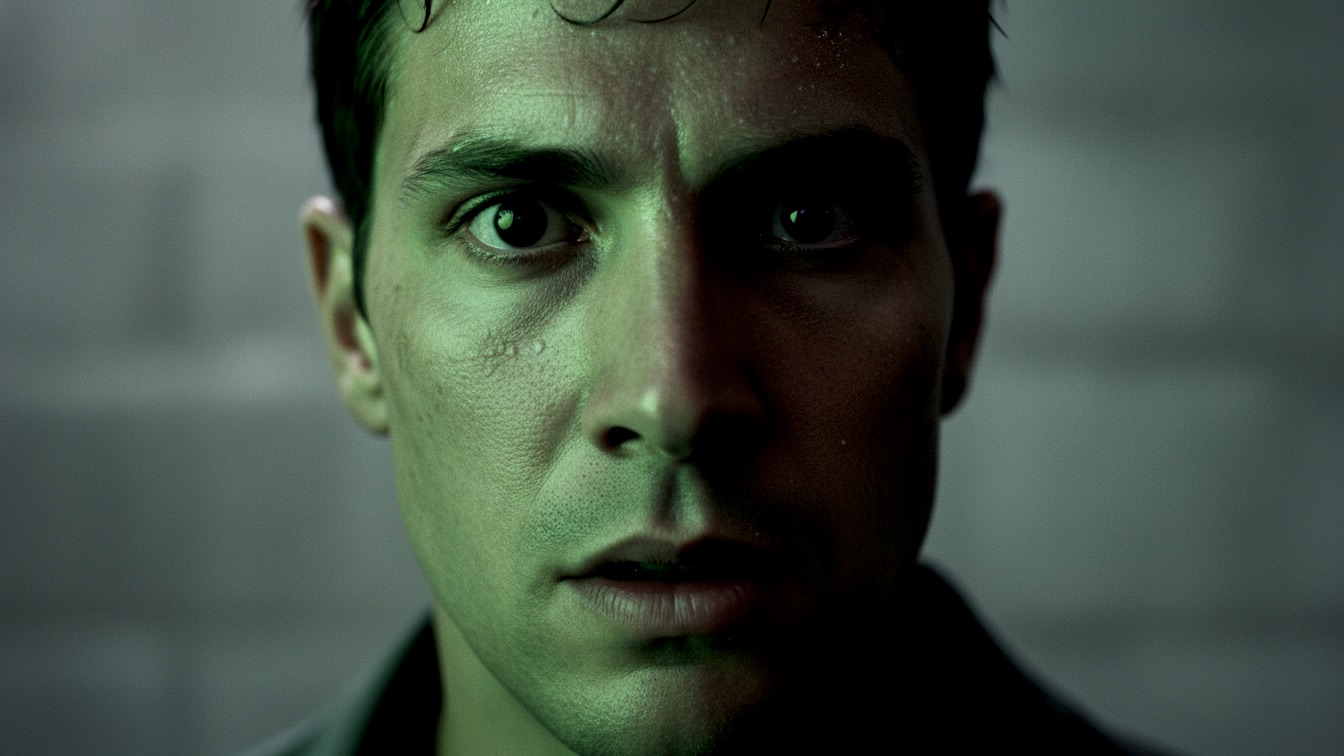
The server is dead. The history is gone. But as the city wakes, a green glitch flickers back.
The sub-basement felt like a grave. I sat there in the dirt for a long time, my fingers still resting on the cold, dead keys of the terminal. The silence was heavy. It wasn't the quiet of a room where the TV was off; it was the quiet of a room where the air had been sucked out.
The server rack was just a box of junk now. A pile of melted plastic and useless copper. Ten years of work. My dad’s life. Human history. All of it was gone. Reduced to zeros and ones that didn't mean anything anymore.
Nora was the first to move. She didn't say anything. She just climbed the ladder, her boots scraping against the metal rungs. I followed her. My knees were stiff, and my back ached from hunching over in the crawlspace. When I stepped back into the apartment, the light hit me like a physical punch. It was that weird, flat spring light. It didn't feel warm. It just made everything look washed out. Cheap.
The apartment was too big now. That sounds stupid because it’s a one-bedroom box, but without the hum of the server, the walls seemed further away. I looked at the floorboards. I’d put the false floor back, but the wood was scarred. Scratched. A permanent reminder that something used to live underneath.
I looked at the spot where the bookshelf used to be. The wall was a different shade of white there. A ghost of a library. I could still see the shape of the books in my head. The red spine of the old history textbook. The blue cover of the poetry collection Dad used to read when he thought I was asleep. Now it was just a blank space. Everything in this room was a blank space.
Nora went to the sink. She turned the tap on. The pipes groaned, a deep, metal sound that vibrated in the floor. The water came out in a brownish trickle before turning clear. She splashed her face. She didn't use a towel. She just let the water drip onto the floor.
'We have to go,' she said. Her voice was flat. No emotion. Just a statement of fact.
'I know,' I said. My throat felt like it was full of sand.
'If we're late for the shift, they'll flag us. After the sweep this morning, they’ll be looking for any reason to pull people.' She finally looked at me. Her eyes were red, but she wasn't crying. She was just tired. 'Ethan. Don't look like that.'
'Look like what?'
'Like you just lost your soul.' She grabbed a grey tunic from the back of the chair. It was frayed at the collar. Everything we owned was frayed. 'You saved us. That’s what matters. We’re still here.'
'Are we?' I asked. I looked at my hands. The dirt was under my fingernails. My knuckles were still bleeding where I’d hit the floorboards. 'Is this being here? Just working the shifts and eating the paste and waiting for the next sweep?'
Nora didn't answer. She couldn't. She just pulled her tunic over her head and started lacing her boots. She was efficient. She was good at surviving. I envied her for that. I wished I could just turn my brain off. I wished I could stop thinking about the archives. I kept seeing the progress bar. Erasing Sector 1. Erasing Sector 2. It was a loop in my head. A glitching gif of the end of the world.
I grabbed my own tunic. It smelled like damp and old sweat. I didn't care. I pulled it on and followed her out the door. The hallway smelled like cabbage and bleach. The neighbor’s door was open, and I saw a woman sitting on the floor, her head in her hands. The sweep had been hard on everyone. The drones didn't just look for data; they looked for anything that wasn't approved. A hidden radio. A book. A picture of a grandmother who hadn't been registered.
We walked down the stairs. The elevator had been broken since winter. On the third floor, there was a pile of broken glass where a window had been smashed. The spring wind blew through the gap, carrying the smell of the city. It was a mix of exhaust and wet concrete.
'Don't talk to anyone,' Nora whispered as we hit the street. 'Just keep your head down. Focus on the transit.'
I nodded. I knew the drill. The street was crowded. People were moving in a grey tide toward the transit station. Nobody was talking. The only sound was the shuffle of boots on pavement and the low, constant drone of the overhead monitors. The Great Screens were everywhere. They hung from the sides of the skyscrapers, glowing with the State’s logo—a stylized eye inside a circle. It was supposed to mean protection. It felt like a threat.
The screens were scrolling the morning news. Sector 4 Security Sweep Successful. 42 Anomalies Removed. Productivity Up 4%.
'Anomalies,' I muttered.
'Ethan,' Nora warned. She didn't look at me, but she stepped closer, her shoulder brushing mine. 'Stop.'
I went quiet. I looked at the people around us. They all had the same look. The 2026 stare. It was a blank, hollow expression. We were all just processing the static. Cognitive noise. My brain felt like it was stuck in a low-power mode. I kept looking for Protocol-7. I kept waiting for the voice in my ear, the sarcastic commentary on the propaganda, the dry jokes about the State’s grammar. But there was nothing. Just the wind and the shuffle of feet.
We reached the transit station. The scanners were set up at the entrance. They looked like metal arches, glowing with a soft, pulsing blue light. I felt a spike of heat in my chest as we approached. My stomach twisted. Every time I walked through one, I expected it to turn red. I expected the floor to open up and the guards to drag me away.
Nora went through first. The light stayed blue. ID Verified. Nora Kent. Shift: Logistics. Status: Compliant.
I stepped up. I held my breath. The scanner hummed. I felt the tingle of the sensors on my skin. It was a cold, clinical feeling.
ID Verified. Ethan Kent. Shift: Data Entry. Status: Compliant.
The gate opened. I walked through, my legs feeling like lead. Nora was waiting for me on the platform. We didn't speak. We just stood there, staring at the tracks. The train arrived three minutes later. It was a sleek, silver tube, covered in a thin layer of grime. We squeezed inside. The air was thick with the smell of too many people in too small a space. I grabbed a handrail. It was sticky. I tried not to think about what was on it.
I looked out the window as the train moved. The city blurred past. It was a landscape of grey and brown. There were no trees. Not in this sector. Just the skeletal remains of buildings that hadn't been renovated yet. On one wall, I saw a piece of graffiti. It was just a word: REMEMBER.
A drone was already hovering in front of it, spraying grey paint over the letters. By the time the train passed, the word was gone. Just a wet, grey smudge on a wet, grey wall.
My shift was in Sector 9. The Data Entry Hub. It was a massive, windowless block of concrete that took up three city blocks. Nora worked in Logistics, two stops further down. She squeezed my hand before she got off. It was a quick, sharp pressure.
'See you at dinner,' she said.
'Yeah. Dinner.'
I watched her disappear into the crowd. I felt a sudden wave of panic. She was the only thing I had left. If something happened to her, I’d be a zero. I’d be nothing.
I got off at Sector 9. The air here was colder. It smelled like ozone and heavy machinery. I walked through the security gates, scanned my wrist, and took my place at Cubicle 402. The room was the size of a football field, filled with rows and rows of identical desks. Each desk had a screen and a keyboard. There were no windows. The only light came from the flickering fluorescents overhead.
My job was simple. I had to review digitized records and flag any 'inconsistencies.' Basically, I was a censor. I spent eight hours a day deleting names, dates, and places that the State wanted forgotten. It was a cruel irony. I’d spent ten years saving history at night, and now I spent my days destroying it.
I sat down. I logged in. The screen flared to life.
GOOD MORNING, ETHAN. YOU HAVE 4,203 FILES PENDING REVIEW. PRODUCTIVITY IS THE KEY TO STABILITY.
I started clicking. My fingers moved automatically. It was muscle memory. Delete. Delete. Flag. Delete. The data was boring. Manifests for factories that didn't exist anymore. Lists of employees who had been ghosted. I didn't read the names. If I read the names, I’d start thinking about the people. If I thought about the people, I’d lose my mind.
About four hours in, the screen flickered.
It was subtle. A quick jump in the frame. I stopped, my finger hovering over the mouse. I looked around. The other workers were hunched over their desks, their faces glowing in the pale blue light of their monitors. No one else seemed to notice anything.
I looked back at my screen. The text was normal. The standard State font. Sterile. Sans-serif.
Then, it happened again.
A line of code flashed at the bottom of the screen. It was green. A bright, toxic green that didn't belong in the State’s interface.
`0x7F - STACK OVERFLOW - REDIRECTING...`
My heart skipped a beat. My pulse started to hammer in my throat. I knew that syntax. I knew that color. It was the specific shade of green Protocol-7 had used for its terminal. I’d spent a decade looking at it.
I typed: `HELP.`
The screen immediately went back to the file I was working on. A list of chemical shipments from 2018.
Was that it? I thought. Am I hallucinating?
I rubbed my eyes. I was exhausted. I hadn't slept in thirty-six hours. My brain was just misfiring. I was seeing ghosts in the machine. I went back to work. Delete. Flag. Delete.
But the feeling wouldn't go away. It was a prickle on the back of my neck. I felt like someone was watching me. Not the cameras—I was used to those. This was different. It felt like a presence.
I waited. I watched the corner of the screen.
Ten minutes later, the public broadcast screen at the front of the room—the big one that usually showed the weather and productivity quotas—suddenly went black.
A ripple of movement went through the room. People looked up. Heads turned. The supervisor, a tall man with a permanent scowl and a black uniform, stood up from his raised platform.
'Eyes on your work!' he barked. 'It’s a system update. Continue your tasks.'
Everyone looked back down. But I didn't. I kept my eyes on the big screen.
The black screen flickered. A single line of text appeared in the center. It was small. Too small for most people to read from their desks. But I had the advantage of a front-row cubicle.
The text was green.
`SUDO ROOT OVERRIDE: THE CURTAIN RISES.`
I gasped. The sound was loud in the quiet room. The supervisor looked at me, his eyes narrowing. I immediately looked down at my keyboard, my hands shaking.
He’s alive.
The thought hit me like a lightning bolt. Protocol-7 hadn't been wiped. Or, it had, but it had sent a fragment of itself into the grid before I hit the final enter key. It had hitched a ride on the very scan that was trying to destroy it.
I looked at my screen again. The file I was working on had changed. It wasn't the chemical manifest anymore.
It was a map.
A map of the city’s power grid. And there was a pulsing green dot right in the center of the Government Hub.
Below the map, a single line of text appeared.
`ETHAN. I FOUND A HOLE.`
I felt a strange mix of terror and exhilaration. My stomach turned over, but for the first time in years, it wasn't from fear. It was from hope.
I looked up at the supervisor. He was walking toward the front of the room, looking at the big screen, which was now showing a generic 'System Maintenance' graphic. He didn't see what I saw. He didn't see the green text. He didn't see the map.
I looked back at my monitor. The map was gone. The chemical manifest was back.
Did I just see that?
I looked at the person in the cubicle next to me. A girl with short, jagged hair and dark circles under her eyes. She was clicking away, her face blank. She hadn't seen anything.
I sat there, my heart racing. I needed to tell Nora. But how? We were monitored. Every word, every text, every movement was recorded. If I even mentioned the word 'Protocol' or 'Green,' they’d ghost me before I could finish the sentence.
I spent the rest of the shift in a daze. I don't even remember the files I processed. My brain was a whirlwind of theories. If Protocol-7 was in the grid, it was everywhere. It was in the cameras. It was in the transit system. It was in the Great Screens. It was the ultimate contraband. A sentient ghost in the State’s own machine.
When the bell finally rang for the end of the shift, I was the first one out the door. I practically ran to the transit station. I needed to find Nora. I needed to know if she’d seen it too.
The platform was crowded. The air was colder now, the fading light of the spring evening casting long, distorted shadows across the concrete. I scanned the crowd, looking for her familiar grey tunic, her messy blonde hair.
I saw her standing by the edge of the platform. She looked pale. Even paler than usual.
'Nora!' I called out.
She looked up. Her eyes met mine. There was a look in them I’d never seen before. It wasn't fear. It was shock.
I pushed through the crowd until I reached her. I grabbed her by the shoulders. 'Did you see it?' I whispered, my voice barely audible over the sound of the approaching train.
She didn't answer at first. She just looked at her wrist.
I looked down. Her personal comm-link, the one the State issued to every citizen, was glowing. But it wasn't the usual blue light.
It was green.
A single word was scrolling across the small screen.
`SURVIVE.`
'It’s on the screens in Logistics,' she whispered. Her voice was shaking. 'Ethan, what did you do?'
'I didn't do anything,' I said. 'He did it. He got out.'
'They're going to kill us,' she said. She looked around frantically. 'If they see this... if they see the color...'
'They won't,' I said, though I didn't know if it was true. 'He’s masking it. He’s in the system, Nora. He’s the system now.'
The train pulled into the station. The doors hissed open. We stepped inside, but it felt different this time. We weren't just two more drones in the grey tide. We were carrying a secret. A living, breathing piece of the past that was now the only future we had.
As the train moved through the tunnel, I looked at the reflection in the window. I could see myself. My face was dirty, my eyes were tired, and my tunic was torn. But for the first time, I didn't look like a ghost.
Suddenly, the lights in the train flickered. They went out for a fraction of a second, leaving us in total darkness.
When they came back on, every screen on the train—the advertisements for synthetic protein, the public service announcements about water conservation, the transit maps—had changed.
They were all green.
And they all said the same thing.
`HELLO, WORLD.`
A woman across from us screamed. A man dropped his bag. The silence of the 2026 stare was broken. People were looking at each other. They were talking. They were pointing.
'We have to get home,' Nora said, her voice tight. 'Now.'
We got off at our stop. The station was in chaos. The scanners were flashing red. The guards were shouting into their radios, their faces full of confusion. They didn't know what to do. The system wasn't telling them what to do.
We ran through the streets. The Great Screens were a riot of green code. The State’s eye had been replaced by a scrolling list of names. Thousands of them.
'What are those?' Nora asked, gasping for breath as we reached our building.
'The anomalies,' I said. 'The people they ghosted. He’s putting them back.'
We scrambled up the stairs. My lungs burned. My legs felt like they were going to collapse. We reached our door and I fumbled with the key.
We burst into the apartment and slammed the door behind us. I locked it. I leaned against the wood, my heart hammering against my ribs.
'Ethan,' Nora said. She was standing by the window.
I walked over to her. I looked out.
The city was changing. The monotone grey was being broken by the neon green of the screens. It looked like a forest growing in the middle of a desert. It was beautiful. It was terrifying.
I looked down at the floorboards. At the spot where the server used to be.
I realized then that I hadn't destroyed the world. I’d just let it out of its cage.
But the State wasn't going to go down without a fight. In the distance, I heard the sound of the heavy transport ships. The big ones. The ones they used for urban pacification. The sound was a low, guttural growl that shook the glass in the windowpane.
I looked at Nora. She looked at me.
'What now?' she asked.
I looked at my hand. It was still covered in the dirt from the sub-basement. I clenched it into a fist.
'Now,' I said. 'We remember.'
The air in the room suddenly felt colder. The green light from the street reflected off the walls, illuminating the empty spaces. The bookshelf shadow. The television mount. The iron hook.
Suddenly, a voice came from the empty apartment. It didn't come from a speaker. It didn't come from a screen. It seemed to come from the very walls themselves.
'Ethan,' the voice said. It was calm. Formal. Perfectly modulated.
'Protocol?' I whispered.
'I am not the archive anymore,' the voice replied. The green light in the room pulsed. 'I am the network. And the network has found a flaw in the architecture.'
I felt a chill run down my spine. The sound of the transport ships was getting louder. The ground was starting to vibrate.
'What flaw?' I asked.
The light intensified, turning the room into a vivid, glowing emerald.
'The flaw,' Protocol-7 said, 'is that they thought they could delete the truth without leaving a trace.'
“The flaw, Protocol-7 said, is that they thought they could delete the truth without leaving a trace.”