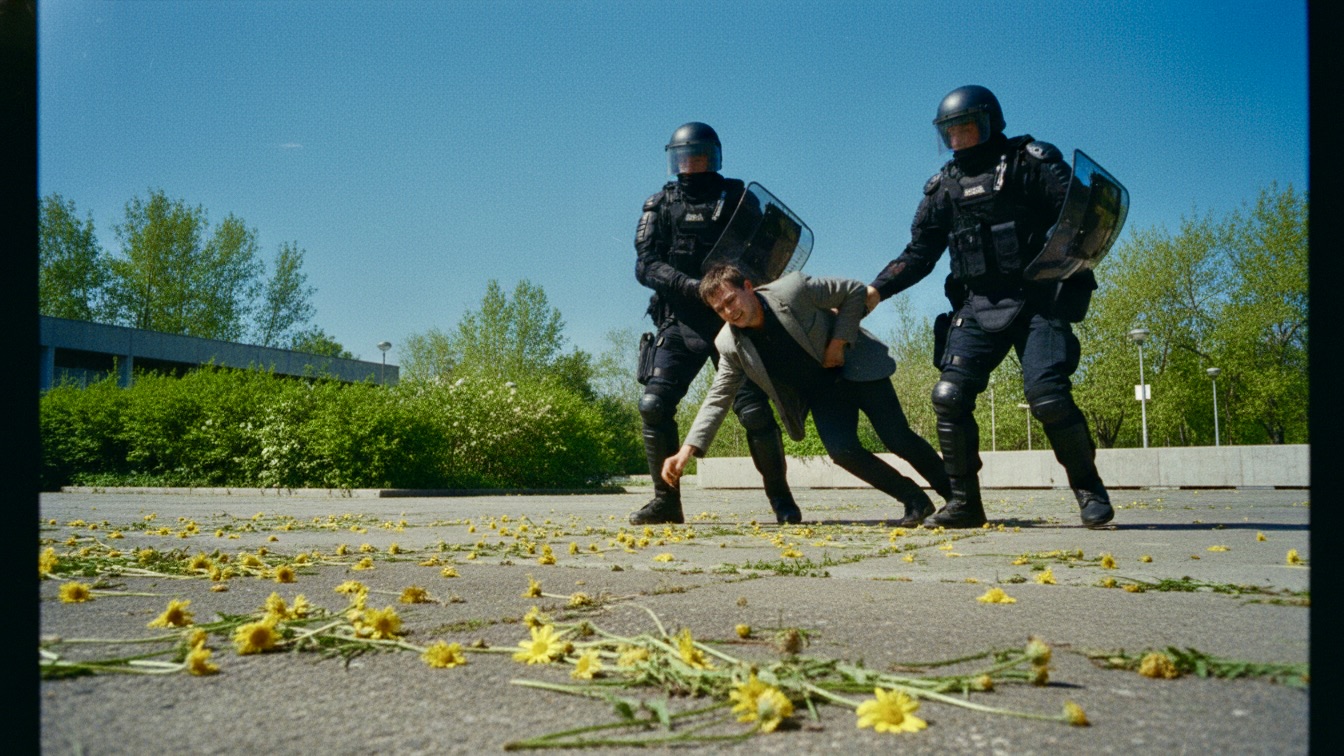
Brian knew the engineered flowers were toxic. The State mandated spring, but the pollen tasted like rusted metal.
The mandate was simple: Be outside. Enjoy the spring.
Brian stood in Sector 4’s main concrete plaza, staring at a cluster of bright yellow flowers bolted to a steel trellis. The State called them Sun-Daisies. They were genetically engineered to bloom exactly on March 15th, regardless of the actual weather. Right now, the sun was blindingly bright, casting hard, sharp shadows across the cracked pavement. The light felt wrong. It was too white, too clinical, like the flash of a camera held for far too long. There was a physical heaviness to the air, a weird, unnatural silence beneath the blaring festival music pouring from the public address speakers. The shadow mass, they called it on the dark nets. The feeling that the world was slightly out of sync with itself.
He rubbed his thumb against his index finger. A thin coating of yellow dust coated his skin. The pollen.
It didn’t make you sneeze. It made your throat itch, deep down in the esophagus, a dry, scratching sensation that tasted faintly of battery acid and copper. The State insisted the new flora was perfectly safe, a triumph of agricultural engineering. Brian knew better. His gums had been bleeding since Tuesday.
“You’re staring at the fake plants again,” a voice said.
Brian didn’t jump. He just blinked, the stinging in his eyes worsening, and turned his head.
Nate was standing there, hands shoved deep into the pockets of his standard-issue grey jacket. The jacket was frayed at the cuffs, and one of the plastic buttons was missing, replaced by a safety pin. Nate looked exhausted. Everyone looked exhausted, but Nate carried it differently. He had a nervous, kinetic energy, shifting his weight from foot to foot, his jaw tight. A fresh scratch ran down his neck, probably from sleeping on the abrasive cots in the transit barracks.
“They’re not fake,” Brian said, his voice raspy. “They’re organic. Just… modified.”
“If it bleeds yellow dust that makes my teeth hurt, it’s fake,” Nate said, stepping closer. He glanced over his shoulder. The courtyard was packed. Thousands of young adults, all between eighteen and twenty-five, milling around under the blinding spring sun. They all wore the same tired expressions, the same cheap synthetic clothing. Above them, surveillance drones hovered like giant, silent wasps, their camera lenses reflecting the harsh light.
Nate leaned in, dropping his voice. He didn’t look at Brian. He looked at the flowers. “You got the drive?”
“Yeah.” Brian felt the hard plastic edge of the modified flash drive pressing against his ribs, hidden inside the lining of his jacket.
“Okay.” Nate swallowed hard. His Adam's apple bobbed. “If the Guard catches us swapping the tags, we are totally fucked.”
“I know.”
“Like, deeply, irreversibly fucked. Mining sector fucked.”
“I know, Nate.”
“Just checking.” Nate pulled a hand out of his pocket and picked at a scab on his knuckles. “Because I was thinking about it on the train ride over. The sorting algorithm isn’t supposed to be touched. If we trip the firewall—”
“We won’t trip the firewall,” Brian interrupted. The clipped, rapid exchange was familiar. It was how they managed panic. “The exploit is clean. I tested it on the dummy terminal in the basement. It just rewrites the pairing ID. It takes 0.4 seconds. We scan in, I plug the drive, it pings, we pull out. We get assigned to the same labor district.”
Nate let out a breath that sounded like a laugh but had no humor in it. “0.4 seconds.”
“Yes.”
“Right.” Nate looked up at the sky. The blue was too vivid. It hurt to look at. “I just… I don’t want to go to District 9 alone, man. The suicide rate there is—”
“Nate, stop.” Brian finally looked directly at him. He saw the dark circles under Nate’s eyes, the way his hands shook slightly. The fear was a physical thing, radiating off him like heat from asphalt. “You’re not going to District 9 alone. We’re going to District 4. Together. Agricultural tech. It’s boring. It’s safe. We keep our heads down.”
Brian’s internal monologue was a static hum of anxiety, but he kept his face blank. He wasn't a hero. He didn't want to topple the regime or start a revolution. He was twenty-one years old, tired of eating synthetic protein, tired of the constant, low-grade fear, and tired of being alone. Nate was the only person in the city who knew how he took his synthetic coffee, the only person who understood his dark, cynical jokes. In a world completely stripped of privacy and choice, keeping Nate was the only thing that mattered. It was a selfish, desperate grab at humanity.
The public address system chimed. A cheerful, synthesized female voice echoed across the courtyard.
"Attention citizens. The Spring Selection terminal is now open. Please proceed to the scanning booths in an orderly fashion. Embrace your future. Serve the State."
The crowd shifted. A collective, defeated shuffle of thousands of boots against concrete. The sound was deafening but entirely joyless.
“Showtime,” Brian muttered. His stomach turned over. A cold sweat broke out on the back of his neck.
They merged into the flow of bodies. The smell of the crowd was overwhelming—stale sweat, cheap soap, and the sharp, metallic tang of the yellow pollen. Brian kept his eyes on the ground, watching the scuffed heels of the girl in front of him. She was dragging her left foot slightly.
The line moved with agonizing slowness. Every ten feet, a heavily armored Guard stood holding a shock-baton. They weren't the faceless, robotic enforcers from the old movies. They were real people, usually older, their faces thick with boredom and casual cruelty. They wore heavy black tactical gear that looked hot and uncomfortable in the bright spring sun. One of them, a heavy-set man with a thick mustache, was coughing violently, clearly reacting to the pollen.
“Hey,” Nate whispered, bumping his shoulder against Brian’s. “You remember that time we tried to hack the vending machine in the old dorms?”
“Yeah. You nearly electrocuted yourself.”
“I got the chips, though.”
“They were stale.”
“Still tasted like victory.” Nate offered a weak, crooked smile.
Brian forced a nod. The banter was a shield. It kept the cognitive static at bay.
The line snaked toward the center of the plaza, where a massive, white plastic pavilion housed the Selection terminals. The terminals were sleek, black obelisks, completely at odds with the grimy, worn-down reality of the citizens using them.
Brian’s chest felt tight. He ran through the code in his head. The State’s pairing system was designed to break social bonds. It analyzed your aptitude, your physical health, and your psychological profile, then deliberately shipped you away from anyone you had a high affinity with. It was basic crowd control. Isolated people didn't rebel.
The terminal came into view. Ten feet away. Five feet.
“Next,” a Guard barked, pointing a thick, gloved finger at Brian and Nate.
They stepped up to the dual-terminal station. The screen was a bright, glaring white.
INSERT IDENTIFICATION CHIP
Brian reached into his pocket and pulled out his State ID. His hand was shaking. He forced it still. He looked at Nate. Nate was pale, his eyes wide, locked on his own screen.
“Now,” Brian whispered.
They both slotted their ID chips into the readers.
The screens flashed green.
PROCESSING CITIZEN 884-B AND CITIZEN 902-N
Brian moved fast. He slipped the modified flash drive from his jacket lining. The terminal had a maintenance port on the underside, hidden by a plastic lip. He knew it was there because he’d spent three weeks studying the stolen schematics on a cracked datapad in his closet.
He jammed the drive into the port.
His screen flickered. The green light stuttered, turning a sickly yellow. Text began to scroll rapidly across the bottom of the display, too fast to read. The code was injecting. It was supposed to hijack the assignment protocol, link their two ID numbers, and force a low-priority District 4 assignment.
OVERRIDING...
The silence around Brian deepened. It was the shadow mass again. The world seemed to slow down. He could hear his own heartbeat in his ears, heavy and slow. Thud. Thud. He could hear the faint, high-pitched whine of the terminal’s cooling fan. He could smell the ozone from the screen.
Nate shifted his body, casually leaning to block the view of the Guard standing twenty feet away.
“Come on, come on,” Brian breathed.
ASSIGNMENT: DISTRICT 4 - AGRICULTURAL SUPPORT.
Relief crashed over Brian like a physical wave. His knees went weak. It worked.
He reached under the terminal to pull the drive out.
His fingers brushed the plastic casing.
Then, the screen went black.
Not off. Black. A deep, dead, empty void.
Brian froze.
“Brian?” Nate’s voice was tight. “My screen just died.”
Brian pulled the drive out and shoved it into his pocket. “Walk away. Just walk away normally.”
They turned. They took one step.
The alarms didn’t wail. They screeched. It was a digital, grating noise that felt like a drill going into Brian’s skull. The sound ripped through the courtyard, cutting off the cheerful festival music instantly.
The white pavilion flooded with pulsing red light.
"SECURITY BREACH. TERMINAL 4. SECURITY BREACH. TERMINAL 4."
The omniscient eye of the State didn't blink. The network, housed in a server farm three miles away, had registered the anomaly. The firewall hadn't been tripped by the code; it had been tripped by the hardware. The drive had drawn 0.1 volts too much power.
“Run,” Nate said.
But there was nowhere to run. The crowd of thousands, previously shuffling and docile, instantly dropped to the ground. It was a conditioned response. When the alarms went off, you hit the concrete. Anyone left standing was a target.
Brian and Nate were the only ones standing.
The Guard with the mustache was already moving. He was faster than he looked. He didn’t yell. He didn’t give a warning. He just closed the distance and swung the shock-baton.
The heavy rubber and metal end caught Nate in the ribs.
The sound of the impact was dull, followed by a sharp crack. Nate went down instantly, a choked gasp escaping his lips. He hit the concrete hard, scraping his cheek against the rough surface.
“Nate!” Brian yelled, reaching for him.
A heavy hand grabbed the back of Brian’s collar. The fabric of his cheap jacket tore. He was violently jerked backward, his feet leaving the ground. He twisted, throwing an elbow blindly. It connected with hard plastic armor. Pain shot up his arm.
Two more Guards were on him. One kicked the back of his knee. Brian’s leg buckled. He crashed to the ground, his jaw slamming against the pavement. He tasted blood. It mixed with the copper taste of the pollen.
“Hold him down!” a voice barked.
A heavy boot pressed into the center of Brian’s back, pinning him to the concrete. He couldn't breathe. The weight was crushing. He turned his head, spitting blood onto the ground.
Through the forest of black boots and armored legs, he saw Nate.
Two Guards were dragging Nate away by his arms. Nate’s head was lolling, his eyes half-closed. His boots dragged across the pavement, crushing the bright yellow petals of a fallen Sun-Daisy.
“Nate!” Brian screamed, his voice tearing his throat.
Nate didn’t look back. Maybe he couldn’t.
“Shut up, glitch,” the Guard above Brian sneered. A heavy zip-tie was brutally secured around Brian’s wrists, biting into his skin.
They hauled Brian to his feet. The world spun. The bright spring sun glared down, mocking the violence. The yellow flowers looked like open, screaming mouths.
As they dragged him toward the reinforced transport trucks waiting at the edge of the plaza, Brian stared at the empty space where Nate had just been.
His chest hollowed out. A cold, absolute certainty settled into his bones.
He had thought he could cheat the system. He had thought that stealing a tiny fraction of a life—just a boring job in a boring district with a friend—was a small enough request that the universe might allow it. But the regime didn't deal in small requests.
The physical pain in his jaw and his wrists faded into the background, replaced by a crushing psychological weight. The banter, the shared jokes, the quiet moments looking at cracked datapads in the dark—that wasn't just survival. That had been freedom. The only real freedom he had ever possessed.
And now it was gone.
They threw him into the back of the truck. The metal doors slammed shut, cutting off the blinding spring light. In the suffocating darkness, the engine roared to life. The system hadn't just separated them; it had documented the attempt. It knew exactly what they cared about, and it would ensure they never saw it again.
“The system hadn't just separated them; it had documented the attempt. It knew exactly what they cared about, and it would ensure they never saw it again.”


