The sky turned the color of a bruised lung as the wildfire breached the last remaining firebreak near the reserve.
The email from the Ministry arrived at 3:14 PM. Koda didn't even have to open it to know what it said. The subject line—'Status Update: Project Mycelium-7'—was enough of a funeral bell. He sat in the cramped, humid air of the trailer he called a lab, the smell of damp earth and sterile plastic thick in his throat. Outside, the Northwestern Ontario spring was behaving badly. It was too dry. The snow had vanished in a week, leaving behind a landscape of brittle brown needles and mud that felt like concrete.
He clicked the link. 'Consultation delays.' 'Further environmental impact assessments required.' 'Funding suspended pending federal oversight committee review.' Koda leaned back, his chair creaking. He looked at the petri dish on his desk. Inside, a thick, milky-white fungal mat pulse-throbbed with a life of its own. It was a hybrid, a bio-engineered strain designed to eat heat and exhale moisture. It was supposed to be the answer for the condemned houses on the reserve—structures that were basically tinderboxes waiting for a spark.
"They canned it," he said aloud. The walls didn't answer.
The door to the trailer kicked open. Neeba walked in, her boots caked in the grey dust of the access road. She was carrying two crates of what looked like industrial filters, but Koda knew better. She looked at the screen, then at him.
"The Ministry?" she asked.
"The Ministry," Koda confirmed. "They're calling it a 'procedural pause.' Which means they're waiting for the fire to do the work for them. If the community burns, they don't have to fix the houses. They just relocate us to the city and call it a tragic necessity."
Neeba dropped the crates. The thud shook the floor. "Well, good thing I don't care about procedures. The shipment is here."
"The carbon-capture tech?" Koda stood up, his heart doing a weird, fast trip against his ribs.
"The government thinks it's going to a site in Thunder Bay. The driver is a friend of a friend. He 'got lost' on the logging roads. We have four hours before the GPS pinger alerts the head office that the truck is stationary on a dead-end road in the middle of nowhere."
"Neeba, this is federal property. If we take those units, it's not just a fine. It's—"
"It's survival, Koda. Look at the horizon. You see that?"
He looked through the grime-streaked window. To the west, the sky wasn't blue. It was a sickly, washed-out yellow. The provincial government had already designated the area a 'total loss zone.' They weren't even sending water bombers anymore. They were just letting it burn until it hit the rock line.
"I need the carbon-capture units to feed the spores," Koda muttered, his mind already calculating the chemical conversion. "The fungal mats need high-CO2 environments to trigger the rapid growth phase. If I can pump the exhaust from those units directly into the house foundations..."
"Then do it," Neeba said. She grabbed his arm. Her grip was tight, desperate. "The wind shifted an hour ago. The fire is coming fast. We don't have a 'consultation' window. We have tonight."
They worked in a fever. The community was quiet—a heavy, expectant silence. People were packing cars, eyes darting to the smoke on the horizon. Koda and Neeba didn't pack. They moved from house to house in the central cluster, dragging the heavy, hijacked carbon-capture units. Koda's tech was a messy slurry of biology and salvaged hardware. He sprayed the foundations with the milky white spores, then hooked up the hoses.
"It looks like mold," one of the elders, Mrs. Gauthier, said as she watched them spray her porch.
"It’s life, Mrs. Gauthier," Koda said, wiping sweat from his forehead. "Just stay inside. Keep the windows shut. When the heat hits, the walls are going to sweat. Don't worry about the smell."
"Is it going to save us?" she asked.
Koda looked at Neeba. She was tightening a valve, her face set in a mask of grim determination. "It's the only thing that might," he said.
By 8:00 PM, the sky was gone. The world was orange and black. The sound started then—a low, rhythmic thrumming like a thousand idling trucks. It was the sound of the forest dying. The heat began to crawl across the skin, a dry, itchy sensation that made every breath feel like swallowing sand.
Koda checked his tablet. The sensors he'd buried in the fungal mats were spiking. "The CO2 levels are perfect. The spores are blooming. Neeba, look."
Under the houses, the white mats were expanding. They didn't just grow; they surged. They crawled up the siding, a thick, leathery membrane that looked like pale elephant skin. It was cool to the touch, vibrating slightly as it pulled moisture from the air and the carbon-capture units.
"It's working," Neeba whispered.
Then the headlights appeared.
Three black SUVs crested the hill, their sirens silent but their strobe lights cutting through the thick smoke. They stopped fifty yards from the first house. Men in tactical gear stepped out, wearing respirators that made them look like insects.
Sergeant Poiler was the first one to approach. He didn't look like a cop; he looked like a corporate janitor with a gun. He worked for Global Climate Solutions—the company that owned the 'stolen' carbon units.
"Koda!" Poiler shouted over the growing roar of the fire. "Turn it off! Move away from the equipment!"
Neeba stepped forward, a heavy wrench in her hand. "Get lost, Poiler! This equipment is saving lives. Your company was just going to use it for tax credits!"
"It’s twenty million dollars of proprietary tech!" Poiler yelled back. He signaled his men. They moved in a semi-circle, hands on their holsters. "We’re here to reclaim the assets. Move!"
"The fire is five miles out!" Koda screamed, pointing at the wall of flame now visible through the trees. "If you take those units now, the pressure drops, the fungi die, and these people burn! You want that on your soul?"
"I have a contract, kid!" Poiler lunged for the nearest unit.
Neeba didn't hesitate. She swung the wrench, catching Poiler in the shoulder. He went down with a grunt, his men immediately drawing their sidearms.
"Whoa!" Koda jumped between them, his hands up. "Look at the trees!"
A crown fire—the kind that jumps from treetop to treetop—burst over the ridge. It wasn't a fire anymore; it was a physical force, a tidal wave of heat that sucked the air out of the clearing. The SUVs' windows shattered from the thermal shock. One of the security guards screamed as his tactical vest started to melt.
"Inside!" Koda grabbed Poiler by the collar of his expensive jacket. "Get inside the house!"
"Are you crazy?" Poiler gasped, clutching his shoulder. "It’s a wooden shack!"
"It’s a fortress! Move!"
They scrambled onto Mrs. Gauthier's porch. The fungal membrane had now completely encased the structure. It looked like a giant, pale cocoon. Neeba shoved the security guards through the door, Koda diving in last just as the first wave of flame licked across the yard.
Inside, the air was strange. It was cool. It was incredibly humid, smelling of mushrooms and ozone. Mrs. Gauthier was sitting on her sofa, clutching a rosary, her eyes wide. The security guards huddled in the corner, their weapons forgotten, their faces pale with terror.
The sound outside was unbearable—a screaming, tearing noise as the fire consumed everything. The windows were covered by the fungal mat, but they could see the orange glow pulsing through the translucent membrane. The house groaned, the wood settling under the weight of the growth, but the heat didn't come.
"The temperature is holding at seventy-two degrees," Koda said, staring at his tablet. His hands were shaking. "The mycelium is transpiring. It’s creating a micro-climate. It's... it's breathing."
Poiler looked at the wall. He touched the leathery surface. It was wet. "This is... this is impossible. The outside temperature must be over a thousand degrees."
"Biology is better than your carbon-capture filters, Poiler," Neeba said, sliding down the wall to sit on the floor. She looked exhausted, her face streaked with soot. "We didn't steal your tech. We upgraded it."
For three hours, they sat in the fungal womb. They heard the SUVs explode outside—muffled thumps that barely vibrated the floor. They heard the ancient pines snapping like toothpicks. They heard the wind howling, a banshee scream of a world being erased.
And then, the sound changed. The roar faded to a hiss. The intense orange glow behind the fungal walls dimmed to a dull, charcoal grey.
Koda stood up. He walked to the door. The handle was cool. He pushed, but the fungal mat was thick. He had to use a knife to slice through the membrane. It felt like cutting through thick, wet steak.
As the slit opened, the most incredible sensation hit them.
Oxygen.
It wasn't the smoky, poisonous air they'd been breathing for days. It was clean. It was sharp. It felt like a physical weight being lifted off their chests. The pressure differential caused a rush of air to whistle through the house.
Koda stepped out onto the porch.
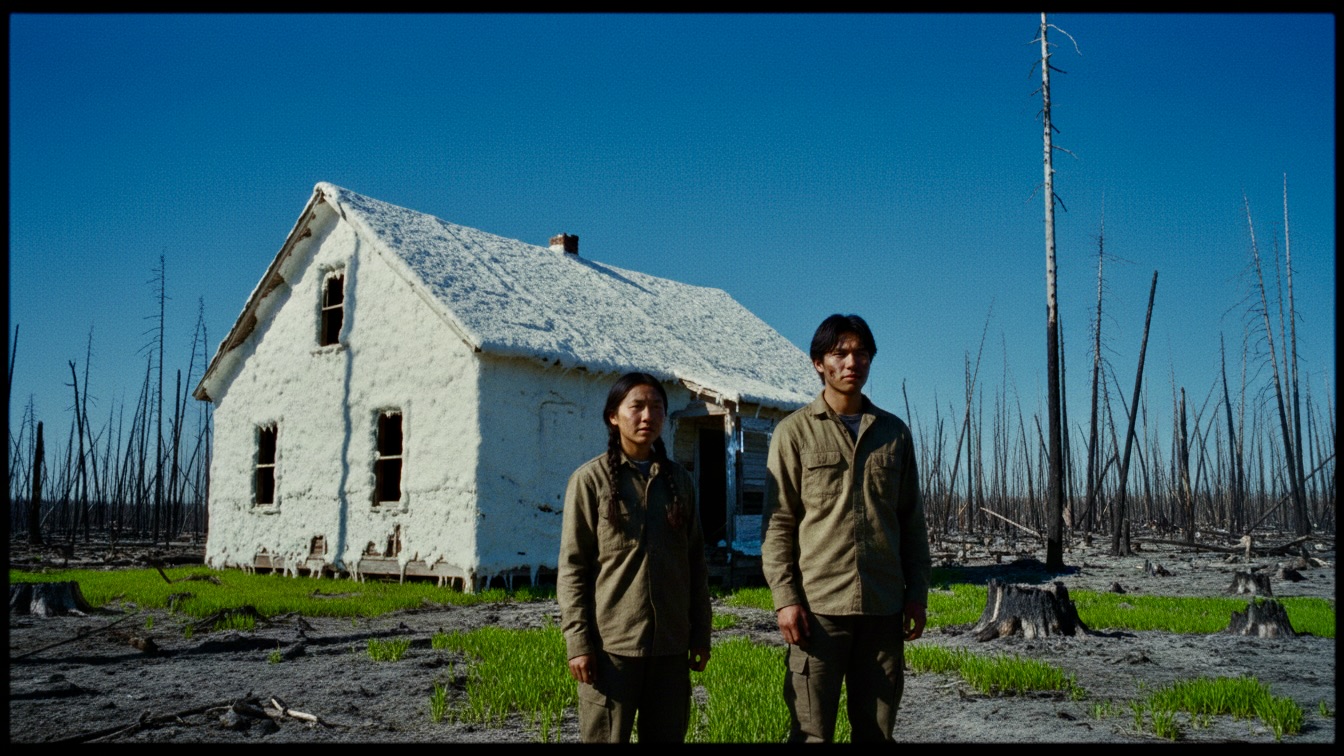
He gasped. The world was gone. As far as he could see, the forest was a graveyard of black skeletons. The ground was a carpet of grey ash, still swirling in the wind. The SUVs were blackened husks, their tires melted into puddles of rubber.
But the houses—the seven houses they had treated—were standing. They were white, organic shapes in a world of charcoal. They looked like pearls dropped in a grill. The fungal mats were charred on the very outside, a crust of black carbon protecting the living, moist interior.
Neeba stepped out beside him, followed by a trembling Poiler and his team.
"We’re alive," Mrs. Gauthier whispered, stepping onto her scorched porch. She looked at the green shoots already poking through the ash near the base of the house—seeds that had been protected by the fungal moisture.
Poiler looked around, his mouth hanging open. He looked at his ruined vehicles, then at the standing homes. He pulled out his satellite phone. It took three tries to get a signal.
"This is Poiler," he said, his voice cracking. "Cancel the reclamation. Send medical. And... send the Ministry. All of them. They need to see this."
He looked at Koda, a strange mix of respect and corporate calculation in his eyes. "They're going to want to buy this, you know. They'll try to own it."
Koda looked at the vast, empty horizon. The claustrophobia of the last few years—the fighting for funding, the begging for recognition, the fear of the coming fire—it was all gone. There was only the clarity of the task ahead.
"Let them try," Koda said, his voice steady. "The spores are already in the wind. You can't patent the air."
Neeba smiled, a real, sharp smile. She looked at the charred landscape, then back at the living walls of their home. "We have work to do," she said. "There are a lot more houses in the north."
Koda nodded. He felt a sudden, overwhelming surge of energy. The burden of the 'total loss zone' was gone. They weren't a tragedy anymore. They were a blueprint.
He looked at the blackened sky, where the first stars were beginning to poke through the thinning smoke. A new quest was beginning, one that wouldn't be fought in labs or boardrooms, but in the dirt, in the heat, and in the very breath of the earth itself.
“He looked at the blackened sky, where the first stars were beginning to poke through the thinning smoke, knowing the government would come for the tech, but the spores were already traveling on the wind.”


