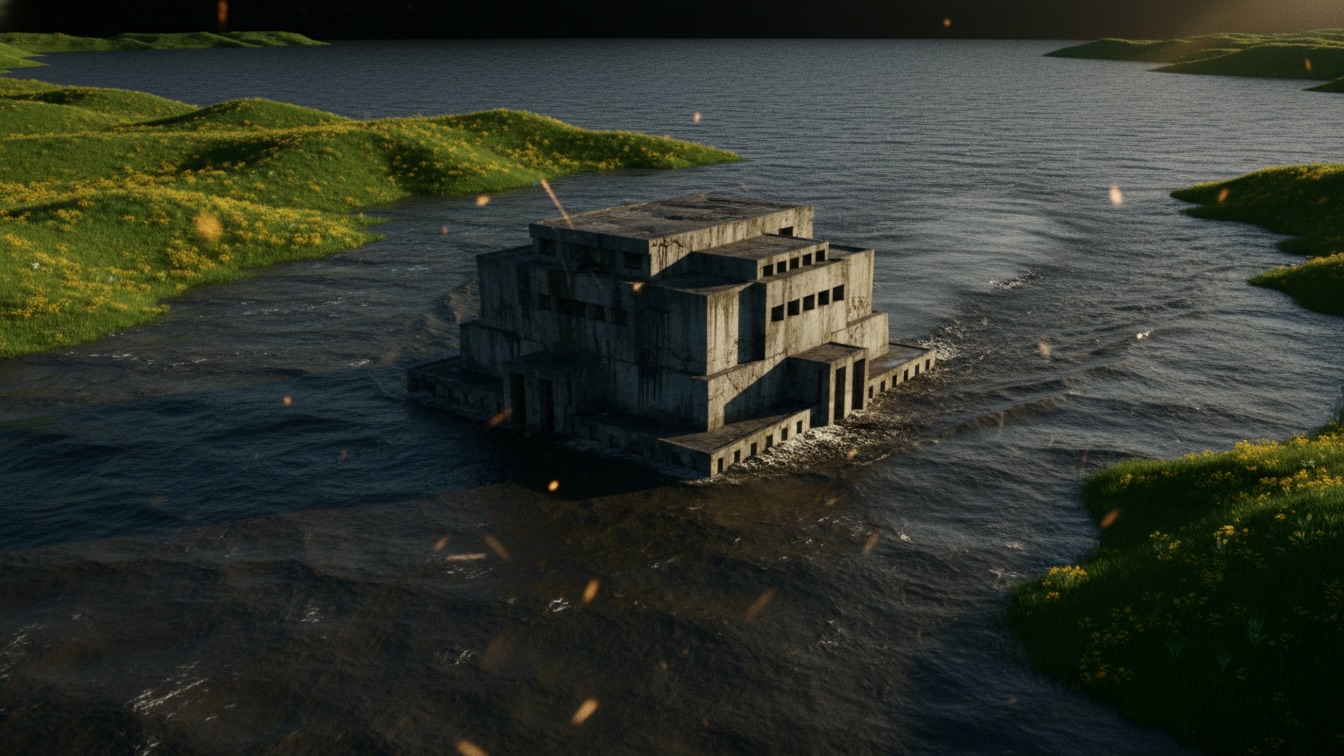
Dr. Woodfeld finds a birthday cake preserved in fish scales while the depot begins its slow, rhythmic migration.
"It's still here," Woodfeld said.
Aris didn't look up from the tablet. "Shouldn't be."
"Well, it is." Woodfeld wiped a smear of grey grease from his glasses. He used the hem of his lab coat. The coat was stained with salt and old coffee. He was seventy-two, and his knees felt every year of it. The damp air of the depot didn't help. It was spring, but the warmth hadn't reached the interior of the concrete shell. It was just wet. Cold, heavy wet that sat in the lungs like wool.
The floor was covered in a thin layer of milky water. It didn't flow. It just vibrated. Woodfeld stepped over a pile of rusted rebar. His boots made a wet, sucking sound. He hated that sound. It reminded him of things that were supposed to stay buried. He looked toward the center of the room. The birthday kingdom was a mess of collapsed cardboard and tattered streamers, but in the middle of the wreckage sat the cake. It was a tall, three-tier monstrosity. It should have been a pile of mold by now. Instead, it was white. Bright, shimmering white.
"Look at this," Woodfeld said.
Aris finally stood. He was a younger man, but his face was etched with a permanent exhaustion. He walked over, his movements stiff. He stopped three feet from the cake. "Is that ice?"
"No," Woodfeld said. He leaned in. He could smell it now. It didn't smell like sugar. It smelled like a harbor at low tide. "Fish scales."
Thousands of them. Tiny, translucent discs layered over the frosting in a perfect, tight weave. They were dry but glossy. They had formed a hard shell. A cocoon. Underneath the scales, the cake looked moist. The red icing of the lettering—Happy Birthday—was still vivid. Woodfeld reached out a gloved finger. He tapped the surface. It clicked. It was as hard as a fingernail.
"Why would they do that?" Aris asked.
"To keep it," Woodfeld said. "Or to hide it."
He turned his attention to the cooling tanks. They weren't cooling anything anymore. The power had been dead for weeks, but the water inside wasn't stagnant. It was thick. The 'zombie' fish—the ones they had been tracking since the spill—were no longer the skeletal, starving things they had been in the winter. They were huge. They were bloated. Their bodies had stretched until the skin was transparent. Inside their bellies, thousands of micro-plastic pellets caught the dim light. Blue, green, orange, and white. The fish didn't swim so much as hover. They looked like heavy, liquid lanterns. Stained-glass ornaments filled with trash.
"They're eating the recycled stock," Aris said. He pointed to a ruptured bin near the tank. The pellets were gone. The floor was clean.
"They aren't just eating it," Woodfeld said. "They're wearing it. Look at the gills."
The gills were threaded with fine, nylon filaments. The fish were becoming the very thing that had killed them. It was a closed loop. A somber, quiet evolution that didn't need a lab or a grant. It just needed time and a lack of witnesses. Woodfeld felt a chill that had nothing to do with the temperature. This wasn't a disaster anymore. It was a renovation.
Aris moved to the corner where the old recording equipment sat. The depot had been a monitoring station once. Now it was a tomb for data. He pressed a button on the console. It shouldn't have worked, but the northern lights were heavy outside, and the air was thick with static. The machine hissed. A low, rhythmic pulse filled the room. It wasn't music. It wasn't speech. It was a deep, thrumming vibration that made the water in the tanks ripple in geometric patterns.
"What is that?" Woodfeld asked.
"The midnight anthem," Aris whispered. He stared at the screen. A series of green lines were forming a grid. "It's not a song, Doctor. It's a map."
"A map of what?"
"The Great Lake's floor. Look. Those peaks. Those aren't rocks. Those are the sunken barges. The fish are mapping the trash."
Woodfeld watched the lines. They were precise. They showed the canyons of discarded tires and the plains of rusted drums. The audio was a digital echo of the world below. It was as if the lake was talking to itself, cataloging its scars. The sound grew louder. It was a heavy, grinding noise that seemed to vibrate in Woodfeld's teeth. He felt a sudden, sharp pain in his hip. He needed to sit down, but there was nowhere dry.
He walked toward the exit, needing air. The wildflower fence—the one the workers had planted to hide the construction—was blooming. The flowers were a sickly, neon yellow. They shouldn't have been blooming yet. It was too early. As he got closer, the wind caught the petals. It didn't sound like rustling leaves. It sounded like a dry throat trying to clear itself.
"Don't go," the fence whispered.
Woodfeld stopped. He didn't turn around. He knew what he heard. The voice was thin. It sounded like paper being torn. "Who's there?"
"The thaw is a lie," the fence said. The yellow flowers swayed in unison, though there was no breeze. "The water wants the weight back. Stay on the high ground. The mud is hungry."
Woodfeld backed away. His heart was hammering against his ribs. He felt small. He felt old. The world was changing into something he didn't have a vocabulary for. He looked back at Aris, who was still mesmerized by the map. Aris didn't hear the flowers. He was listening to the fish.
"Aris!" Woodfeld shouted. "We need to leave. Now."
"The map is moving," Aris said. His voice was flat. "The coordinates are shifting south. Toward the shore."
Then, the floor groaned. It wasn't the sound of settling concrete. It was the sound of a muscle tensing. The entire depot, a structure of thousands of tons of steel and stone, shifted. It was a slow, sliding movement. The water in the tanks sloshed over the edges. The fish didn't panic. They drifted with the motion, their plastic-filled bellies glowing in the dark.
Woodfeld looked out the open bay door. The ground outside wasn't stable. The mud was churning. It looked like a boiling pot of grey soup. The depot wasn't sinking. It was floating. It was being pulled. The building began to tilt, a long, deliberate incline toward the dark expanse of the lake. The wildflower fence was already halfway underwater, its yellow heads bobbing as it continued to hiss its warnings into the rising tide. The concrete beneath Woodfeld's feet began to hum, a deep, resonant sound that matched the anthem on the recording. The kingdom was going home.
He grabbed the doorframe as the building lurched. The sound of tearing earth was deafening, a wet, catastrophic roar that swallowed the spring birdsong. The depot was no longer a building; it was a vessel, and the mud was its river.
“The concrete beneath Woodfeld's feet began to hum, a deep, resonant sound that matched the anthem on the recording.”


