The wind on the maintenance deck didn't just blow; it shoved. Sam tasted copper and pollen.
The hatch wheel wouldn't turn.
Yung was putting his whole back into it, grunting, his sneakers slipping on the metal grating of the elevator floor. He looked wreck. His nose was still bleeding, a slow red trickle mixing with the sweat on his upper lip. The faint LED ring behind his ear—the expensive new jack that started this whole mess—was dark. Fried.
"It's jammed," Yung wheezed.
"It's not jammed. It's heavy," Sam said. He was sitting on the floor, legs sprawled. His right arm, the mechanical one, lay in his lap like a piece of industrial debris. The servos were dead. The battery coupling had sheared during the fight in the kitchen. Now it was just thirty pounds of dead steel and plastic attached to his shoulder socket. It pulled at his skin, a dull, constant drag.
"Move," Sam said.
He used the wall to stand up. His knees popped. He felt old. He was twenty-six, but right now he felt fifty. He shoved Yung aside with his good hip.
Sam gripped the iron wheel with his left hand—his flesh hand. He braced his boots. He ignored the dead weight of his right arm swinging uselessly at his side. He pulled. The rust on the threads screamed. A flake of orange corrosion chipped off and hit him in the eye. He blinked it away, gritting his teeth, and pulled harder.
The seal broke. The air pressure equalized with a wet thwump, and the hatch swung upward.
The wind hit them instantly.
It wasn't a breeze. It was a physical blow. We were seventy stories up. The air up here didn't care about you. It rushed down the open shaft, carrying the smell of ozone and wet asphalt. And pollen. So much pollen.
"Go," Sam yelled over the noise.
Yung scrambled up the ladder and out onto the deck. Sam followed. Climbing one-handed with a dead prosthetic was a nightmare. He had to hook his left elbow over the rungs, haul his weight up, pause, breathe, and do it again. The dead arm clanged against the metal ladder, ringing like a bell.
He rolled out onto the maintenance deck and lay there for a second, staring at the sky.
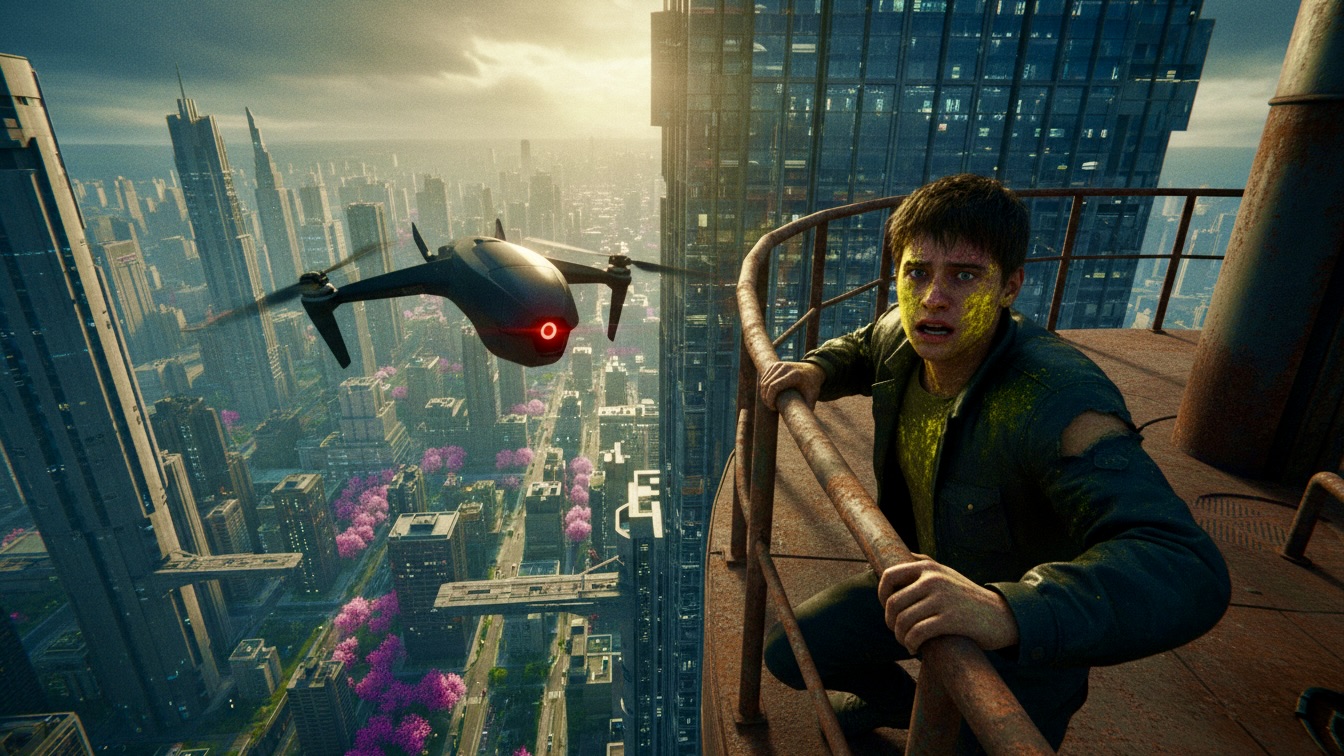
It was a bruised purple, heavy with rain, but the sun was still cutting through low on the horizon. The light was weird. Sickly yellow. The bio-domes had released their spring cycle all at once, and the wind had carried the spores up here. The deck—a narrow steel catwalk ringing the spire's communication array—was coated in it. Thick, yellow dust. It looked like sulfur.
"Sam. The door."
Sam sat up. Yung was standing by the heavy blast door that led back into the building's upper HVAC plant. He was hammering the keypad.
"It's dead," Sam said. He wiped yellow dust from his mouth. It tasted bitter.
"The EMP shouldn't have hit this high," Yung said. He looked frantic. He kept punching the code. 1-1-4-7. 1-1-4-7. "It's a localized circuit!"
"Vargas doesn't use cheap EMPs, Yung. They fried the whole grid. We're locked out."
"We can't be locked out. We're outside."
"I know."
"We are literally outside. Look at this!"
Yung gestured at the catwalk. It was a grid of steel mesh, maybe four feet wide. On one side, the dark, windowless hull of the spire. On the other, a waist-high railing and then nothing. Just the drop. Sector Four was a toy set down there. The cars were pixels. The people were invisible.
The wind gusted. Yung slipped. His sneaker lost traction on the pollen-slicked metal. He grabbed the rail, his knuckles turning white.
"Careful," Sam said. He got to his feet. The dead arm threw off his center of gravity. He had to lean left to stay upright. "Don't touch the rail. It's wet."
"It's not wet, it's sticky. This stuff is glue."
"It's bio-engineered pine pollen. It gets sticky when it activates. Just stay away from the edge."
Sam walked to the door. He tried the manual override lever. It wouldn't budge. The mag-locks had failed safe, which meant they had fused shut. They weren't getting back inside.
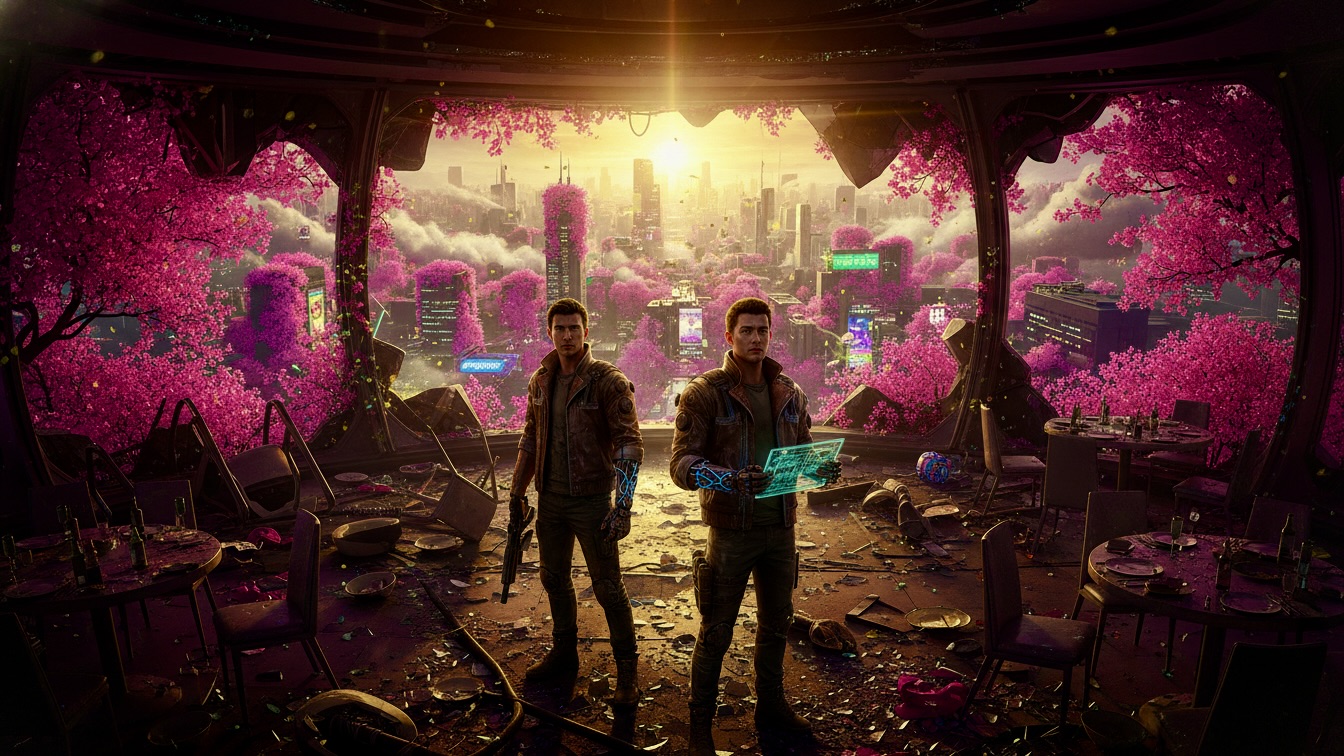
He looked around. The catwalk circled the building. Above them, the massive dishes of the comms array groaned in the wind. Below them, the glass roof of the restaurant where they'd just eaten was smoking.
"They know we're up here," Sam said.
"Maybe they think we're stuck in the elevator."
"They aren't stupid, Yung. They're corporate. They have heat sensors."
As if on cue, a sound cut through the wind. A high-pitched whine. Like a mosquito, but bigger. Much bigger.
Sam looked up.
Two drones dropped from the roof overhang. They were matte black, shaped like teardrops, with four rotored wings buzzing in a blur. Hunter-seekers. Standard Vargas issue. They didn't have guns—guns were heavy—but they had tasers and tranquilizer darts. And they were fast.
"Run," Sam said.
They ran.
It was a clumsy, terrifying sprint. The pollen made the steel mesh feel like ice. Sam's boots slid with every step. He kept his head down, shoulders hunched. His dead arm swung wildly, banging against his thigh, bruising the muscle.
Bzzzzzt.
A taser prong sparked against the railing right next to Sam's hip. The air smelled of burnt ozone again.
"They're shooting!" Yung screamed.
"Keep moving!"
"Where? Where are we going?"
"Around the bend! Break line of sight!"
They rounded the curve of the spire. The wind hit them harder here, unobstructed. It tore at Sam's jacket. He slipped, his left foot sliding out. He went down on one knee. The impact jarred his teeth.
He looked back. The drones were banking around the curve. The sensors on their front chins glowed angry red.
Yung grabbed Sam's jacket. "Get up!"
"I'm up, I'm up!"
They scrambled forward. The catwalk ended ahead. It didn't stop; it just merged into a service ladder that went up to the very top of the antenna array. A dead end. If they went up there, they were just targets against the sky.
Sam stopped. He grabbed the railing, ignoring the sticky pollen.
"What are you doing?" Yung yelled. The drones were closing the gap. Thirty meters. Twenty.
Sam looked down.
Below the catwalk, maybe fifteen feet down and twenty feet out, a monorail track cut through the air. It was the freight line. It bypassed the sector traffic, running straight from the manufacturing hub to the port.
The track hummed. A low, vibrating frequency that Sam could feel in his teeth.
"The train," Sam said.
Yung looked over the edge. He paled. "No."
"It's the only way off."
"It's too far!"
"It's not too far. It's just fast."
"Sam, I can't make that jump!"
"You have to."
A dart whizzed past Sam's ear and stuck into the shoulder of his jacket. He ripped it out. The tip was dripping with clear blue fluid. Neuro-paralytic. One scratch and he'd be drooling on the floor while the drones picked him apart.
"Listen to me," Sam grabbed Yung's shirt. He shook him. "The freight line runs every four minutes. I can feel the track vibrating. It's coming."
"We'll miss."
"We won't miss. We aim for the cargo containers. They're flat."
"And if we slip?"
"Then we don't have to worry about the debt anymore."
The hum of the track got louder. A deep, guttural roar. Around the curve of the adjacent building, the nose of the mag-train appeared. It was a heavy hauler, battered grey steel, moving fast. Too fast.
The drones hovered. They were taking aim. They were calculating the trajectory. They knew they had the targets pinned.
Sam looked at the drones. Then he looked at Yung.
"I can't jump with this arm," Sam said.
It was the truth. He hadn't thought about it until right now. The weight was too much. It would drag his right side down. He'd tumble in the air. He'd miss the roof.
Yung stared at him. The panic in his eyes shifted. It became something else. Focus.
"Cut it," Yung said.
"What?"
"Cut the arm. Drop the weight."
"I can't just cut it, Yung. It's bolted to my skeleton."
"The emergency release. The manual latch under the deltoid plate."
"That's for medical techs. It takes a wrench."
"I don't have a wrench," Yung said. He looked at the drones. They were ten meters away. Charging their capacitors for a volley.
Yung reached into his pocket. He pulled out a small, flat multitool. Cheap steel. He unfolded the pliers.
"Turn around," Yung said.
Sam turned. He gripped the railing. "Do it fast."
He felt Yung's hands on his shoulder. Cold, shaking fingers. Yung jammed the pliers under the plating of the prosthetic. He dug around. Sam grit his teeth. It felt like someone was digging a spoon into his collarbone.
"Found it," Yung muttered.
"Pull it!"
The drones fired.
Two darts hit Sam's back. They pinged off the metal plating of the arm. A third one grazed his neck, burning like a wasp sting.
Yung wrenched the pliers.
There was a loud clunk. The internal latches disengaged.
The weight vanished.
The arm fell. It hit the metal grating of the catwalk with a heavy, dead thud.
Sam felt instantly light. Too light. He staggered, his balance totally shot. He looked down at his shoulder. The socket was exposed, a mess of wires and ports, but the heavy limb was gone.
"Train!" Yung screamed.
The mag-train was roaring beneath them. The wind of its passing whipped Yung's hair into his eyes.
"Jump!" Sam yelled.
He didn't wait to see if Yung followed. He vaulted the rail.
For a second, there was nothing. No noise. No wind. Just the terrifying suspension of gravity. Sam saw the yellow pollen floating in the air next to him. He saw the grey blur of the train roof rushing up to meet him.
He hit hard.
He didn't land on his feet. He landed on his side. The impact knocked the wind out of him instantly. He rolled, sliding across the corrugated metal roof of the container. The surface was wet with rain and pollen.
He clawed at the metal. His fingernails tore. He was sliding toward the edge. The train was moving at eighty miles an hour. The wind was trying to peel him off like a sticker.
He jammed the boot of his right foot against a rivet. He stopped.
Gasping, chest heaving, he looked up.
Yung had landed ten feet away. He was flat on his stomach, arms spread wide, hugging the roof of the train like he was trying to merge with it.
Sam looked back at the spire. It was receding fast. The two black drones hovered near the catwalk, small dots against the bruised purple sky. They didn't follow. The train was moving out of their jurisdiction. Or maybe they just figured the fall had done the job.
Sam let his head drop onto the cold metal of the train roof. The rain started then. Big, heavy drops. They washed the yellow dust from his face.
He looked at his right shoulder. The empty socket was filling with water. It stung.
He looked at Yung. Yung was laughing. It was a hysterical, jagged sound, lost in the wind.
"We're alive!" Yung yelled, his voice cracking.
Sam didn't laugh. He watched the city blur past, a streak of neon and grey. He thought about his arm, lying back there on the catwalk. That arm had cost three years of savings.
"We're broke," Sam said to the wind. "We are so broke."
Yung crawled over. He looked terrible. His clothes were torn, his face smeared with blood and yellow sludge. He sat next to Sam, cross-legged on the speeding train roof, ignoring the danger.
"Hey," Yung said. He poked Sam in the good shoulder.
"Don't touch me."
"We got away."
"I lost my arm, Yung."
"I know. I'm sorry. I'll buy you a better one."
Sam looked at him. "With what money?"
"I don't know yet. But I will."
Yung looked forward, into the wind. He was shivering. The adrenaline was wearing off, and the cold was setting in. "Where does this train go?"
Sam closed his eyes. "Port Authority. Sector Eight."
"Sector Eight? That's the scrapyard."
"Yeah."
"Fitting."
The train banked, leaning hard into a turn. They both grabbed the ridges of the container roof to keep from sliding off. The city lights below were turning on, a grid of amber and white waking up for the night shift.
Sam watched the skyline recede. The spire was just a needle in the distance now. He felt lighter without the arm, but it was a phantom lightness. His brain still told him the hand was there, clenched in a fist.
"Sam?"
"What."
"Thanks."
Sam didn't answer. He just watched the rain wash the yellow pollen off his boots, swirling into little toxic rivers that ran off the edge of the train and into the dark.
“Sam didn't answer. He just watched the rain wash the yellow pollen off his boots, swirling into little toxic rivers that ran off the edge of the train and into the dark.”