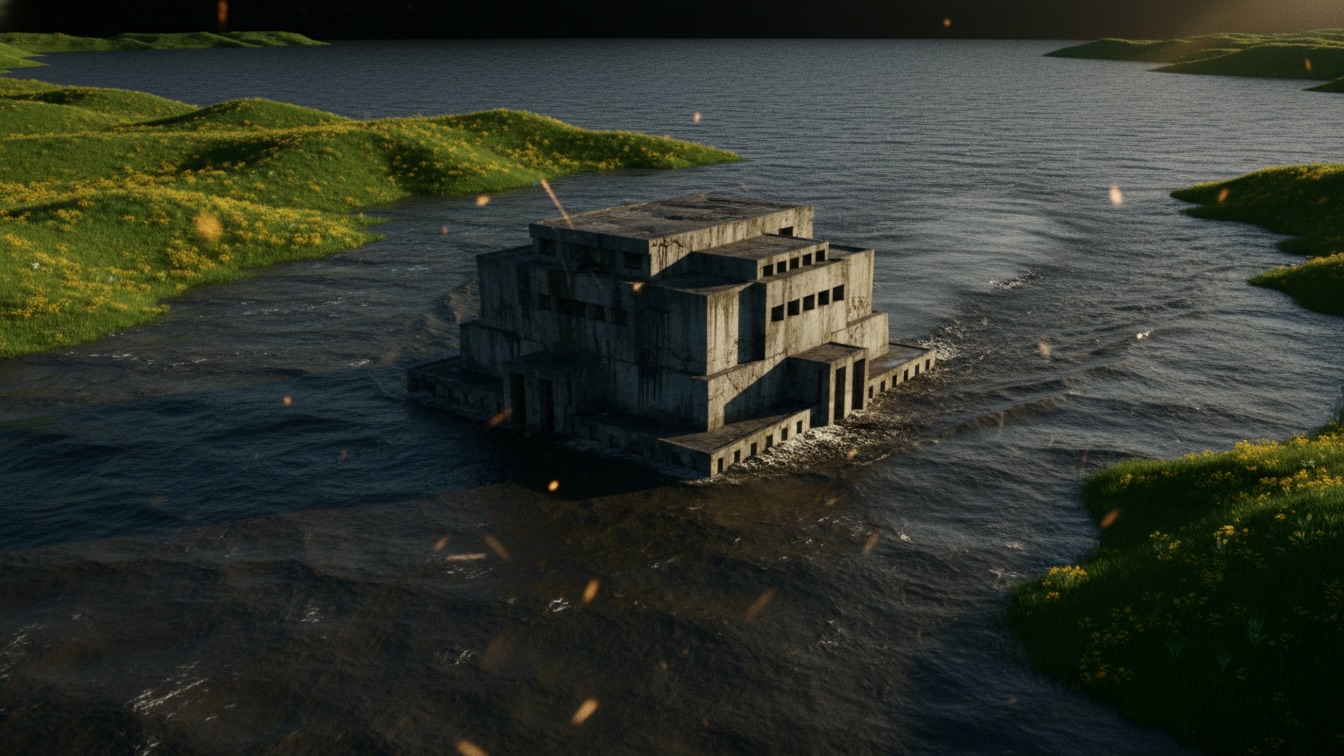
The narrative follows two researchers, Woodfeld and Aris, as they inspect a derelict monitoring depot located near a heavily polluted Great Lake. Inside the damp, concrete shell, they discover that the environment has begun to reclaim human artifacts in disturbing ways, most notably a birthday cake preserved under a hard shell of fish scales. They observe "zombie" fish that have integrated micro-plastic waste into their very biology, transforming themselves into glowing, translucent vessels of trash.
As Aris activates old recording equipment, he discovers that the fish are emitting a rhythmic "anthem" that serves as a sonar map of the sunken industrial waste on the lake floor. While Aris is mesmerized by the data, Woodfeld experiences a surreal encounter with a fence of yellow wildflowers that whispers a warning about the rising tide. The story reaches a climax when the entire depot, unmoored by the churning mud, begins to slide into the lake. The structure is no longer a stable building but a vessel being pulled back into the water by a sentient, hungry earth.
The primary theme of the text is the grotesque evolution of nature within the Anthropocene. The story suggests that nature is not merely dying due to human interference but is actively adapting by incorporating industrial waste into its biological fabric. The fish do not just consume the plastic; they wear it, turning the very thing that killed them into a new physiological feature. This "closed loop" evolution represents a terrifying shift where the environment no longer needs human observation or protection to survive.
Another significant theme is the "Uncanny," specifically the corruption of domestic and familiar symbols. The birthday cake, typically a sign of celebration and the passage of human time, is transformed into a "monstrosity" protected by a biological cocoon. By coating the cake in fish scales, the environment claims a human ritual and renders it alien. This creates a deep sense of psychological unease, as the boundaries between the human world and the wild world are blurred and eventually erased.
The narrative also explores the theme of environmental retaliation and the hubris of human architecture. The depot is described as a "tomb for data" and a "concrete shell," highlighting the futility of human efforts to contain or monitor the natural world. When the building begins to float and move toward the lake, it signifies that the earth is reclaiming its space. The "renovation" Woodfeld senses is a literal restructuring of the world where human foundations are proved to be temporary and unstable.
Woodfeld is a seventy-two-year-old scientist who embodies the physical and psychological exhaustion of a lifetime spent witnessing environmental decline. He is deeply attuned to his physical surroundings, feeling the dampness in his lungs and the age in his knees. His perspective is grounded in a sensory reality that makes the "sucking sound" of the mud feel like a haunting reminder of things that should stay buried. He represents the old guard of science, one that is beginning to realize that his traditional vocabulary is insufficient for the changing world.
Psychologically, Woodfeld is the more intuitive of the two men, as he is the only one who hears the warning from the sentient wildflowers. His fear is not just a reaction to the physical danger of the sinking building, but a deeper existential dread regarding the loss of human agency. He feels "small" and "old" because he recognizes that the world has moved beyond his understanding. His primary conflict is the struggle between his scientific training and the undeniable, supernatural evidence of a world that is turning against its inhabitants.
Aris is a younger man whose character is defined by a "permanent exhaustion" and a clinical detachment from the horrors he investigates. Unlike Woodfeld, he remains focused on his tablet and the recording equipment, seeking to quantify the anomalies rather than feel them. He represents a generation that has grown up in the shadow of ecological collapse, leading to a psychological numbing where wonder and terror are replaced by data collection. He is mesmerized by the "midnight anthem," seeing it as a map rather than a warning.
His obsession with the digital representation of the lake's floor suggests a disconnect from the physical reality of his immediate environment. While the floor beneath him groans and the building begins to tilt, his attention remains fixed on the shifting coordinates on his screen. Aris’s conflict is an internal one; he is so focused on the "how" of the environmental shift that he ignores the "why" and the immediate danger to his life. He is a tragic figure who seeks to map the destruction even as he is being swallowed by it.
The author employs a somber and clinical tone that heightens the sense of "eco-horror" permeating the story. By using precise, cold descriptions for grotesque imagery—such as the "liquid lanterns" of the plastic-filled fish—the narrative creates a chilling contrast between beauty and decay. The pacing starts with a slow, atmospheric build-up, focusing on small details like the texture of the cake and the smell of the air. This deliberate speed allows the sense of dread to thicken before the sudden, catastrophic movement of the depot at the end.
Sensory details are used effectively to ground the reader in a world that feels both wet and heavy. The "milky water" that vibrates and the "dry, glossy" scales of the cake provide a tactile quality to the setting that makes the environment feel like a character in itself. The auditory elements, from the "sucking sound" of boots to the "digital echo" of the fish, create a soundscape that mirrors the transition from the natural to the industrial. These details work together to emphasize the physical reality of the characters' predicament.
The narrative voice is third-person limited, focusing primarily on Woodfeld’s internal state, which allows for a more emotional and visceral experience of the setting. The personification of the "hungry" mud and the whispering fence adds a layer of magical realism that challenges the characters' scientific worldviews. This stylistic choice suggests that the environment has gained a voice and a will of its own. The final transition of the depot from a "building" to a "vessel" serves as a powerful metaphor for the loss of human stability in a world that is literally and figuratively shifting.


