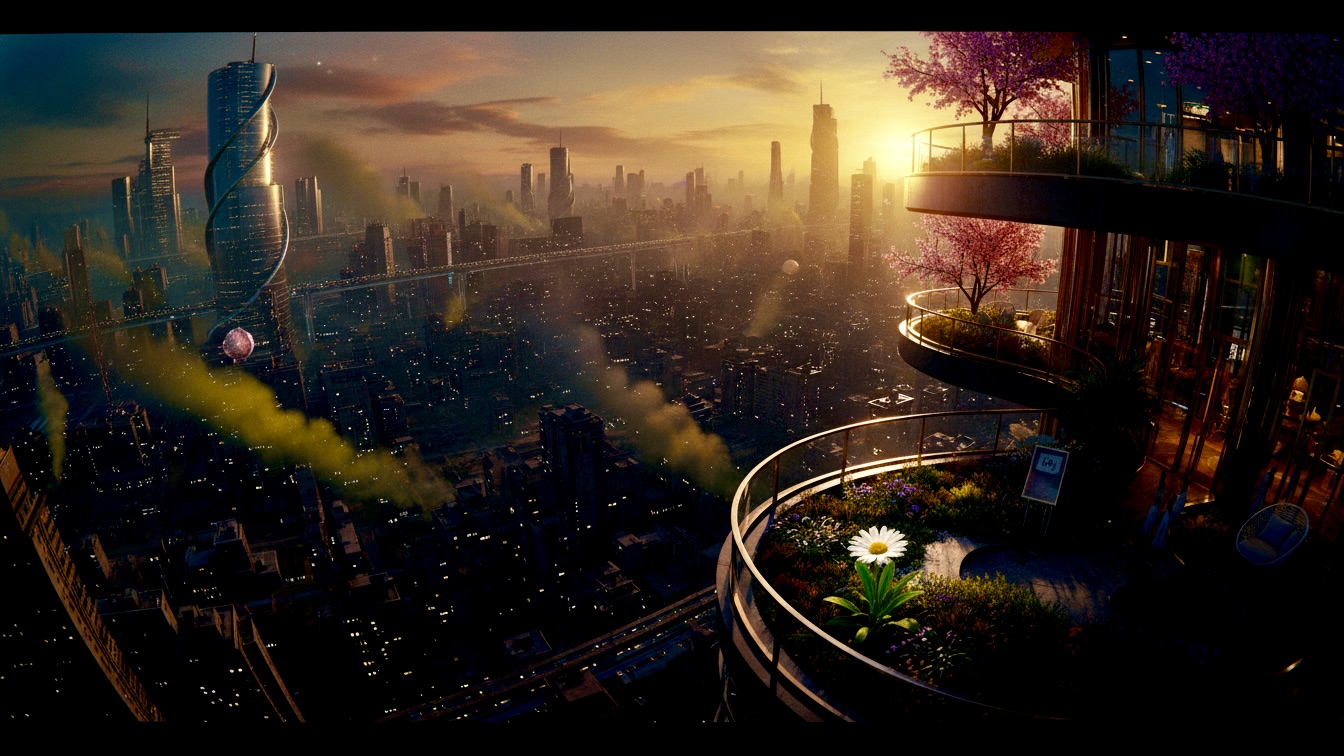
The narrative follows Olaf, a marginalized laborer working in the pristine, hyper-filtered environment of the High Zone. While cleaning the penthouse of CEO Sterling, he observes the slow decline of the last natural daisy in the district, a biological treasure that is suffocating under atmospheric settings optimized for human comfort rather than botanical survival. Sterling and his daughter, Mina, treat the flower as a disposable status symbol and a backdrop for social media, remaining entirely indifferent to its biological needs. Olaf’s empathy for the plant mirrors his concern for his daughter, Ida, who is dying of lung-rot in the polluted Slums below.
Driven by a desperate impulse to help both the flower and his daughter, Olaf attempts to take a bag of high-grade fertilizer from a supply closet. He is immediately detected by an unfeeling Security AI, which imposes a five-hundred-credit fine for a "Dignity Violation." This penalty proves fatal, as it depletes the Breath Credits Olaf needs to purchase oxygen for Ida. When Sterling eventually orders the wilting daisy to be thrown away in favor of a synthetic replacement, Olaf rescues the dead flower and brings it home. He arrives only to witness Ida’s final moments before she suffocates, eventually burying her in the industrial slush with the withered daisy as her only companion.
The primary theme of the story is the commodification of existence, where even the most basic requirements for life, such as oxygen and nature, have been transformed into tiered luxury goods. In this dystopian society, the "Breath Credit" system serves as a literal measurement of a person's right to exist, creating a world where poverty is synonymous with suffocation. The author explores how the decoupling of survival from human rights leads to a profound moral decay. The wealthy characters do not merely possess more money; they possess the very air that the poor are forced to trade their labor and health to obtain.
Another central theme is the tragic disconnect between artifice and reality. Sterling and Mina represent a class of people who have lost the ability to distinguish between a living entity and a manufactured asset. To them, the daisy is "mid" or "depressing" once it stops serving its aesthetic purpose, whereas to Olaf, its wilting is a visceral sign of suffering. This theme is punctuated by the replacement of the real flower with a silk one from Neo-Tokyo. The artificial flower is preferred because it offers the "effect" of life without the "headache" of maintenance, signaling a society that values the appearance of perfection over the messy, demanding reality of living things.
The narrative also examines the cruelty of systemic surveillance and the concept of "Dignity Violations." The Security AI functions as a tool of psychological and physical control, enforcing the class divide through automated "justice." By labeling the act of taking fertilizer as a violation of dignity, the system ironically strips Olaf of his actual dignity and his daughter’s life. This highlights how technology in this world is not used to improve the human condition but to maintain the "Comfort Mandate" of the elite at the cost of the lower class's survival.
Olaf serves as the emotional anchor of the story, acting as a "meat-based utility" who possesses a depth of empathy that his employers lack. He is a man defined by his sensory awareness; he can feel the "swallowing glass" of the lower-level air and the "sickly translucent gray" of the dying petals. His internal conflict arises from the tension between his instinct to survive and his desire to preserve something beautiful and living. He is physically depleted, characterized by shaking hands and a "knot of nothing" in his stomach, yet he remains the only character capable of recognizing the intrinsic value of the daisy.
His motivations are entirely centered on his daughter, Ida, and his actions are a desperate gamble against a rigged system. When he reaches for the fertilizer, he is not merely stealing; he is attempting to reclaim a fragment of the natural world to sustain his family. The guilt he carries is compounded by the mechanical coldness of the world around him. By the end of the narrative, his grief transforms into a quiet, burning hatred. He realizes that his oppressors are not just cruel, but fundamentally broken, unable to perceive the difference between the living and the dead.
Sterling represents the pinnacle of corporate detachment and the dehumanization inherent in extreme wealth. He views the world through the lens of "mineral yields" and "depreciated assets," treating even his own daughter with a measure of distance. His interaction with the daisy is entirely transactional; he bought it as a trophy but lacks the fundamental curiosity or care to keep it alive. To him, the flower is a "vibe" that has gone wrong, a piece of furniture that has failed to perform its duty.
He is a man who has optimized his environment to the point of sterility, removing the "smell of people" and the "smell of exhaust" until he lives in a blank slate. This environmental control is a metaphor for his emotional state. He is insulated from the consequences of his actions and the suffering of those beneath him. His decision to discard the daisy is not an act of malice, but an act of profound indifference. This indifference is ultimately more chilling than active cruelty, as it suggests that the lives of those like Olaf and Ida do not even register as significant enough to warrant a thought.
Mina acts as a bridge between the corporate greed of her father and the vapid performativity of a media-saturated culture. Her primary interaction with the world is through a "wrist-comm" and a hovering drone, suggesting that she perceives reality only as a series of curated images. She does not see the daisy as a living thing but as a prop that is failing to "pop" against the floor. Her complaint that the flower is "mid" reveals a linguistic and emotional poverty that stands in stark contrast to Olaf’s rich, sensory observations.
Her character highlights the generational aspect of this dystopia, where the youth have been raised in an environment of such extreme artifice that they find nature "dusty" or "off." She is a consumer of experiences who lacks the capacity for genuine connection. When she walks away from the flower, leaving a smudge of fake tan on the ceramic pot, she leaves a literal mark of her artificiality on a piece of the natural world. She is a victim of her own luxury, existing in a state of bored detachment that renders her incapable of feeling the weight of the tragedy unfolding around her.
Ida is the physical manifestation of the cost of the High Zone’s luxury. She is a tragic figure who represents the "lung-rot" and decay inherent in the Lower Levels. Despite her terminal illness, she maintains a connection to the idea of growth, tending to a pathetic patch of moss in a scrap-metal window-box. Her "garden" is a symbol of the resilience of the human spirit in the face of industrial ruin. She does not need the daisy to be perfect; she only needs it to be real.
Her death is the direct result of a system that prioritizes "Executive Comfort" over human life. She dies not because her body failed, but because a computer algorithm decided that her father’s attempt to help a plant was worth five hundred credits of her breath. Her final moments, spent touching a dead flower and calling it beautiful, emphasize her innocence and the profound loss of beauty in her world. She is the ultimate sacrifice to the "Comfort Mandate," a child who never had enough oxygen to truly live.
The narrative employs a stark, visceral prose style that emphasizes the sensory divide between the High Zone and the Slums. The author uses sharp, aggressive metaphors, such as the transition between zones feeling like "swallowing glass" and the sound of a cough being like "someone tearing a sheet of paper." These descriptions anchor the reader in Olaf's physical experience, making the atmospheric conditions a tangible character in the story. The contrast between the "sterile hum" of the penthouse and the "damp cardboard" smell of the slums creates a powerful sense of place and class disparity.
Pacing is handled with a deliberate, slow-build tension that mirrors the "slow death" of the daisy. The story begins with a quiet observation of the environment and gradually narrows its focus onto a single, high-stakes moment in the supply closet. The intervention of the Security AI shifts the tone from melancholic to claustrophobic, as the financial penalty introduces a ticking clock element to the plot. The final act, involving Olaf’s descent and Ida’s death, moves with a grim inevitability, stripping away any hope of a reprieve and forcing the reader to confront the finality of the system's cruelty.
The narrative voice is a first-person perspective that is weary, cynical, and deeply observant. Olaf’s internal monologue provides a necessary critique of the world he inhabits, offering a psychological depth that contrasts with the "flat" and "bored" dialogue of the elite characters. The use of technical jargon like "Breath Credits," "Dignity Violation," and "Environmental HUD" world-builds efficiently without the need for lengthy exposition. This stylistic choice reinforces the idea that in this future, life has been reduced to a series of data points and administrative hurdles, making Olaf’s final, wordless grief all the more poignant.


