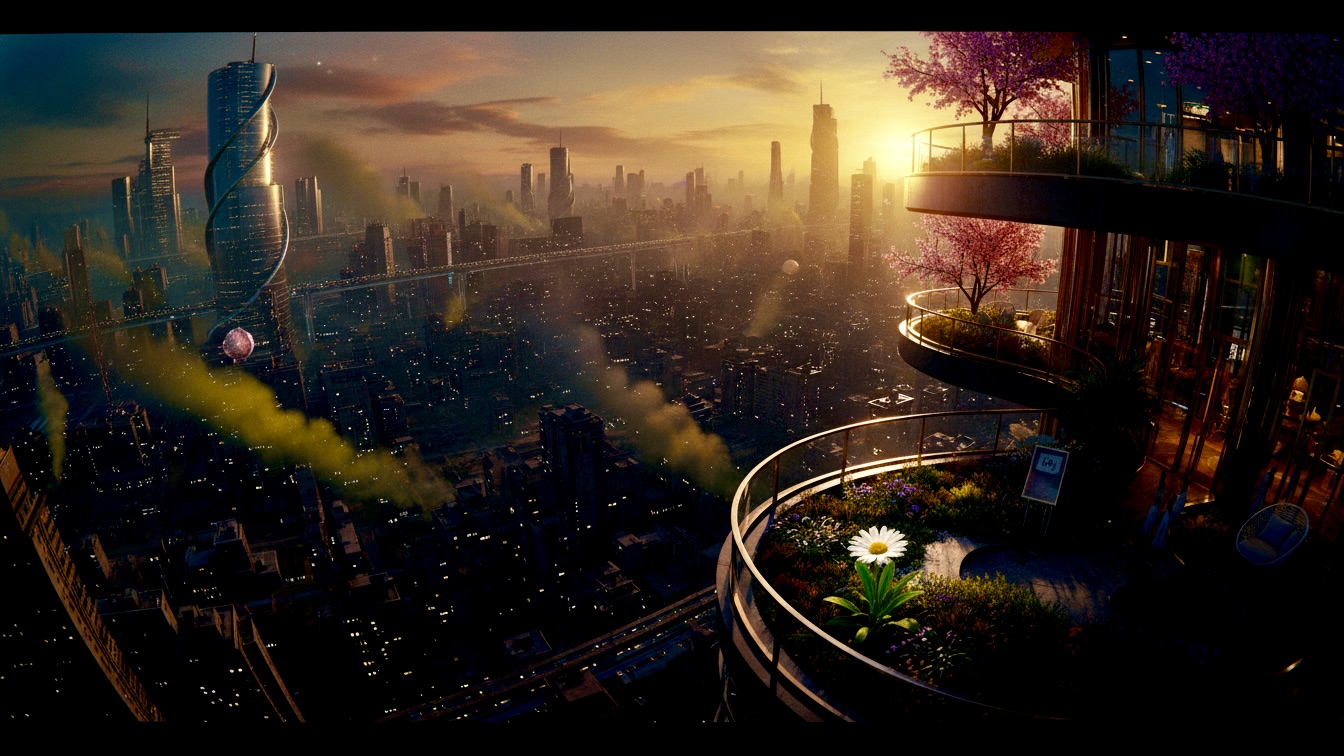
Format: Short Film / Anthology Episode | Est. Length: 10-12 minutes
Imagine a world where the very air you breathe is a tiered commodity, and "Oxygen and Dead Daisies" serves as a haunting entry in a Black Mirror-style anthology titled The Last Respiration. This series explores a hyper-stratified future where biological life is a luxury and the working class exists as "meat-based utilities" in the shadows of sterile, high-altitude penthouses. Each episode examines a different facet of this ecological and social collapse, focusing on the intersection of corporate greed and the desperate preservation of human dignity in a world where nature has been replaced by "Executive Comfort" presets.
A janitor in a sterile, high-altitude penthouse risks his life credits to save a dying daisy, only to realize the "clean" air of the elite is as toxic to life as the soot of the slums.
In a future where oxygen is a tiered subscription, a low-level worker risks his remaining life credits to steal a dying flower for his ailing daughter. He soon discovers that in a world of synthetic perfection, the cost of a single natural breath is higher than he can afford.
The story explores the commodification of nature and the dehumanization of the working class in a technocratic dystopia. It highlights the contrast between "Executive Comfort"—a sterile, artificial existence—and the "Lower Levels," where life is messy, painful, but ultimately more authentic. The daisy serves as a symbol for both the fragility of life and the hollow vanity of the elite who own it but cannot sustain it.
The second core theme is the tragic disconnect between perception and reality in a post-biological world. The elite cannot distinguish between a living entity and a high-end silk replica because they have lost their connection to the biological world. This disconnect mirrors their view of the working class, whom they see as "furniture that moves" rather than sentient beings with needs and families.
For Olaf, the stakes are literal survival; every "Dignity Violation" or credit fine shortens his lifespan and that of his daughter, Ida. For the daisy, it is the extinction of the natural world in favor of synthetic "vibes." Ultimately, the stakes are the preservation of human empathy in a system designed to calculate the value of a breath down to the last credit.
The primary external antagonist is the Security AI, a cold, algorithmic enforcer of the "Comfort Mandate" that punishes any deviation from corporate efficiency. This is bolstered by the indifference of CEO Sterling and his daughter Mina, who represent a class that views life as an "insured asset" rather than a living thing. Internally, Olaf struggles with the crushing weight of his own poverty and the agonizing choice between obeying the rules to stay alive or breaking them to provide a moment of beauty for his dying daughter.
Olaf, a "meat-based utility" in the High Zone, spends his shifts cleaning the penthouse of CEO Sterling, where the last natural daisy in the district is slowly suffocating in the sterile, low-humidity air. While Sterling and his social-media-obsessed daughter, Mina, treat the plant as a failing prop, Olaf recognizes its distress and attempts to adjust the environmental controls, only to be fined 500 "Breath Credits" by the omnipresent Security AI. This fine effectively sentences his daughter, Ida, who suffers from "lung-rot" in the soot-choked Lower Levels, to a premature death.
When Sterling orders the "depreciated" daisy to be incinerated in favor of a synthetic silk replacement, Olaf secretly rescues the dying flower and takes it down to the slums. He arrives home to find Ida on the brink of death, her oxygen tank empty because of his deducted credits. He gives her the dead daisy, a final gesture of beauty before she passes away, leading to a bitter realization: the masters of the High Zone have lost the ability to distinguish between life and the hollow imitation of it.
Olaf: A weary, malnourished laborer whose psychological arc moves from quiet, invisible compliance to a state of profound, silent rebellion. At the start, he is a "ghost" focused on survival, but by the end, his grief transforms into a cold, sharp hatred for a system that values silk over skin.
Ida: Olaf’s eighteen-year-old daughter, a tragic figure representing the collateral damage of the High Zone’s luxury. She transitions from a state of hopeful fragility—tending to her window-box moss—to a peaceful, if premature, death, finding beauty in a dead flower that her social superiors deemed "trash."
CEO Sterling: A man who has outsourced his humanity to algorithms and "Executive Comfort" presets. He begins and ends the story as a static figure of indifference, unable to perceive value in anything that isn't an insured asset or a visual "vibe."
Mina: Sterling’s daughter, a product of the digital age who views the world through a wrist-comm lens. She is the embodiment of the "synthetic" future, prioritizing "popping" colors and social media engagement over the actual survival of a biological entity.
The Sterile High: Olaf cleans the High Zone penthouse, establishing the sensory void of filtered air and the invisible status of the workers. We see the daisy under its spotlight, its graying petals contrasting with the clinical perfection of the room. The tension is established through the hum of the HVAC and the looming presence of the Security AI.
The Violation: Mina enters for a photoshoot, highlighting her detachment from the dying plant, followed by Olaf’s desperate attempt to save the daisy by overriding the CO2 levels. The Security AI intervenes, issuing a 500-credit fine that visually drains Olaf’s life-meter on his HUD. This midpoint shift raises the stakes from a botanical rescue to a life-or-death financial crisis.
The Disposal and Rescue: Sterling dismisses the daisy as "shit" and orders its destruction, choosing a silk replacement with "scent-injectors." Olaf ignores the incinerator and hides the flower in his bag, a small act of defiance that goes unnoticed by the AI because the object no longer has value. He descends through the transit tubes, the air visibly thickening and darkening as he nears the Slums.
The Final Breath: Olaf returns to his cramped unit to find Ida struggling for air, her moss garden brown and withered. He presents the dead daisy, and Ida’s wonder at the "real" object provides a brief, heartbreaking moment of connection before she dies from lack of oxygen. The episode ends with Olaf burying her in the gray slush of a scrap-heap, staring up at the glowing High Zone with a newfound, icy clarity.
The episode begins with a sense of sterile, cold detachment, evoking a feeling of clinical isolation. As Olaf moves toward the Lower Levels, the mood shifts to a heavy, suffocating claustrophobia, mirroring the "swallowing glass" sensation of the soot-filled air. The climax is a devastating blend of tenderness and rage, leaving the audience with a lingering sense of injustice and the bitter irony of a world that replaces life with perfect, unfeeling replicas.
If expanded, the season would follow Olaf’s slow radicalization as he begins to sabotage the High Zone’s atmospheric systems from within. He would join an underground network of "Air-Pirates" who steal oxygen canisters from the elite to distribute to the lung-rot wards of the Slums, turning his grief into a weapon against the corporate structure.
The overarching narrative would escalate toward a "Great De-Oxygenation," where the working class threatens to shut down the carbon-scrubbers of the High Zone. This arc would explore the moral complexities of environmental terrorism versus survival, culminating in a confrontation where the elite must choose between their synthetic luxuries and the very biological life they have spent centuries trying to sanitize.
The visual style relies on a sharp color dichotomy: the High Zone is rendered in overexposed whites, clinical blues, and high-contrast lighting that feels "too clean" to be real. In contrast, the Lower Levels are shot with a shallow depth of field, using a palette of muddy grays, rusted oranges, and thick, hazy atmosphere that emphasizes the physical weight of the air.
The tone is a "Quiet Dystopia," drawing influence from the grounded sci-fi of Children of Men and the sterile corporate horror of Severance. The camera should remain voyeuristic and static in the High Zone to mimic the Security AI, becoming handheld and intimate once Olaf reaches his home in the Slums.
The intended audience includes fans of high-concept social science fiction and anthology series like Black Mirror or Electric Dreams. It appeals to adult viewers (18-45) who enjoy atmospheric, "slow-burn" narratives that provide a biting critique of modern environmental and economic disparities.
The 10-12 minute runtime demands a lean, three-act structure with minimal dialogue. The first four minutes establish the High Zone’s rules and the daisy’s plight; the middle four minutes cover the confrontation with the AI and the rescue of the flower; the final minutes focus on the descent and the emotional fallout in the Slums. Pacing should feel rhythmic and mechanical in the first act, becoming increasingly frantic and breathless as Olaf returns home.
The "Security AI" voice should be processed to sound unsettlingly calm, using directional audio to make it feel as though it is whispering directly into the viewer's ear. Practical effects are preferred for the "lung-rot" makeup and the physical decay of the daisy to ensure the biological elements feel visceral and "real" against the CGI-heavy backdrop of the High Zone.
The contrast between the "High Zone" and "Lower Levels" can be achieved through distinct lens choices—anamorphic for the wide, empty spaces of the penthouse and spherical, macro lenses for the cramped, detailed textures of the slums. The environmental HUD on Olaf’s belt should be a subtle, integrated VFX element that serves as a ticking clock for the audience, visually depleting as he loses credits.


