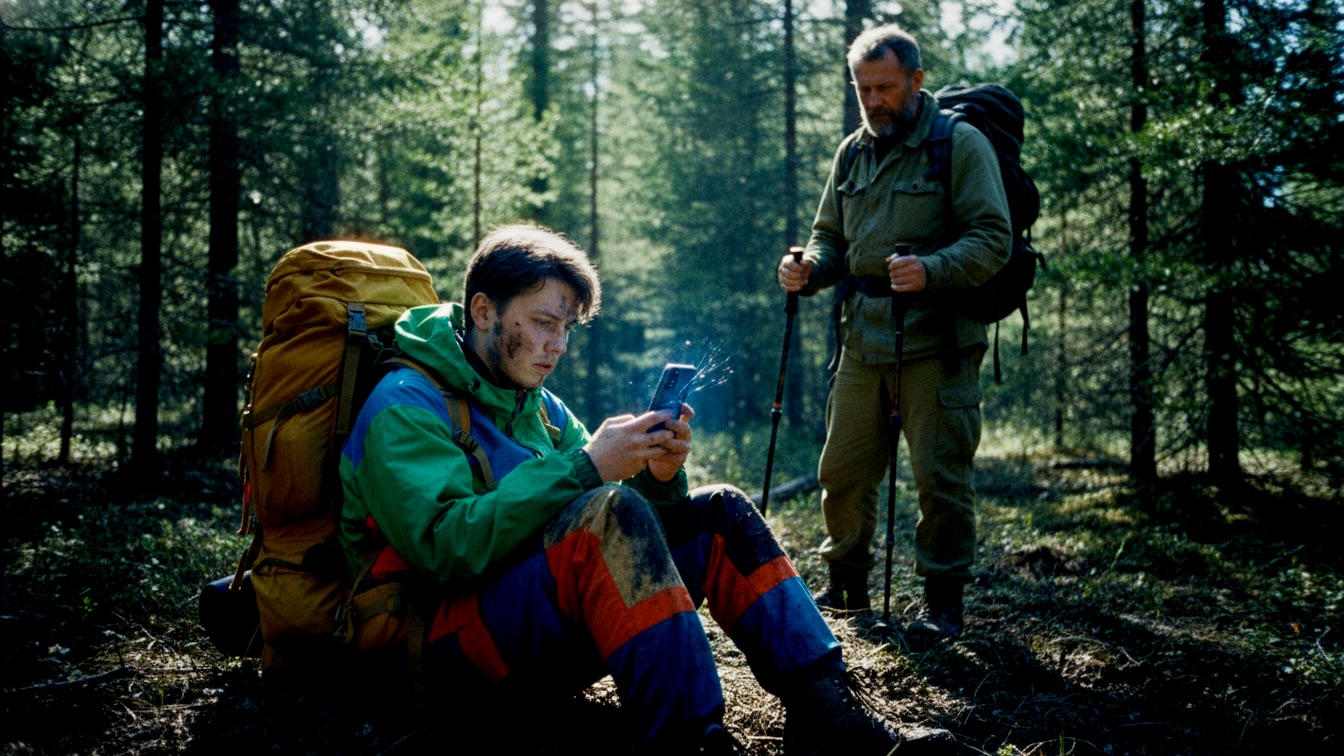
The chapter begins with a jarring arrival as Sam and her ex-partner, Jordan, are dropped by helicopter into the unforgiving Boreal forest of northern Canada. They are leading a group of six teenagers on a wilderness therapy retreat designed as a digital detox, but the primary conflict centers on Sam’s own debilitating addiction to her smartphone. While Jordan moves with practiced ease and stoicism, Sam immediately spirals into a physical and psychological withdrawal, desperate for a signal to check her social media and validate her existence through a distant romantic interest named Matt.
As the group treks through the freezing mud and dense brush, the tension between Sam and Jordan boils over, revealing the "anxious-avoidant" trap that destroyed their past relationship. Sam accuses Jordan of using the wilderness to hide from real human friction, while Jordan counters that Sam has lost her grip on reality entirely. The situation turns dire when a sleet storm hits, prompting Sam to make a reckless, life-threatening climb up a shale cliff in a futile search for a cell signal. She falls and sustains a serious leg injury, forcing Jordan to provide emergency medical care inside a small yellow nylon tent.
Inside the tent, the two characters share a moment of raw, unmediated honesty and physical connection that seems to bridge the chasm between them. For a few hours, the "static" in Sam's brain is replaced by the reality of her own pain and Jordan’s presence. However, this progress is tragically undercut during their emergency evacuation. As the helicopter gains altitude and a cell signal returns, Sam instantly abandons the hard-won human connection for the glow of her screen, illustrating the terrifying power of her digital dependency.
The central theme of the story is the profound erosion of human presence caused by digital addiction. Sam is not merely a social media user; she is a victim of a physiological "dopamine loop" that has rewired her brain to prioritize virtual validation over physical safety or interpersonal intimacy. The narrative explores how the digital world acts as a phantom limb, where the absence of a signal feels like a literal suffocation or a loss of self. This theme is underscored by the irony that Sam, a trained psychologist, is fully aware of the mechanics of her addiction but remains powerless to stop it.
Another significant theme is the contrast between different forms of emotional avoidance. While Sam uses the digital world to escape the vacuum of her own insecurity, Jordan uses the vast, disconnected wilderness to escape the demands of emotional intimacy. The story suggests that both are "off the grid" in their own way—Sam is absent from her physical surroundings, and Jordan is absent from the emotional needs of those around him. Their conflict highlights the difficulty of finding a middle ground between total digital immersion and aggressive isolation.
The story also examines the concept of "reality" in the modern age. To Sam, reality is curated, quantified by "likes," and maintained through a constant stream of data. The Boreal forest, with its freezing mud and violent storms, represents a "physical reality" that is hostile and demanding. The climax in the yellow nylon tent suggests that only extreme physical pain or vulnerability can truly break the digital spell, yet the ending provides a cynical view of recovery. The theme concludes on a dark note, suggesting that even a brush with death cannot compete with the engineered allure of the algorithm.
Sam is a deeply conflicted protagonist whose professional expertise in psychology serves as a bitter irony to her personal failings. She is the embodiment of "anxious attachment," a condition she attempts to soothe through the constant, thin tether of her smartphone. Her identity is entirely externalized; without the "mirror" of her phone to reflect her worth back to her, she experiences a total collapse of the self. This is evidenced by her physical symptoms, such as the "phantom vibration syndrome" and the "vibrating" anxiety that Jordan observes.
Her motivation throughout the chapter is not to lead the teenagers or even to survive the elements, but to find a "hit" of dopamine. This drive is so primal that it overrides her survival instincts, leading her to climb a slick rock face during a sleet storm. She is a character in the throes of a true "behavioral sink," where the need for a digital connection has become more vital than oxygen. Her fall is a physical manifestation of her internal state—a desperate reach for something that isn't there, resulting in a violent return to the earth.
Despite her moment of clarity in the tent, Sam’s character arc is a tragedy of regression. She is capable of deep empathy, as seen in her interaction with Benji, yet she cannot apply that same grace to herself. The ending reveals that her "awakening" was temporary. The moment the "ping" of a notification returns, she abandons her growth and her connection to Jordan. She chooses the "blindingly bright" pixels over the human being sitting next to her, proving that her addiction is a cycle she is not yet ready to break.
Jordan serves as the "avoidant" foil to Sam’s anxious desperation. He is characterized by a "frustratingly calm" demeanor and a mastery over the physical world that borders on the robotic. He finds comfort in the lack of signal because it removes the "friction" of having to perform emotionally for others. For Jordan, the wilderness is a sanctuary where he can exist without being "perceived" or held accountable to the digital tethers that Sam finds so essential.
His motivations are rooted in a desire for autonomy and a rejection of the "validation culture" Sam represents. However, his avoidance is its own form of dysfunction. As Sam points out, his "mountain-guru routine" is a shield he uses to deflect the messy, demanding parts of human relationships. He is competent in a crisis—expertly pitching tents and treating wounds—but he struggles with the quiet, sustained intimacy of a partnership. His silence is "deafening," a passive-aggressive tool used to maintain distance.
In the tent, Jordan shows a rare moment of vulnerability and tenderness. By placing his hand on Sam’s cheek and holding her, he steps out of his avoidant shell to provide the "grounding" she desperately needs. He is a character who clearly still cares for Sam, but he is exhausted by the "weight of her insecurity." The tragedy of the ending hits Jordan just as hard as it does the reader; he watches the woman he just saved vanish into her phone, confirming his fear that he can never compete with the screen.
The pacing of the story is masterfully handled, mimicking the frantic, jagged energy of withdrawal. The opening is loud and chaotic, characterized by "mechanical screams" and "violent downdrafts," which mirrors Sam’s internal panic. As the group moves into the forest, the pacing slows into a grueling, rhythmic slog, emphasizing the oppressive nature of the environment. The climax on the cliff and the subsequent scene in the tent provide a sharp contrast—the former is a blur of motion and terror, while the latter is a claustrophobic, intimate stillness.
The narrative voice is a close first-person perspective that allows the reader to feel the visceral nature of Sam’s addiction. The author uses sensory details to ground the reader in the "viscous soup" of the mud and the "white-hot" pain of the iodine. These tactile descriptions—the smell of wet earth, the sting of sleet, the metallic tang of blood—are used to pull the protagonist (and the reader) out of the digital ether and into the physical world. This makes the final return to the "blindingly bright" screen feel even more jarring and unnatural.
The tone of the story is one of escalating dread and cynical irony. The "yellow nylon tent" serves as a powerful symbol of a fragile, temporary refuge from both the external storm and the internal addiction. The use of the "ping" at the end of the story is a brilliant auditory device that shatters the emotional resonance of the preceding scenes. It serves as a stylistic punctuation mark that resets the narrative to its starting point, leaving the reader with a sense of profound unease about the inescapable nature of the digital world.


