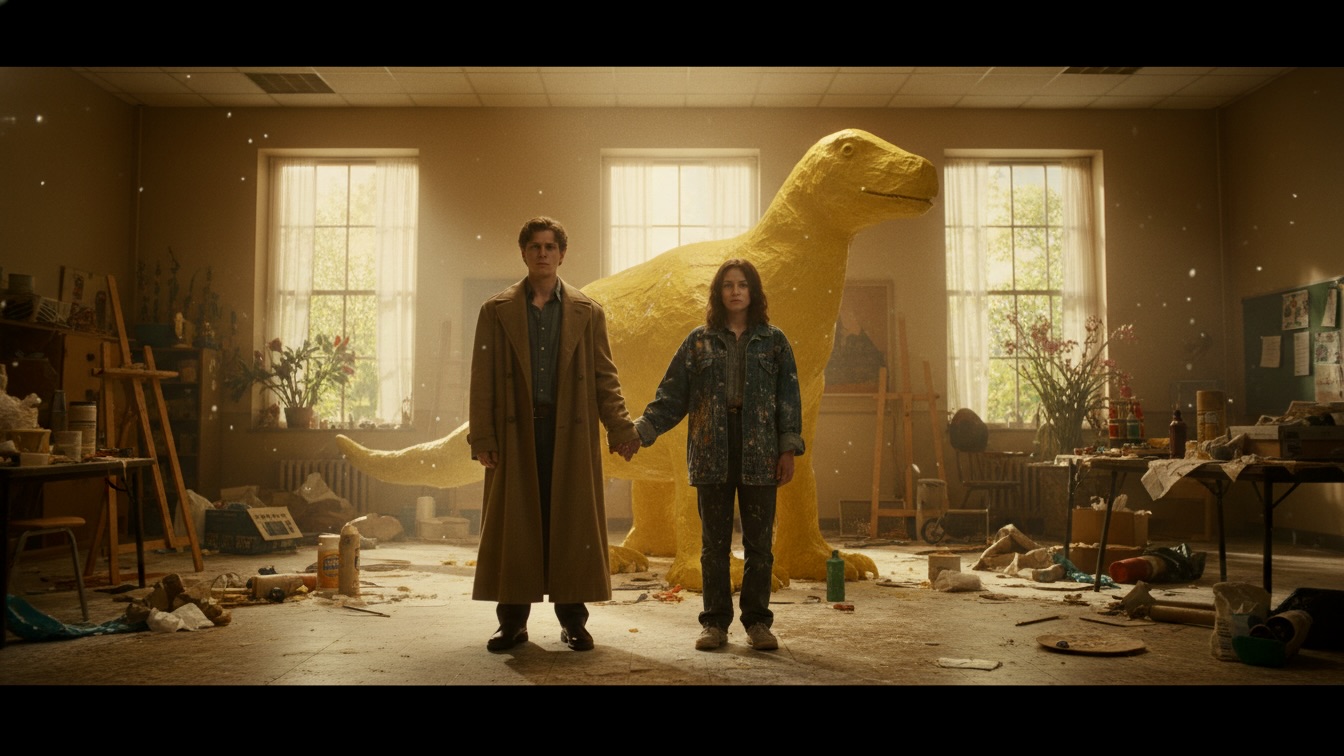
Felix stared at the rejection letter. The community arts grant required a love story. They had thirty-four cents.
The red envelope sat on the plastic folding table like a threat. It had no stamp. The community center doors had been locked since noon, yet there it was. Jamie stared at the heavy paper. It smelled strongly of cheap copier toner and faint, expensive cologne. The room was hot. It was April, but the building’s radiators were still running on a winter schedule, pumping dry, metallic heat into the stagnant air. Jamie could feel a line of sweat tracing down her spine. She hated sweating. It felt like a failure of bodily logistics.
Felix tapped the corner of the envelope with a metal ruler. He was wearing an oversized wool trench coat. It was seventy degrees outside. He looked like a Victorian ghost who had recently discovered thrift stores and despair.
"Is it biological warfare or bureaucratic indifference?" Felix asked. His voice was loud, projecting to the back of the empty room out of habit. He always spoke as if a critic was taking notes in the shadows.
"I am leaning toward indifference," Jamie said. "But do not touch it with your bare hands. Just in case."
She tore the flap open with the edge of her house key. Her thumbnail snagged on the thick paper. Inside was a single sheet of heavy stock. The city seal sat at the top, an embossed eagle that looked deeply exhausted. It was a rejection letter for their spring exhibition grant. But stuck to the back, attached by a single, rusted paperclip, was a yellow sticky note. It was handwritten in aggressive cursive.
Jamie read it aloud. "Reject Harrison proposal. Councilor Reyes requires high-engagement community romantic narratives for Q2 funding. Will only approve projects featuring relatable interpersonal relationships."
Felix dropped the ruler. It clattered against the plastic table. The noise echoed off the cinderblock walls. He looked at the sticky note. He looked at Jamie. His jaw tightened.
"This is a violation of artistic integrity," Felix said. He crossed his arms. The wool coat rustled heavily. "The institution of municipal funding is a graveyard of creativity. They do not want art. They want a pacifier for the masses. They want cheap sentimentality."
"They want to know you are not going to spend five thousand dollars on a welded metallic cube again," Jamie said. She pulled out her phone. The screen was cracked in the top left corner. She checked the banking app. "We have exactly thirty-four cents in the shared account, Felix. You owe four thousand, nine hundred dollars to the steel supplier. The supplier who leaves voicemails at two in the morning. The supplier who sounds like he breaks legs for a hobby."
"My vision for the cube was misunderstood. It was a commentary on urban isolation."
"It collapsed in the town square and crushed a municipal trash can. We are bankrupt. If we do not secure this grant, you are moving back to your mother's basement in the suburbs. And I will have wasted three months doing your logistics for free."
Felix stared at the ceiling. The fluorescent lights buzzed. They sounded like angry bees trapped in glass. He closed his eyes. "I will wither in the suburbs, Jamie. They have lawns. They have homeowner associations. My aesthetic purity will not survive the manicured hedges."
"Then we are going to lie," Jamie said. She put her phone in her pocket. The metal was warm against her leg. "We are going to give Councilor Reyes a narrative. We are going to give him a romance."
Felix opened his eyes. He looked down at her. "A fake relationship? Us? For government capital?"
"Yes. I will be your tragic muse. We will tell him we fell in love building community infrastructure. We will look deeply into each other's eyes. We will secure the five thousand dollars. And I am taking thirty percent for my acting services."
Felix considered this. He adjusted the collar of his ridiculous coat. "Fine. But we must rehearse. My artistic reputation is at stake. If I am to perform as a man in love, it must be a masterpiece of deception."
Fifteen minutes later, they were sitting in a grimy diner three blocks from the municipal building. The vinyl booth was sticky. Jamie wiped the table with a dry napkin. It did nothing. The air smelled like burnt coffee and old frying oil.
"We need a meet-cute," Felix said. He was drinking tap water from a chipped ceramic mug. He held it with both hands. "Something fundamentally rooted in the tragedy of the modern city."
"No tragedy," Jamie said. She was eating french fries. They were cold, but she was hungry. Her stomach had been growling since breakfast. "Reyes wants heartwarming. He wants relatable. He does not want a commentary on the collapse of capitalism. He wants to win his re-election campaign."
"Fine. We met at the hardware store. We were both reaching for the same can of industrial sealant."
"That is weird. We met at the community center. I was organizing the food drive. You were painting a mural. You dropped your brush. I handed it to you. Our hands brushed. Sparks flew. Simple. Efficient."
Felix sighed. He looked out the window. The street was busy. Cars moved in slow, angry bursts. Pedestrians kept their heads down, staring at glowing screens. Spring was happening aggressively outside. The trees were violently green. The pollen count was visibly high. A yellow film coated the roofs of the parked cars.
"It lacks thematic depth," Felix complained. "But it possesses a certain brutal efficiency. I will allow it."
They walked to the council building in silence. The pavement radiated heat. Jamie felt the sweat gathering at her collar again. She watched Felix out of the corner of her eye. He walked with a deliberate, heavy stride. He was terrified. She knew him well enough to see the tension in his shoulders. Underneath the pretentious vocabulary and the thrift-store wardrobe, he was just a twenty-two-year-old kid in massive debt.
The waiting room of the municipal arts council was an exercise in civic depression. The walls were painted a color that was neither gray nor beige, but a sad compromise between the two. The chairs were rigid plastic. The receptionist was typing loudly. Her fake nails clicked against the keyboard like tiny hammers. She did not look up when they entered.
They sat. The plastic chair dug into Jamie's lower back. She bounced her leg. The cognitive static in her brain was loud today. She mentally calculated the cost of cheap art supplies. Flour. Water. Newspaper. Chicken wire. If they scammed the five thousand, paid off the steel supplier, and took her cut, they would have exactly one hundred dollars left to actually build the community project they were pitching. It was a disaster waiting to happen. She rubbed her temples. A headache was blooming right behind her left eye.
"Mr. Harrison and Ms. Lin," the receptionist finally said. "Councilor Reyes will see you."
Councilor Reyes’s office was too warm. He sat behind a large desk made of imitation wood. He folded his hands. His knuckles were surprisingly hairy. He had the wet, desperate eyes of a man who needed a viral marketing campaign to save his career. He looked at them with a mixture of boredom and hope.
"The committee is bored of murals, Mr. Harrison," Reyes said. He leaned back. The leather chair squeaked loudly. "We desire human infrastructure. We require love. The city needs a romance to distract from the pothole crisis on the east side. Your previous proposal was... metallic. Cold."
Felix stood taller. He placed a hand over his heart. It was incredibly theatrical. Jamie wanted to kick him under the desk, but she held still.
"My previous artistic vision was a reflection of my internal state, Councilor," Felix said. His voice was deep, resonant. He was acting. He was actually quite good at it. "I was isolated. But then, the spring came. And with it, a profound shift in my civic reality."
He turned to Jamie. He reached out and took her hand. His fingers were cold. They were slightly damp with sweat. Jamie’s stomach executed a sharp, uncomfortable flip. She had not expected the physical contact. She squeezed his hand back, hard, digging her nails slightly into his palm to ground herself.
"We are in love, Councilor," Jamie said. She kept her voice steady. She looked Reyes directly in the eyes. "Madly. It is a severe distraction to our productivity. We met at the community center. He dropped a brush. I handed it to him. The city ceased to be a grid of concrete. It became a garden."
She stole the garden line from a movie she half-watched on an airplane three years ago. It tasted like ash in her mouth.
Reyes stared at them. The silence stretched. The fluorescent light hummed. Then, Reyes slowly pulled a handkerchief from his pocket and dabbed the corner of his eye.
"This is the civic engagement we need," Reyes whispered. "The youth, finding connection in the municipal spaces. It is beautiful. I will approve the grant. Five thousand dollars. But the project must reflect this union. It must be a collaborative community endeavor."
"It will be a monument to our shared affection," Felix declared.
They left the building twenty minutes later with a signed authorization form. They walked three blocks before either of them spoke.
"You squeezed my hand too hard," Felix said. He was rubbing his palm.
"You did not warn me you were going to initiate physical contact," Jamie replied. Her heart was still beating a little too fast. The residual adrenaline of lying to a government official. That was all it was. "We have the money. Now we have to buy supplies. We have a budget of one hundred dollars to build a monument to our shared affection."
"What can we possibly build for one hundred dollars?"
"Papier-mache," Jamie said. "We are going to make a giant papier-mache sculpture with the neighborhood children. It fits the collaborative requirement. And flour is cheap."
The hardware store was vast and smelled strongly of chemical fertilizer. The fluorescent lights flickered, casting a sickly pallor over the aisles. They bought three large bags of unbleached flour, a massive roll of chicken wire, and a pair of heavy work gloves. The total came to forty-two dollars.
Carrying the chicken wire onto the city bus was a logistical nightmare. The roll was four feet tall and fiercely uncooperative. The metal edges caught on the rubber doors. It scratched against the plastic seats. The other passengers stared at them with naked hostility.
Jamie stood in the aisle, gripping the metal pole. The bus lurched forward. She stumbled, crashing into Felix. The wool of his coat scratched her cheek. He caught her arm to steady her.
"Apologies," Jamie muttered, pulling away quickly. The bus smelled like damp wool and exhaust.
"The public transit system is a theater of physical compromise," Felix said loudly. An old woman in the front row glared at him.
Saturday morning arrived with brutal humidity. The community center room was cleared of its plastic tables. In the center of the linoleum floor stood the chicken wire armature. Felix had spent three hours bending the sharp metal into a massive, abstract shape. It looked like a deformed egg.
"What is it?" Jamie asked. She was wearing a paint-stained denim jacket. She had tied her hair back. She was currently mixing a massive plastic bucket of flour and tap water. The paste was thick, sticky, and smelled faintly sour.
"It is a conceptual representation of a heart, expanding under the pressure of societal expectation," Felix explained. He was cutting up stacks of stolen newspapers with a pair of dull scissors.
"It looks like a potato," Jamie said.
Before Felix could defend the potato, the front doors banged open. The neighborhood kids arrived. There were twelve of them. They ranged in age from six to ten. They were loud, chaotic, and entirely unsupervised.
Kevin, an eight-year-old with a missing front tooth and a profound surplus of energy, immediately ran to the bucket of paste and plunged his bare arms into it up to the elbows.
"Excellent enthusiasm, Kevin!" Felix shouted over the noise. "Now, take the paper, submerge it in the binding agent, and apply it to the armature! You are building the skin of the city!"
It was a disaster immediately. The kids did not care about the skin of the city. They cared about the tactile thrill of making a massive mess. Wet newspaper flew through the air. Flour paste dripped onto the linoleum, creating a hazardous, slippery film.
A small girl named Sarah sat in the corner, quietly attempting to eat a handful of the raw paste.
Jamie lunged across the room. Her boots slipped on the wet floor. She caught herself on the wall. "Do not eat the adhesive, Sarah! It is a choking hazard and it lacks nutritional value!"
"It tastes like bread," Sarah said, her mouth completely coated in gray sludge.
"It is raw flour and municipal tap water. Spit it out immediately."
Jamie held out a paper towel. Sarah spat. Jamie wiped the girl's face. Her own hands were coated in the drying paste. It felt tight on her skin, pulling at the tiny hairs on her knuckles. It was itching. She ignored it.
Across the room, Kevin was throwing clumps of wet Sunday comics at the walls.
"Kevin, you must respect the medium!" Felix yelled. He was holding a dripping strip of the sports section. "The paper remembers being a tree! It wants to be strong again!"
"I want to make a dinosaur!" Kevin screamed. He threw a wet clump of paper directly at Felix. It hit him square in the chest, sticking to the lapel of his trench coat.
Felix looked down at the gray mass on his vintage wool. He looked up. His eyes were wide.
"Retreat," Felix said.
He grabbed Jamie’s sleeve and pulled her toward the back of the room. They ducked into the janitorial supply closet and slammed the heavy wooden door shut.
The closet was a vertical coffin. It was pitch black until Jamie fumbled for the string attached to the bare overhead bulb. She pulled it. A harsh, yellow light snapped on.
The space was impossibly small. It smelled intensely of industrial lemon bleach and wet, dirty cotton. A massive yellow mop bucket took up a third of the floor space. Jamie was pressed flat against the metal shelving unit. The metal was cold. It bit through her denim jacket.
Felix stood directly in front of her. The closet was too small for his coat. The heavy wool fabric brushed against her knees. He was breathing through his mouth. His chest rose and fell rapidly. His nose was smeared with dry flour.
"He is a domestic terrorist," Felix whispered.
"He is eight years old," Jamie whispered back. "And you are wearing a trench coat to a papier-mache workshop. You brought this upon yourself."
"It was the sports section. It was incredibly heavy."
He shifted his weight. His sneaker bumped against her boot. The tiny space seemed to shrink further. The air was thick, heavy with the smell of the bleach and the sour flour paste drying on their clothes.
Jamie looked up at him. The overhead light cast deep, harsh shadows under his eyes. The theatricality was gone from his face. The pretension had entirely evaporated. He just looked like a tired boy.
Her heart kicked the inside of her ribs. Once. Twice. Hard, heavy thuds. She felt the blood move hot into her neck. She swallowed. Her throat was completely dry. The cognitive static in her brain abruptly cut out. There was no noise. Just the sound of his breathing, and the distant, muffled screams of the children destroying the community center room.
Felix was looking at her. His eyes dropped to her mouth, then back up to her eyes. He swallowed, too. His Adam’s apple bobbed.
"Jamie," he said. His voice was completely normal. No projection. No audience.
"What?" she asked. Her voice cracked slightly. She hated that it cracked.
He leaned in. He did not ask permission, but he moved slowly enough that she could have pushed him away. She did not push him away. She closed her eyes.
The kiss was awkward. It was fundamentally messy. Their noses bumped. The angle was wrong. He adjusted. He brought his hand up, cupping the side of her face. His palm was rough with dried glue. The pressure of his fingers against her jaw was firm. The awkwardness dissolved. It became extremely, overwhelmingly real. Her hands moved on their own, grabbing the lapels of his stupid, ruined coat, pulling him closer.
It felt like stepping off a curb and realizing the drop was much deeper than expected. Her stomach plummeted. The heat in the closet became unbearable, but she did not care. She kissed him back, hard, leaning into the solid weight of him against the cold metal shelves.
Someone slammed a heavy object against the closet door.
"I know you are in there!" Kevin screamed from the other side. "The dinosaur needs more skin!"
They broke apart. Jamie gasped for air. Her chest was heaving. She stared at Felix. His lips were slightly parted. His hair was a mess. The flour on his nose was smudged.
"Right," Jamie said. Her voice was breathy. She cleared her throat forcefully. "The dinosaur. We must return to the civic infrastructure."
Felix nodded slowly. He looked dazed. "Yes. The infrastructure."
He opened the door. The humidity and the noise of the main room hit them like a physical wall.
They spent the next three hours cleaning the floor and trying to salvage the sculpture. By the end of the day, the chicken wire armature was covered in a thick, lumpy shell of gray paper. It did not look like a heart. It did not look like a potato. It looked exactly like a diseased, abstract dinosaur.
"We will let it dry," Felix said quietly, staring at the wet mass. He had not looked Jamie directly in the eye since they left the closet. "We will paint it tomorrow."
The drying process took three days because of the spring humidity. The smell of the sour flour permeated the entire building. They painted it with cheap, discounted acrylics. Felix chose a violent, saturated yellow. It made the lumps and imperfections stand out with aggressive clarity.
The day of the exhibition, the community center was packed. The neighborhood kids had brought their parents. The mayor’s office had sent a photographer. Councilor Reyes stood at the front of the room, wearing a sharp suit and a massive, self-satisfied smile.
Jamie stood next to Felix. They were holding hands. It was required for the performance, but Jamie’s palm was sweating for entirely different reasons now. Every time his thumb brushed against her knuckles, her brain short-circuited. She kept staring at the sculpture to avoid looking at him.
Felix had titled the piece 'The Fossil of Civic Apathy'.
Councilor Reyes stepped up to the microphone. The feedback shrieked briefly.
"Citizens," Reyes boomed. "Today, we witness the power of love. Mr. Harrison and Ms. Lin have taken the cold, hard reality of our city and transformed it into a monument of warmth. They have guided our youth. They have built a bridge of affection."
Reyes walked over to the bright yellow, lumpy mass. He reached out to touch it.
Jamie’s stomach clamped down. The acid rose in her throat. If he touched it too hard, the weak chicken wire might buckle. The entire scam would collapse in front of the cameras.
Reyes patted the side of the dinosaur. It held firm. It sounded hollow, like a dried gourd.
Reyes turned back to the crowd, wiping a tear from his eye. "You have captured the struggle. The weight of the city. And yet, it stands. Because of your love. What is the internal structure that holds this magnificent piece together?"
Felix squeezed Jamie’s hand. He leaned toward the microphone.
"Our bond is the internal armature, Councilor," Felix said. His theatrical voice was back, but Jamie could hear the slight tremor in it. "We built it together. With our own hands. And the hands of the future generation."
The crowd applauded. The photographer snapped pictures. Kevin ran up and kicked the sculpture. It echoed loudly.
After the crowd thinned out, Reyes approached them. He was holding a large, manila envelope and a thick, black three-ring binder. He handed the envelope to Felix.
"The official grant disbursement," Reyes said. "Five thousand dollars. You have earned it. Your romance is a triumph of municipal policy."
"Thank you, Councilor," Jamie said. She felt a massive wave of relief. The debt would be paid. The lie had worked.
Reyes did not smile. He handed the heavy black binder to Jamie. It required both her hands to hold.
"However," Reyes said, his voice dropping to a bureaucratic monotone. "The city requires strict oversight on all narrative-based funding. To ensure the romance is not... fraudulent. We have instituted a new policy for Q2."
Jamie stared at the binder. The cover was blank. The plastic was cold.
"What policy?" Felix asked.
Reyes smiled, tapping the thick binder on his desk, and informed them the mandatory emotional audit would begin at dawn.
“Reyes smiled, tapping the thick binder on his desk, and informed them the mandatory emotional audit would begin at dawn.”


