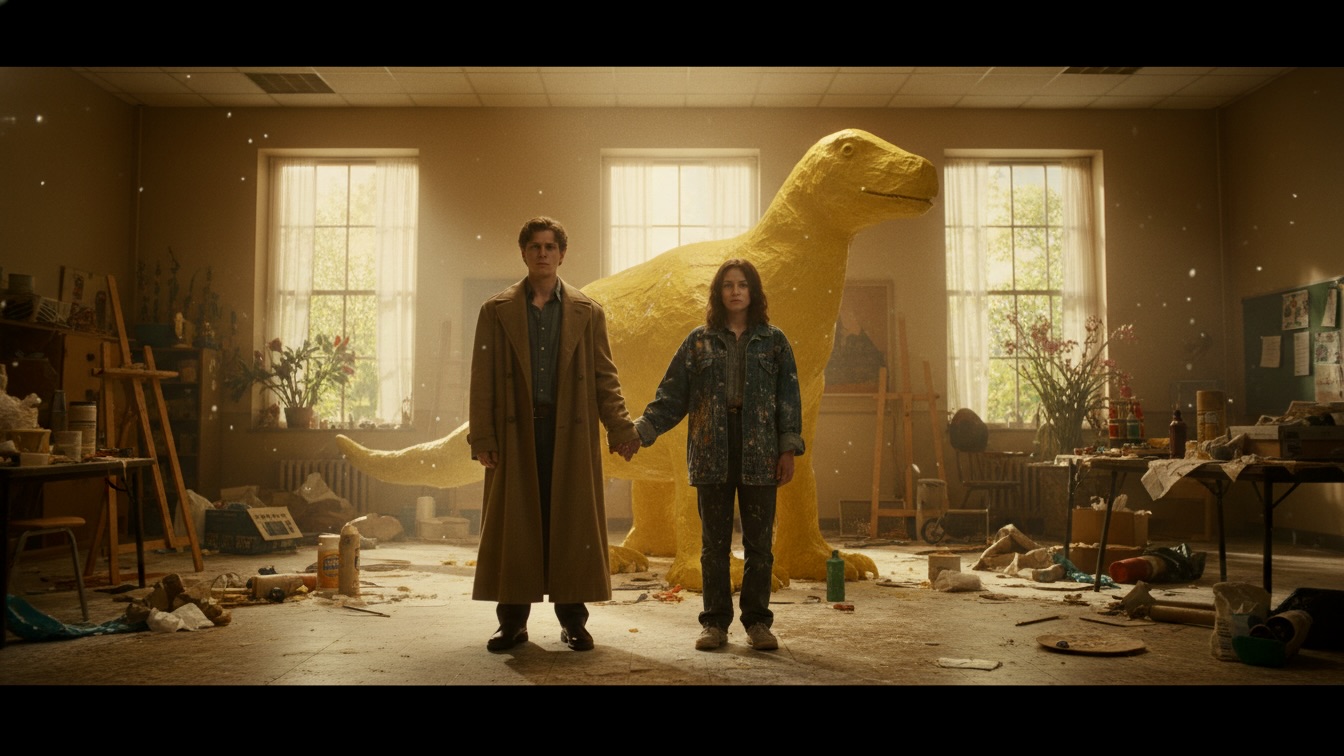
The story follows Jamie and Felix, two struggling artists facing imminent financial ruin after a failed public art installation. After receiving a rejection for a municipal grant, they discover a cryptic note suggesting that funding is only available for projects featuring "relatable interpersonal relationships." Jamie, the pragmatic logistical mind of the duo, convinces the pretentious and theatrical Felix to fake a romantic relationship to secure the five thousand dollars they need to pay off a dangerous debt. They successfully pitch their fabricated love story to Councilor Reyes, a desperate politician seeking sentimental content to distract from the city’s failing infrastructure.
To fulfill the requirements of the grant, they organize a community papier-mâché workshop with local children, which quickly devolves into chaotic mess. During the workshop, Jamie and Felix are forced to hide in a cramped janitorial closet to escape the rowdy children. In the suffocating, intimate dark of the closet, the lines between their performance and reality blur, resulting in a genuine and clumsy kiss. Though the resulting sculpture is an aesthetic disaster, Reyes is moved by their "shared affection" and approves the funds. However, the victory is immediately complicated when Reyes reveals that the city will now conduct a mandatory "emotional audit" to ensure their romance is authentic.
One of the central themes of the narrative is the tension between artistic integrity and the commodification of emotion. Felix begins the story as a purist who views municipal funding as a "graveyard of creativity," yet he is quickly forced to sacrifice his abstract visions for a "pacifier for the masses." The story suggests that in a late-capitalist urban environment, art is no longer valued for its commentary or aesthetic challenge but for its ability to serve as a bureaucratic tool for civic pacification. The transformation of their "metallic cube" into a lumpy, yellow papier-mâché dinosaur symbolizes the degradation of art when it is forced to meet the narrow, "relatable" criteria of government funding.
The narrative also explores the concept of the "Performance of Self" and the blurring of boundaries between artifice and reality. Jamie and Felix start their ruse as a calculated business transaction, complete with "meet-cutes" and rehearsed scripts. However, the psychological proximity required for their deception eventually triggers a genuine emotional response. The closet scene serves as a crucible where the theatricality of their external world is stripped away, leaving them with a raw, unscripted connection. This suggests that even the most cynical performances can inhabit the performer, making it impossible to distinguish where the lie ends and the truth begins.
Finally, the story highlights the suffocating nature of modern bureaucracy and its intrusion into the private lives of citizens. Councilor Reyes does not just want a sculpture; he wants to own the narrative of Jamie and Felix’s intimacy to bolster his political career. The introduction of the "emotional audit" at the end of the chapter serves as a chilling commentary on the surveillance state. It implies that when individuals trade their personal narratives for capital, they grant the institution the right to scrutinize their most private feelings. The "human infrastructure" Reyes seeks is ultimately just another resource to be managed, audited, and exploited.
Jamie is defined by her hyper-awareness of logistics and her physical reaction to stress. She serves as the grounding force for the partnership, managing the banking apps, debt collectors, and the "cognitive static" of their failing lives. Her hatred of sweating and her view of it as a "failure of bodily logistics" reveals a woman who desperately seeks control in an environment that is increasingly chaotic. She is a pragmatist who is willing to weaponize her own emotions and body to survive, as seen when she negotiates a thirty-percent "acting fee" for her role in the fake relationship.
Despite her cold, analytical exterior, Jamie’s internal state is one of profound exhaustion and sensory overload. Her headaches and the "blooming" pain behind her eye suggest a person who is constantly on the verge of a breakdown, yet she continues to push forward. The closet scene reveals a crack in her armor, where her physical heart rate and the "plummeting" of her stomach betray her carefully maintained detachment. She is caught in a conflict between her need for financial security and a burgeoning, inconvenient attraction to a man she considers an aesthetic liability.
Felix is a character who uses theatricality and pretension as a psychological shield against his own inadequacy and fear. By dressing like a "Victorian ghost" and speaking in grand, resonant tones, he distances himself from the harsh reality of his four-thousand-nine-hundred-dollar debt. He views himself as a misunderstood visionary, but Jamie’s blunt reminders of his "collapsed cube" suggest he is more of a dreamer than a craftsman. His resistance to the suburbs and "manicured hedges" indicates a deep-seated fear of mediocrity and the loss of his unique identity.
Underneath his layers of wool and vocabulary, Felix is vulnerable and dazed by the shifting reality of his situation. When he is in the closet with Jamie, his "theatrical voice" vanishes, and he becomes "just a tired boy." This shift suggests that his persona is a heavy burden he carries to avoid facing his failures. His willingness to participate in the "masterpiece of deception" shows a flexible morality, yet his genuine reaction to the kiss indicates that he is perhaps more desperate for connection than he is for "aesthetic purity."
The pacing of the story is masterfully handled, moving from the stagnant, "metallic heat" of the opening scene to the frantic, humid chaos of the papier-mâché workshop. The author uses a "pressure cooker" approach, where the physical environment—the heat, the cramped closet, the "brutal humidity"—mirrors the rising tension between the characters. The transition from the slow, cynical planning in the diner to the "adrenaline of lying" in the council office creates a sense of narrative momentum. This culminates in the closet scene, where the world outside pauses, allowing for a moment of intense, concentrated character development.
The tone of the narrative is sardonically observant, blending gritty realism with a touch of the absurd. Descriptions like the "embossed eagle that looked deeply exhausted" and the "sad compromise" of the waiting room paint a picture of a decaying civic landscape. The author uses sensory details to ground the reader in the physical discomfort of the characters’ lives, from the "smell of cheap copier toner" to the "sour flour paste" drying on their skin. These details reinforce the theme of the "unromantic" reality that underlies their "romantic" performance.
The narrative voice is sharp and unsentimental, which makes the sudden shift into the "overwhelmingly real" kiss even more impactful. By maintaining a cynical distance for most of the chapter, the author ensures that the moments of genuine emotion feel earned rather than forced. The final twist regarding the "emotional audit" shifts the tone from a romantic comedy of errors into something more dystopian and unsettling. This stylistic pivot leaves the reader with a sense of unease, suggesting that the characters have traded one form of debt for a much more invasive and psychological obligation.


