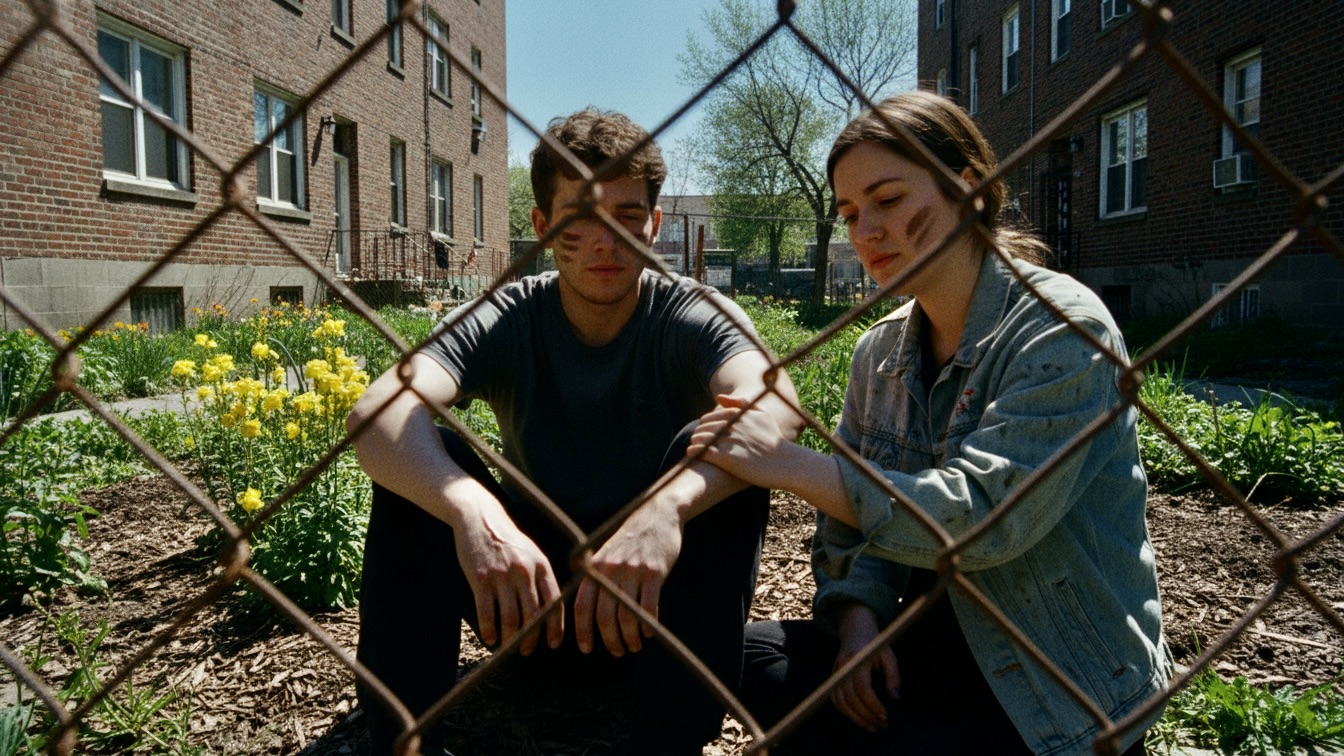
The chapter follows Nick, a former mechanic living with severe post-traumatic stress disorder and physical scarring from a catastrophic car accident. While attempting to help in a community garden, his physical limitations and psychological hyper-vigilance culminate in the breaking of a gardening tool. Gina, the garden’s organizer, intervenes and attempts to teach him a more delicate approach to planting snapdragons.
The situation escalates when a specific mechanical sound from the nearby street triggers a violent flashback for Nick, transporting him back to the moment of his collision. Gina successfully utilizes a grounding technique to pull him out of the panic attack, sharing her own history of grief and the mystical "phantom chime" she associates with the garden. By the end of the encounter, Nick manages to plant a flower with his injured hand, finding a brief moment of stability and connection.
The primary theme of the story is the arduous and non-linear nature of psychological and physical healing. Nick’s struggle illustrates that trauma is not a problem that can be solved with the same logic one uses to fix a machine. While he seeks a "binary system" where things either work or break, the garden teaches him that life often exists in a bruised, middle state. His journey represents the transition from resisting one's scars to learning how to function alongside them.
Another significant theme is the juxtaposition of urban decay against organic growth. The garden is a fragile sanctuary squeezed between brick walls and the "toxic dust" of the city. This setting mirrors Nick’s internal state, where his natural instincts for peace are constantly threatened by the "physics" of a dangerous world. Gina’s philosophy suggests that even in a world governed by harsh statistics and mechanical failures, there is room for unmeasurable moments of grace.
The story also explores the concept of control versus surrender. Nick attempts to exert total control over his environment and his body to prevent further harm, yet this rigidity is exactly what causes his tools and his mind to "snap." Gina serves as a guide who demonstrates that true strength comes from finesse and the ability to "let them breathe." Through the act of gardening, the narrative suggests that surrendering to the reality of one's pain is the only way to eventually move through it.
Nick is a man whose identity was once rooted in his mechanical competence, a trait that now serves as a source of frustration. He views his body as a failing machine, describing his scar tissue as "melted wax" and his hand as having a "useless damn grip." His internal world is dominated by hyper-vigilance, as he constantly calculates the physics of potential disasters. This focus on external threats is a classic defense mechanism, allowing him to avoid the internal wreckage of his trauma.
His psychological state is characterized by a profound sense of isolation and a lack of safety. He treats the soil with aggression because he is projecting his own feelings of being "compacted" and "hard" onto the earth. When the flashback occurs, his entire reality collapses, showing that his technical knowledge offers no protection against his memories. By the end of the chapter, his willingness to let Gina guide his hand indicates a small but vital shift toward trusting another person and his own body.
Gina serves as a grounded, empathetic foil to Nick’s volatility. Having transitioned from the world of financial data to the tactile reality of the garden, she understands the limitations of a purely analytical worldview. She is pragmatic and does not offer Nick hollow platitudes, instead meeting his cynicism with a "hard, flat reality." Her choice to wear mud-caked boots and work in a former trash dump shows her commitment to the messy process of transformation.
Her role in the story is that of a "wounded healer," as she uses her own experience with her sister’s death to help Nick navigate his panic. She recognizes that Nick needs a specific kind of intervention that respects his intelligence while challenging his avoidance. Her story about the "phantom chime" reveals a spiritual depth that balances her rough exterior. By placing her hand over his, she provides the physical anchor he needs to reconnect with the present moment.
The author employs a visceral and sensory-heavy prose style to immerse the reader in Nick’s fractured perspective. Descriptions of the "squeal of a garbage truck" and the "smell of hot trash" create an oppressive atmosphere that heightens the tension. The use of mechanical metaphors, such as "stripped bolt" and "polycarbonate handle," aligns the narrative voice with Nick’s background as a mechanic. These details make the sudden shift into the sensory overload of the car crash feel more jarring and effective.
Pacing plays a crucial role in reflecting the protagonist's internal rhythm. The story begins with a slow, grinding frustration that mirrors the difficulty of digging in compacted dirt. When the "ding" of the bell occurs, the sentences become shorter and more frantic, mimicking the staccato heartbeat of a panic attack. The subsequent grounding exercise slows the narrative back down, using repetitive actions to stabilize both the character and the reader.
The tone of the chapter is gritty yet ultimately hopeful. It avoids being overly sentimental by acknowledging the "bile" and "blood" associated with trauma. The dialogue between Nick and Gina is sharp and laden with subtext, revealing their mutual respect through banter rather than overt emotional displays. This stylistic choice ensures that the final image of the silent, rustling stalks feels earned rather than forced.


