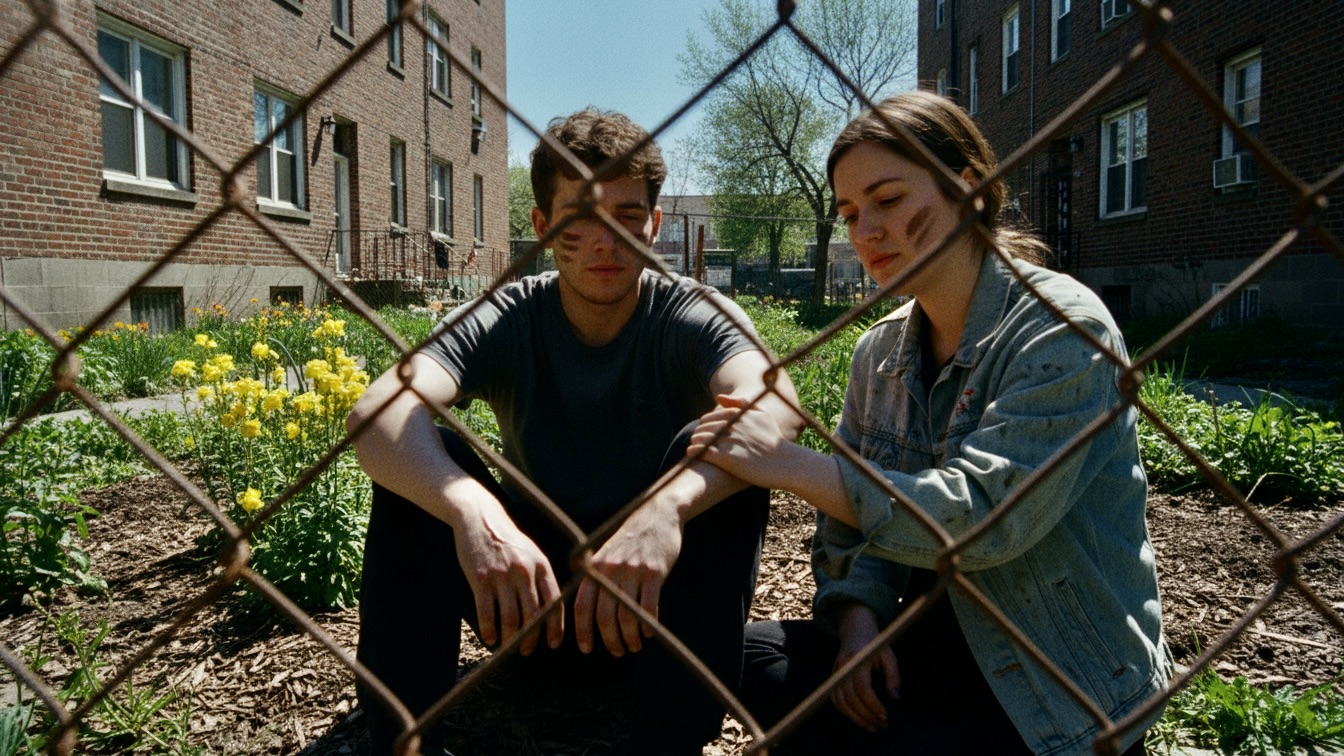
Imagine "The Broken Trellis" as a standalone entry in a prestige anthology series that explores the intersection of urban grit and the quiet, unexplained phenomena of the human psyche. This story serves as a visceral character study, utilizing high-intensity sensory details to transform a mundane community garden into a battlefield of memory and recovery.
Format: Short Film / Anthology Episode | Est. Length: 10-12 minutes
This episode belongs to an anthology titled The Concrete Wild, a series focusing on the hidden emotional lives of city dwellers who find solace or confrontation in neglected urban green spaces. Each episode explores a different character’s "ghost"—be it a literal haunting or a psychological trauma—that manifests through the sensory experience of nature reclaiming the city. The series maintains a consistent thread of "The Unmeasurable," suggesting that the city itself remembers the tragedies that occur on its streets.
The sharp snap of a plastic trowel echoes against brick walls as Nick’s scarred, spasming hand reveals the violent tension he carries within. He isn't just gardening; he is holding a defensive perimeter against a world he no longer trusts.
A traumatized mechanic must confront the auditory ghost of the car crash that ruined his life when a mysterious chime triggers a dissociative episode in a community garden. He must choose between the safety of his hypervigilance and the vulnerability required to let something new grow.
The primary theme is the struggle between "Force" and "Finesse," represented by Nick’s mechanical, binary worldview versus Gina’s organic, patient approach to life and trauma. It explores the concept of "The Unmeasurable"—the idea that some wounds cannot be fixed with a wrench and some sounds exist outside the realm of physics.
Secondary themes include the communal nature of grief and the physical act of "grounding" as a survival mechanism. The story suggests that healing is not the removal of a scar, but the ability to function while carrying it.
For Nick, the stakes are his sanity and his ability to remain present in a world that feels inherently hostile. If he cannot overcome the "phantom chime," he will remain a prisoner to his hypervigilance, eventually losing his connection to reality and the few people, like Gina, who offer him a path forward.
The primary conflict is internal: Nick’s PTSD acts as a relentless antagonist, manifesting as sensory overload and physical spasms. Externally, the antagonistic force is the city itself—the noise, the traffic, and the "phantom chime"—which serves as a constant reminder of the mechanical violence that broke him.
Nick, a former mechanic with a severely scarred hand and a hair-trigger startle response, attempts to volunteer in a cramped urban community garden. His rigid, aggressive approach to the soil leads him to snap his tools and struggle with the compacted earth, all while he obsessively monitors the nearby street for traffic threats. Gina, the garden’s curator who carries her own quiet history of loss, intervenes to teach him that plants—and people—require finesse rather than brute force.
The atmosphere shifts when a specific, mechanical "ding" rings out from the street, perfectly mimicking the silver bell from the truck that nearly killed Nick. This auditory trigger plunges Nick into a terrifyingly vivid flashback, blurring the lines between the garden and the wreckage of his past accident. Gina utilizes a grounding technique to pull him back to the present, revealing that the garden itself seems to echo the tragedies of those who tend it. Nick is left to accept that while the "phantom chime" may be real, he has the strength to keep planting.
Nick (The Broken Mechanic): A man defined by "plastic fatigue," Nick is a high-functioning survivor of a catastrophic T-bone collision. He views the world through the lens of physics and mechanical failure, using his technical knowledge as a shield against the unpredictability of life. By the end of the episode, he moves from a state of rigid, explosive tension to a moment of fragile, grounded acceptance.
Gina (The Grounded Curator): A former tech professional who traded algorithms for dirt after her sister’s overdose, Gina is the emotional anchor of the garden. She is unsentimental and tough, recognizing Nick’s trauma because she lives with her own. She serves as the "guide" who bridges the gap between Nick’s cold logic and the garden’s inexplicable, healing nature.
The Breaking Point: Nick snaps a plastic trowel in a fit of physical frustration, revealing the deep, waxy scar tissue on his hand and his intense hypervigilance toward the passing city traffic. He attempts to dig into the asphalt-hard soil with his bare fingers, but the vibration of a buried brick triggers a nerve spasm that highlights his physical and emotional fragility.
The Lesson of Finesse: Gina arrives and mocks Nick’s "aggressive" gardening, forcing him to watch as she gently massages the root ball of a snapdragon to let it breathe. She challenges his binary view of life and death, insisting that the plants require a delicate touch that his mechanical mind currently lacks.
The Sensory Overload: As Nick tries to mimic Gina’s technique, the city’s sensory input—the smell of hot trash, the yellow pollen, and the roar of diesel engines—begins to compress his world. He explains his "statistical illusion" of safety to Gina, revealing the depth of his paranoia regarding the physics of car accidents and the flimsy protection of the garden fence.
The Phantom Chime: A sharp, silver "ding" rings out from the avenue, instantly transporting Nick back to the moment of his accident where a bell hung from the rearview mirror of the truck that hit him. The scene shifts into a visceral, claustrophobic flashback of crushing metal, airbag powder, and the repetitive, taunting sound of that silver bell swinging against broken glass.
The Grounding: Nick collapses into a full-blown dissociative panic, scrambling away from the "wreckage" of the planter boxes until Gina grabs him and forces his hand flat into the cold, damp dirt. She demands he name "five things that suck," a grounding exercise that forces him to reconnect with the physical reality of the garden and the presence of the pollen, the noise, and her own cheap tools.
The Bruised Bloom: After the panic subsides, Gina reveals that she also hears the "phantom chime" and believes the garden holds the echoes of those who have suffered there. She hands Nick a bruised snapdragon, and with a trembling but controlled grip, he finally plants it in the soil, choosing to exist in the silence that follows the chime.
The episode begins with a sense of Irritation and Brittle Tension, mirroring the "plastic fatigue" of Nick’s tools. As the city noise builds, the mood shifts into Crescendoing Anxiety, peaking in a Terrifyingly Surreal flashback sequence that feels cold and metallic. The resolution provides a Cathartic Grounding, ending on a note of "Heavy Peace"—a realization that the trauma isn't gone, but it is finally being handled with finesse.
In a full season of The Concrete Wild, Nick’s journey would involve him gradually repairing the garden’s "broken trellis," a metaphor for rebuilding his own support systems. He would transition from a student of Gina’s to a co-protector of the space, eventually helping other newcomers navigate their own "phantom" triggers.
The seasonal narrative would explore the mystery of the "Phantom Chime," suggesting it is a localized phenomenon that occurs when someone in the garden reaches a breaking point. The finale would involve a threat to the garden’s existence—such as a developer—forcing Nick and Gina to prove that the "unmeasurable" value of the space is worth more than the land it sits on.
The visual style is "Gritty Naturalism" with a high-contrast color palette: the vibrant, almost toxic yellow of the pollen and the pink of the scar tissue against the drab, grey-brown of the city. The camera work should be handheld and intimate, staying close to Nick’s hands and face to create a sense of claustrophobia that mirrors his internal state.
The tone is reminiscent of Sound of Metal or The Bear, where the sound design is a character itself. The flashbacks should be desaturated and sharp, utilizing fast-cutting and distorted audio to contrast with the slow, rhythmic, and "earthy" feel of the present-day gardening scenes.
The target audience is adults (25-55) who appreciate character-driven dramas with psychological depth. It appeals to viewers who enjoy "urban-noir" aesthetics and stories that deal realistically with mental health, trauma recovery, and the small, quiet victories of human connection.
The 10-12 minute runtime requires a "Pressure Cooker" pacing. The first four minutes build the sensory tension of the garden; the midpoint (the chime) triggers a 90-second high-intensity sequence; the final five minutes focus on the slow, deliberate process of grounding and the emotional fallout. The tempo should feel like a heart rate monitor—steady, then spiking into a blur, then slowly returning to a heavy, rhythmic beat.
The "Phantom Chime" requires a specialized sound design—a sound that is both mechanical and hauntingly musical, distinct enough to cut through the ambient city noise. This sound must be consistent across the episode to ensure the audience recognizes the trigger immediately.
Practical effects are preferred for the gardening elements; the "broken trowel" and the "scar tissue" makeup are critical for the tactile feel of the story. The production should utilize a real urban vacant lot to capture the authentic "hot trash and pollen" atmosphere described in the text, ensuring the environment feels as lived-in and "bruised" as the characters.


