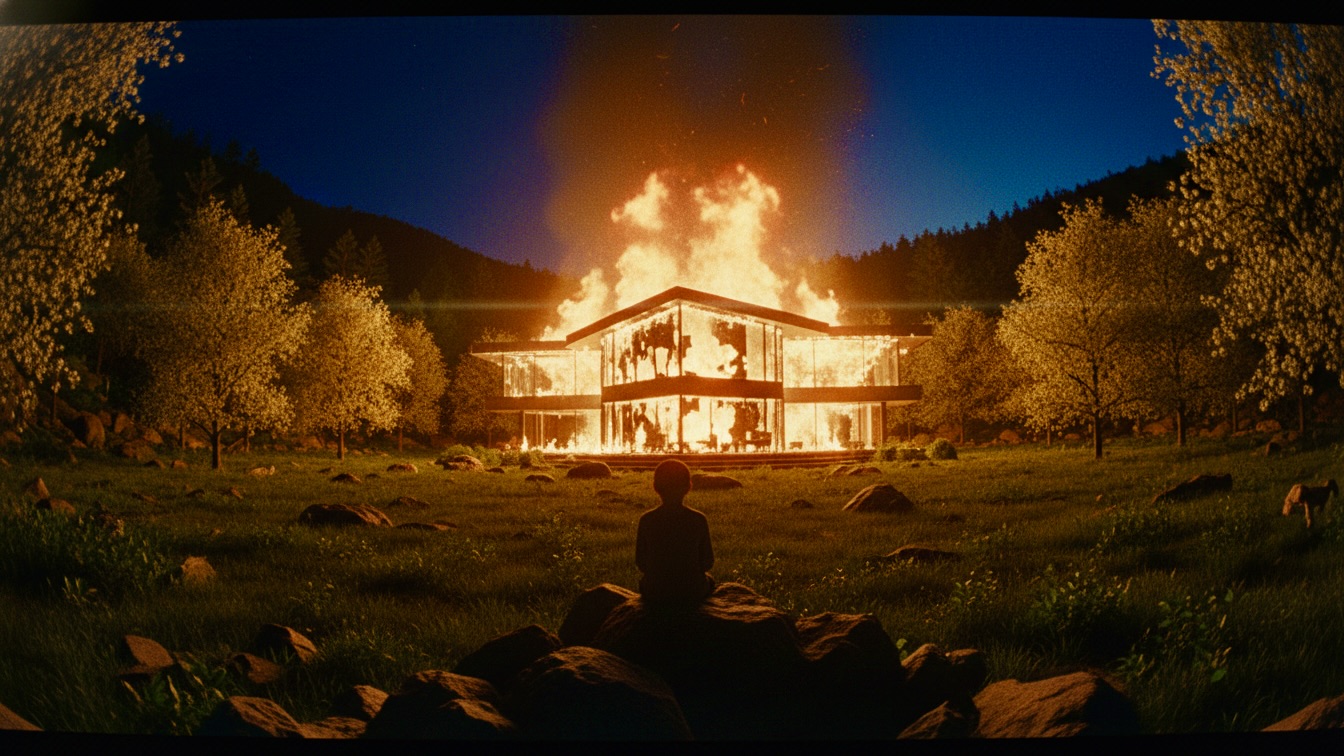
The story unfolds at the Velvet Pine Gala, a high-society event held in a sterile, mountain-top mansion. The narrator, a young boy named Toby, observes the proceedings from beneath a table, hidden by a long cloth that masks his muddy sneakers. Two wealthy guests, Betty Crane and Jim Silver, engage in a cynical conversation about a captured "miracle" held in a glass box. They view this ethereal entity not as a wonder, but as a financial investment and a tool for social branding.
As the auction for the miracle begins, the entity undergoes a terrifying transformation. It shatters its glass prison and manifests as a gargantuan, faceless accountant in a gray suit. This creature, known as the Auditor, begins a literal moral accounting of the guests, accusing them of soul-level debts and emotional bankruptcy. While the adults are confronted with their lies and greed, a fire breaks out in the kitchen, fueled by synthetic gin and vanity.
Despite the encroaching flames, the guests remain obsessed with their digital personas, attempting to document the disaster for social media rather than seeking safety. Toby, guided by a silent gesture from the monster, escapes the burning mansion and finds solace in the cold mountain air. Outside, the Auditor reverts to a small, peaceful figure before dissolving into starlight. Toby is left alone with a blank piece of paper, a stark contrast to the cluttered, debt-ridden lives of the adults he left behind.
The central theme of the narrative is the toxic commodification of the divine and the miraculous. In the world of the gala, nothing is sacred if it cannot be appraised, auctioned, or used to bolster a personal brand. The miracle is stripped of its wonder and reduced to a "glow-worm" or an "investment," highlighting a society that has lost the ability to value anything beyond its price tag. This transformation of the ethereal into the commercial suggests a profound spiritual vacuum at the heart of the elite.
Closely tied to this is the theme of moral and emotional insolvency. The story uses the language of finance—invoices, tax havens, and escrow—to describe the ethical failures of the characters. By personifying judgment as a giant accountant, the narrative suggests that the characters' lives are not just immoral, but fundamentally unbalanced. Their "debts" are not monetary, but represent the kindness they withheld and the empathy they traded for status.
The narrative also explores the hollow nature of performative existence in the digital age. As the mansion burns, the guests are paralyzed by their need to capture the "content" of their own destruction. They prioritize the "lighting" and the "views" over their actual survival, indicating a complete detachment from reality. This suggests that their identities have become entirely externalized, existing only through the lenses of their phones and the validation of their followers.
Finally, the story contrasts the corruption of adulthood with the grounded innocence of childhood. Toby is the only character who notices the sensory reality of the world, such as the smell of the mud or the heat of the fire. While the adults are trapped in a storm of their own "bad papers," Toby is granted a blank page. This symbol of potential suggests that while the adults are defined by their past debts, the child remains unwritten and free from the systemic rot of the gala.
Toby serves as the narrative's moral and sensory anchor, providing a grounded perspective on the absurdities of the adult world. He is physically positioned lower than the other characters, often hiding under tables or looking up, which allows him to see the "mud" and the "dirty sneakers" that the elite ignore. His observations are literal and unpretentious, stripping away the sophisticated jargon used by Jim and Betty to reveal the underlying ugliness of the gala. He is the only character who recognizes the fire as a physical threat rather than a backdrop for a selfie.
His internal state is one of quiet detachment and curiosity rather than fear. While the adults are terrified of the Auditor, Toby perceives the creature as a guide who offers him a way out. By the end of the story, he represents a survival of the self in a world that demands total assimilation into consumer culture. The blank paper he receives from the monster signifies his purity and his escape from the "invoices" that define the lives of the adults around him.
Jim Silver is the embodiment of corporate greed and the obsession with public perception. He views the miracle through the lens of "optics" and "branding," demonstrating a complete lack of genuine empathy or wonder. Even when he attempts to argue for the "humane" treatment of the creature, his motivation is purely financial, as he hopes to drive down the auction price. He is a man who has replaced his soul with a series of business maneuvers, as evidenced by the Auditor’s revelation of his "shell company" charities.
Jim's reaction to the life-threatening fire is perhaps his most defining trait. Instead of fleeing, he sees the catastrophe as the "content of the century," showing that he values his digital reach more than his physical life. He is a character who has become a caricature of success, unable to distinguish between a meaningful life and a high follower count. His eventual shrinking, caused by the "bad papers" stapled to him, reflects the true smallness of his character once his external status is stripped away.
Betty Crane represents the superficiality and vanity of the social elite. Her primary concerns are aesthetic and competitive, as she views the miracle as "last season" and worries about the lighting in her photos even as smoke fills the room. She is described in harsh, unflattering terms through Toby's eyes, resembling a "stepped on" strawberry in her garish pink dress. This physical description mirrors her internal state, which is bruised by a lifetime of shallow consumption and emotional neglect.
Her heart is described as being "held in escrow," a powerful metaphor for her inability to feel or give love. She has spent her life consuming things she does not need, and as a result, she is spiritually bankrupt. Like Jim, she is more concerned with her "lawyer" and her "lighting" than the reality of the disaster unfolding around her. Her character serves as a warning about the soul-crushing effects of a life dedicated entirely to the pursuit of trends and social validation.
The narrative voice is one of the story's most compelling features, utilizing a first-person perspective that blends childlike simplicity with sharp, satirical observation. Toby’s descriptions are often visceral and sensory, such as the "bleach and regret" smell of the gin or the "sandpaper" feel of Jim’s suit. This grounded imagery creates a stark contrast with the abstract, nonsensical talk of the adults. The prose is clean and direct, which heightens the impact of the surreal elements when they finally emerge.
Pacing in the story is handled with a deliberate shift from static observation to chaotic action. The beginning is slow and claustrophobic, mirroring Toby’s position under the table and the stagnant nature of the gala. Once the glass box shatters, the pacing accelerates rapidly, reflecting the panic of the guests and the aggressive spread of the fire. This transition creates a sense of inevitable collapse, as the sterile world of the mansion is consumed by the wild, "hungry" flames.
The tone of the story is darkly whimsical, blending elements of a fairy tale with a biting social critique. The transformation of a "miracle" into a giant accountant is a surrealist touch that serves as a potent metaphor for the way modern life drains the magic out of existence. The ending, however, shifts into a more somber and reflective tone. The image of the house as a "burning dollhouse" and the quiet mountain air provides a sense of catharsis, moving away from satire toward a more profound, quiet isolation.
Sensory details are used effectively to distinguish between the artificial and the natural worlds. The gala is filled with synthetic smells, "plastic" air, and flowers that look like popcorn but have no scent. In contrast, the mountain air is cold, the mud is sticky, and the fire is "bright and wild." These details reinforce the theme that the elite have disconnected themselves from the real world in favor of a curated, odorless, and ultimately flammable simulation of life.


