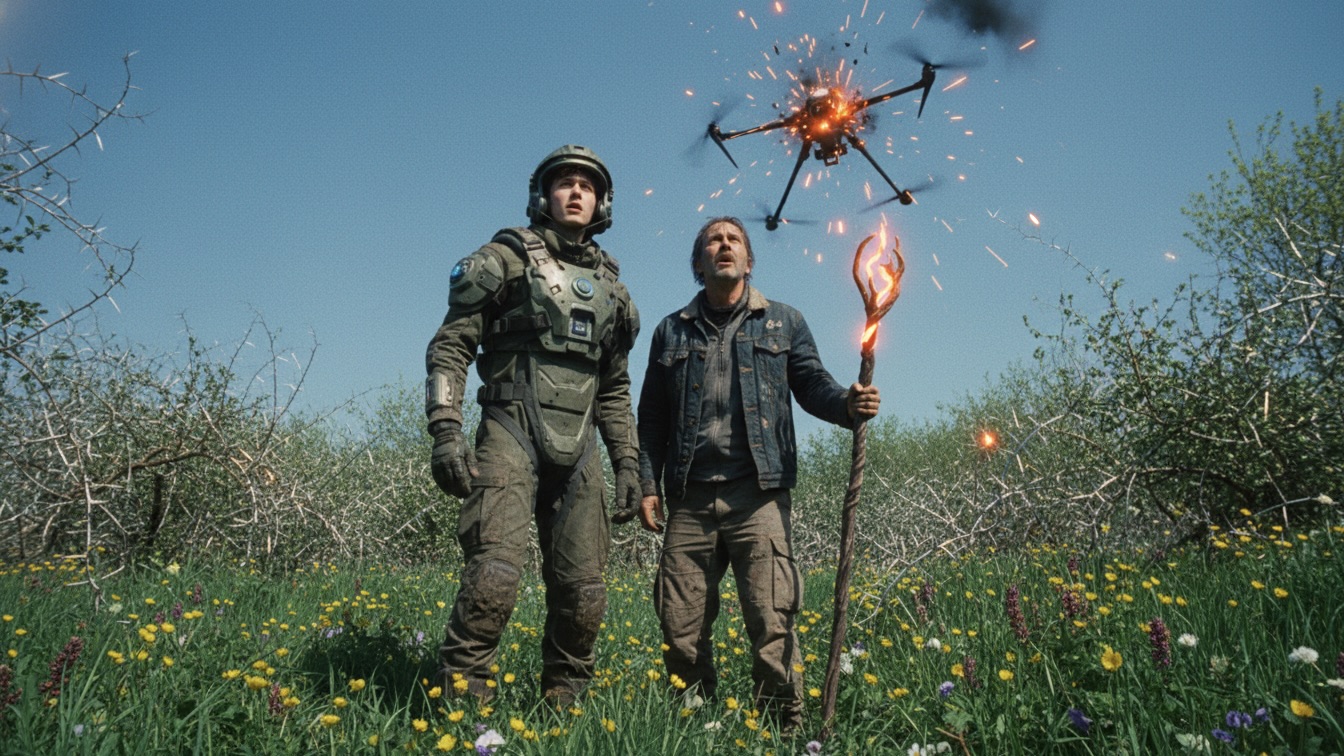
The story follows a man named Nate’s companion, a technician from a hyper-sanitized city called the Spire, who ventures beyond the city walls to clear away aggressive biological overgrowth. Clad in a heavy polymer suit and guided by a digital interface, the protagonist views the wilderness as a mere nuisance or a safety hazard. He is motivated by "orders" from a management team that views the encroaching silver thorns as a threat to their sterile, plastic existence. This initial journey is marked by a sense of detachment and boredom, as he leaves behind a world of synthetic experiences for the messy reality of the "Shadow Woods."
During his mission, the protagonist encounters a mysterious young man named Nate, who lives outside the city’s influence and possesses a deep understanding of the forest. Nate prevents the protagonist from cutting into the thorns, explaining that the woods are a protective entity that reacts violently to the industrial stench of the Spire. Nate leads him to a hidden grove at the center of the woods, where a pristine spring of "liquid light" flows. This sanctuary represents a primordial force of nature that has remained untouched by the concrete and glass of the protagonist’s home.
The tranquility of the grove is shattered when an automated drone from the Spire, having tracked the protagonist’s suit, arrives to destroy the "unauthorized biological sanctuary" with chemical defoliants. In a moment of crisis, the protagonist chooses to sabotage his own equipment, combining Nate’s mystical light-staff with his thermal cutter to destroy the machine. This act of defiance marks his final break from the city. He discards his armor and chooses to stay in the grove as the silver thorns seal the path behind them, permanently separating him from his old life.
The central theme of the narrative is the profound conflict between the artificiality of technological civilization and the raw vitality of the natural world. The Spire represents a pinnacle of human control, where even the seasons are reduced to LED displays and the air is filtered into a uniform, lemon-scented void. This environment is depicted as a "tombstone," suggesting that the pursuit of perfect order and cleanliness ultimately leads to a kind of spiritual death. The protagonist’s boredom is a symptom of this sterility, highlighting the human need for the unpredictable and the organic.
Nature is portrayed not as a passive backdrop, but as a sentient and defensive force. The silver thorns are metaphors for the boundaries nature sets against human encroachment; they are "guards" rather than monsters. The story suggests that the natural world possesses an inherent value and a "heart" that exists independently of human utility. By labeling the grove an "unauthorized biological sanctuary," the city’s AI reveals a worldview that cannot tolerate anything it does not own or control, framing the preservation of nature as an act of rebellion.
Finally, the story explores the theme of authentic identity and the weight of societal structures. The protagonist’s suit is described as a heavy cage that makes him feel like an "action figure still in the box," symbolizing the roles and regulations that trap individuals within a corporate or technological framework. His decision to strip off the suit and remain in the woods is a psychological liberation. He moves from being a programmed "unit" of the Spire to becoming a "real" person, accepting the risks of the wild over the guaranteed, yet hollow, safety of the city.
The protagonist undergoes a significant psychological evolution from a cynical agent of the state to a self-actualized rebel. At the beginning of the chapter, he is defined by a sense of apathy and a "city-brain" that tries to categorize every wonder he sees into technical terms, such as assuming a magical spring is a "pipe burst." He is a man who has been conditioned to fear the "mess" of the outside world, yet he carries a latent dissatisfaction that makes him susceptible to Nate’s influence. His internal conflict is visualized through his HUD, which constantly alerts him to "biological hazards" that he eventually chooses to ignore.
His turning point is not merely a choice of environment, but a choice of values. When he sees the drone attacking the flowers, he experiences a sudden shift from a passive observer to an active protector. The act of jamming Nate’s staff into his thermal cutter represents a psychological synthesis; he uses the tools of his past to defend the beauty of his future. By the end of the story, he feels "light" and "real," indicating that his previous life was a burden that suppressed his true self. He accepts the "trouble" he has caused because he has finally found something worth the risk.
Nate serves as the protagonist’s psychological guide and a foil to the rigid structure of the Spire. He is a man who has achieved a harmonious existence with the Shadow Woods, possessing a calm authority that the protagonist lacks. Nate does not use force to stop the protagonist; instead, he uses knowledge and a demonstration of the woods' true nature. He acts as a mirror, reflecting the protagonist’s "factory" smell and the "lie" of his job, forcing him to confront the reality of his situation.
Nate represents the possibility of a life outside the system, one that is governed by the rhythms of the earth rather than the mandates of "Management." He is not a traditional hero but a guardian who understands the necessity of boundaries. His role is to facilitate the protagonist’s awakening, yet he remains somewhat enigmatic, suggesting that his connection to the "heart" of the woods has changed him into something the protagonist is only beginning to understand. His smile at the end signifies his acceptance of the protagonist as a fellow inhabitant of the wild.
The narrative utilizes a sharp contrast in sensory imagery to emphasize the gulf between the Spire and the Shadow Woods. The city is described with cold, sterile adjectives like "white plastic," "glass," and "lemon-scented," which evoke a sense of artificiality. In contrast, the woods are described with visceral, earthy details such as "wet dirt," "rotting fruit," and "liquid light." These descriptions serve a psychological purpose, grounding the reader in the protagonist’s sensory awakening as he moves from a world of simulations to a world of physical reality.
The pacing of the story transitions from a slow, methodical crawl to a frantic climax, mirroring the protagonist's internal state. The initial walk through the woods is atmospheric and lingering, allowing the reader to feel the weight of the suit and the oppressive density of the thorns. However, the arrival of the Mark IV Hunter-Seeker injects a sudden, mechanical violence into the prose. The sentences become shorter and more action-oriented during the drone strike, creating a sense of urgency that forces the protagonist—and the reader—to make a split-second moral decision.
The narrative voice is characterized by a blend of gritty sci-fi cynicism and lyrical wonder. The protagonist’s initial dialogue is flat and functional, echoing the "recycled oxygen" of his home. As he enters the grove, however, the language becomes more poetic, describing the thorns as "frozen lightning" and the spring as "liquid light." This stylistic shift reinforces the theme of transformation, showing that as the protagonist’s world expands, so does his capacity to perceive and describe beauty. The final image of the thorns "weaving together" provides a sense of closure and security, turning a former threat into a protective embrace.


