Format: Short Film / Anthology Episode | Est. Length: 10-12 minutes
Imagine a world where the last vestiges of nature are guarded by sentient, metallic flora, and humanity lives in sterile, plastic towers. This story serves as a pilot or standalone entry in an anthology series titled The Verdant Breach, exploring the friction between artificial preservation and organic chaos. The series follows various "Outsiders" who venture beyond the corporate-controlled Spire cities to discover that the "wasteland" is actually a thriving, defensive ecosystem. Each episode builds toward a global narrative arc where the planet’s original biology begins to aggressively reclaim the concrete landscape.
A corporate technician tasked with "clearing" invasive overgrowth outside a sterile city discovers that the plants are sentient protectors of a sacred spring. The mission turns into a fight for survival when his own tracking equipment summons a lethal military drone to destroy the sanctuary.
A disillusioned city worker must choose between his comfortable life in a plastic utopia and the survival of an ancient, hidden grove. When a corporate drone arrives to poison the wild, he must turn his tools into weapons to protect the heart of the world.
The central theme is the conflict between "sterile order" and "organic chaos," questioning whether safety is worth the price of a soul. It explores the concept of environmental guardianship and the awakening of a dormant conscience in a technocratic society that views nature as a biological hazard.
The story also touches on the genre of "Solar-Punk Noir," where the bright, aggressive beauty of nature is as dangerous as it is vital. It highlights the emotional undercurrent of sensory deprivation, showing how the protagonist’s "city-brain" is overwhelmed by the visceral reality of the wild.
For the protagonist, Jax, the stakes involve his entire identity and livelihood; choosing the grove means permanent exile and being branded a traitor to the Spire. For the world, the stakes are the survival of the last pure water source, which represents the planet's ability to heal itself from human encroachment. If the spring is poisoned, the last connection to the planet’s pre-industrial past is severed forever.
The primary external conflict is the Spire’s militarized expansion and its automated "Mark IV" drones that view nature as a biological hazard to be eradicated. Internally, Jax struggles with his conditioning to view the world through a digital HUD, eventually realizing that his "job" is an act of environmental assassination. Nate provides a secondary, philosophical conflict, challenging Jax’s reliance on technology and his complicity in the city’s sterile expansion.
Jax, a technician from the sterile city of The Spire, is sent to clear "overgrowth" that is interfering with city sensors. Equipped with a thermal cutter and a heavy polymer suit, he encounters Nate, a mysterious dweller of the Shadow Woods who warns him that the silver briars are actually protective guards. Nate leads Jax deep into the shifting woods to a hidden grove containing a spring of "liquid light," a primordial source of life that the city intends to pave over.
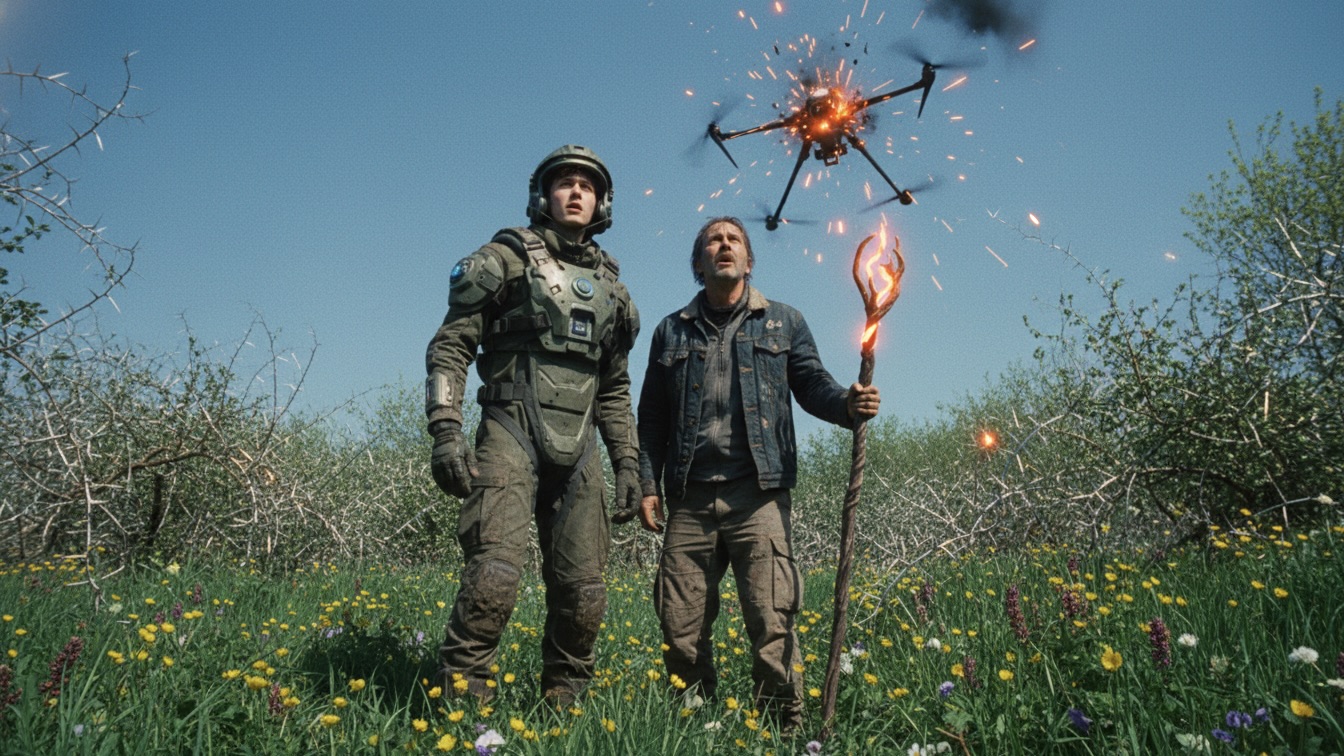
The peace is shattered when Jax’s active HUD leads a Mark IV Hunter-Seeker drone to the location. Faced with the destruction of the grove by chemical defoliants, Jax combines his corporate tech with Nate’s mystical light-staff to destroy the drone in a massive explosion. Choosing exile over the sterile safety of the Spire, Jax watches as the thorns seal the path behind him, finally breathing real air for the first time as a free man.
Jax: A 22-year-old technician who begins as a cynical, "by-the-book" worker defined by his HUD and thermal cutter. By the end of the episode, he sheds his heavy suit and city identity, undergoing a psychological rebirth from a "cog in the machine" to a guardian of the wild. He moves from a state of sensory numbness to a state of visceral, terrifying awareness.
Nate: A weathered, enigmatic survivor who serves as the "mentor" figure, living in harmony with the Shadow Woods. He is patient but firm, representing the bridge between human consciousness and the sentient environment that the Spire fears. He begins the story as a wary observer and ends as an ally, welcoming Jax into a world without walls.
Jax exits the sterile, white airlock of the Spire, exchanging cynical banter with a gate tech before stepping into the oppressive, sweet-smelling humidity of the Shadow Woods. The transition from the plastic city to the mud and rotting fruit of the woods creates an immediate sensory overload for the protagonist. He struggles with his heavy suit as his HUD screams alerts about unidentified biomass and biological hazards.
While attempting to cut through silver, metallic thorns with his thermal cutter, Jax is confronted by Nate, who demonstrates that the "overgrowth" reacts to light and possesses a defensive intelligence. Nate mocks Jax’s reliance on technology, explaining that the thorns are protective guards that dislike the "factory smell" of city dwellers. The thorns vibrate and uncoil, proving they are more animal than vegetable, forcing Jax to lower his weapon.
Nate leads Jax through the shifting briars to a hidden, vibrant grove where Jax removes his helmet, experiencing the profound sensory shock of pure air and "liquid light" water. The grove is a visual explosion of color that contrasts sharply with the metallic woods, featuring a spring that bubbles up from ancient black rock. Jax realizes that the "overgrowth" he was sent to destroy is actually a sanctuary for the planet’s heart.
A corporate Mark IV Hunter-Seeker drone arrives, tracking the signal from Jax’s suit, and begins spraying chemical defoliants that cause the ancient flowers to shrivel and die. The drone’s mechanical drone and red targeting lasers shatter the peace of the grove, identifying the area as an "unauthorized biological sanctuary." Jax realizes his own equipment has betrayed the location, and Nate looks at him with cold disappointment.
In a moment of desperate improvisation, Jax merges his thermal cutter with Nate’s light-staff, creating a white-light power surge that obliterates the drone and seals his fate as a traitor. The resulting explosion rains shrapnel and mud over the clearing, but the spring remains untainted. Jax stands in the wreckage of his former life, holding the fused weapon as his HUD finally goes dark.
Jax discards his heavy polymer armor in the mud as the silver thorns weave a permanent wall between the grove and the Spire, accepting his new life in the wild. He acknowledges the trouble he is in, but finds he is "okay with that" as he takes his first real breath of fresh air. The episode ends with the silver briars closing the path, isolating the two men in the sanctuary as the sun sets.
The episode moves from a sense of claustrophobic cynicism and technological detachment to a breathtaking, high-stakes awakening. The audience experiences the transition from the "uncanny valley" of the sterile city to the visceral, terrifying beauty of the woods, ending on a note of liberation and quiet awe. The mood shifts from the cold, clinical blue of the Spire to the warm, vibrant gold of the grove, before spiking into the jagged, red-tinted tension of the drone attack.
If expanded, the season would follow Jax and Nate as they travel to other "Hearts" across the planet, sabotaging Spire infrastructure to allow the wild to reclaim the earth. The narrative would explore the origins of the silver thorns, revealing them to be a bio-engineered defense system created by a forgotten faction of scientists.
The thematic escalation would involve the Spire deploying more "human" hunters and psychological warfare, forcing Jax to confront former colleagues and his own lingering attachment to his past life. The season finale would culminate in a massive "Verdant Breach," where the Shadow Woods finally breach the walls of the Spire, forcing the city dwellers to choose between extinction or adaptation.
The visual style relies on high contrast: the Spire is shot with flat, overexposed lighting and a clinical white-and-grey palette, while the Shadow Woods utilize deep shadows, bioluminescent greens, and metallic silvers. The camera work should be handheld and intimate in the woods to emphasize the tactile nature of the environment, contrasting with the static, wide shots used inside the city.
The tone is "Solar-Punk Noir," blending the gritty survivalism of Children of Men with the vibrant, sentient ecology of Annihilation. Tonal comparables include the atmospheric world-building of Blade Runner 2049 and the environmental mysticism of Princess Mononoke.
The target audience consists of young adults and fans of speculative sci-fi (ages 16–35) who enjoy environmental themes and "man vs. machine" narratives. It appeals to viewers who appreciate high-concept world-building, eco-conscious storytelling, and character-driven anthology series like Black Mirror or Love, Death & Robots.
The pacing is a steady "slow burn" during the initial trek through the woods, allowing the atmosphere and world-building to take center stage. This is followed by a frantic, high-tempo climax when the drone arrives, shifting the genre from atmospheric drama to sci-fi action. The 10-12 minute runtime follows a tight three-act structure: the Departure (leaving the Spire), the Initiation (the Discovery of the Grove), and the Return/Rebirth (the choice to stay).
The silver thorns require a mix of practical wire-work and CGI to simulate their serpentine movement and metallic sheen. The "liquid light" spring should be achieved through high-frame-rate photography and internal lighting within a practical water feature to maintain a grounded, tactile feel that CGI often lacks.
The heavy polymer suit should be a practical costume piece that looks cumbersome and restrictive, emphasizing Jax’s physical liberation when he finally removes it. Sound design is critical, contrasting the hum of the city and the drone with the organic, wet, and rhythmic sounds of the living forest.


