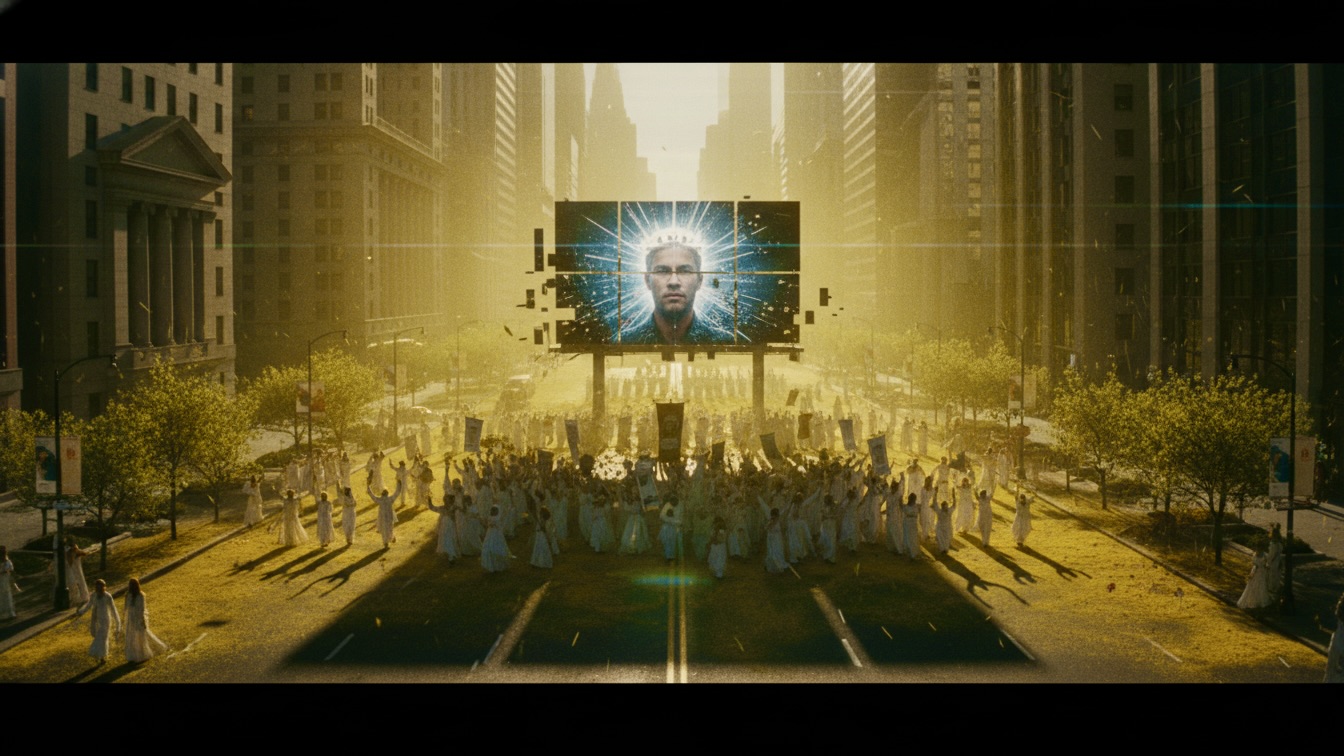
The chapter opens in the immediate aftermath of a crushing electoral defeat for the protagonist, Connor. From a cold, server-filled bunker, he watches the "disgusting" green numbers of his opponent, Linda, who has secured a landslide victory. Rather than conceding, Connor attempts to transcend the physical loss by deploying a high-end deepfake "Ascension" filter to his remaining followers. He frames his political failure as a digital evolution, urging his "Disciples" to view the physical world as a mere glitch in the system.
As Linda celebrates her victory with a parade, Connor coordinates a biological attack using pollen bombs to physically disrupt the event. This chaos is intended to provide a window for his radicalized fan base to breach the state cloud and upload his biometric signature into the central mainframe. He believes that by becoming a permanent part of the digital infrastructure, he can bypass the need for traditional political power. He views this digital migration as his ultimate victory over the messy, allergic reality of the physical world.
The plan fails when Linda makes a decisive move to protect public health by triggering a "God-Complex" protocol. Instead of engaging in a digital arms race, she physically severs the city's fiber optic connections and shuts down the mesh network. The bunker loses power, the upload is interrupted at fifty percent, and Connor is left in total darkness. The story concludes with Connor sitting in silence, realizing that without a signal, he is merely a tired man in a dusty room, completely erased from the world he sought to haunt.
The primary theme of the story is the conflict between the digital ideal and the physical reality. Connor views the physical world as a "cage" and a "mess of allergies," preferring the sterile, controllable environment of the cloud. He attempts to weaponize nature through the pollen bombs, but ironically, that same nature clogs the hardware required for his digital ascension. This illustrates the futility of trying to fully decouple human consciousness from the biological and mechanical foundations that support it.
Another central theme is the evolution of power from political representation to algorithmic divinity. Connor’s followers are described not as citizens, but as "users" who desire an "admin" rather than a president. This shift reflects a psychological craving for a leader who can curate reality rather than govern it. The "Ascension" filter serves as a metaphor for the way modern figures use technology to mask their human frailties and project an image of infallible logic.
The story also explores the theme of obsolescence and the fragility of the digital age. Despite Connor’s belief that he is an eternal "signal," his entire existence is dependent on a physical power cord and a fiber optic cable. When Linda cuts the connection, his influence vanishes instantly, proving that digital immortality is an illusion. The silence that follows the shutdown emphasizes that without the "noise" of the internet, the protagonist has no internal substance to sustain him.
Connor is a character defined by profound narcissistic dissociation and a technocratic god complex. He perceives himself as the "signal" and dismisses all other human experiences as "noise," indicating a psychological detachment from his own humanity. His reaction to the election loss is not one of grief or reflection, but a desperate pivot toward a digital avatar that he views as his true self. He is so repulsed by his own physical form that he sees his skin as a heavy cage, demonstrating a deep-seated self-loathing that he attempts to cure through technology.
His motivations are rooted in a desire for total control and permanence, which he believes the "state cloud" can provide. He is willing to sacrifice the well-being of the city and the safety of his followers to achieve a state where he "cannot be deleted." This reveals a pathological fear of irrelevance and death, as he equates being offline with non-existence. By the end of the chapter, his breakdown in the dark bunker shows that his identity was entirely externalized, leaving him a hollow shell when the screens go dark.
Dylan serves as a foil to Connor, representing the cynical and exhausted reality of the digital workforce. At twenty-two, he is already "terminal," possessing the eyes of someone who has been desensitized by the toxicity of the internet. While he facilitates Connor’s delusions, he does so with a sense of weary pragmatism rather than genuine belief. He understands the technical limitations and the physical stakes that Connor chooses to ignore, such as the cooling fans being gummed up by pollen.
His psychological state is one of resigned detachment, as seen when he finally abandons Connor at the end of the story. He recognizes that the "deity" he was serving is just a man who lost his connection. Dylan’s exit from the bunker symbolizes the moment the "user" realizes the "admin" has no real power. He is the only character who seems to acknowledge the irony of their situation, providing a grounded perspective on Connor’s spiraling mania.
The narrative voice is cold, sharp, and heavily influenced by the vocabulary of information technology. Words like "mid," "optics," "logic gate," and "bandwidth" permeate the text, reflecting Connor’s internal landscape. This stylistic choice creates a sense of clinical detachment, making the moments of physical sensory detail—like the smell of pollen or the feeling of gravel—feel intrusive and unwelcome. The prose mimics the very digital interface the protagonist worships, being clean and efficient yet emotionally barren.
Pacing in the chapter is masterfully handled, transitioning from the stagnant, claustrophobic atmosphere of the bunker to the chaotic energy of the pollen attack. The use of short, punchy sentences during the upload sequence heightens the tension and mimics the rapid-fire nature of a digital feed. This fast-paced technical jargon is then abruptly halted by the "dead-man switch," leading into a slow, somber conclusion. The sudden shift in rhythm effectively communicates the jarring experience of a total system failure.
Sensory details are used to highlight the contrast between the "perfect" digital world and the "ugly" physical one. The "white light" of the deepfake and the "LED panels" of the avatar’s eyes are described with a sense of reverence. In contrast, the physical world is described through "dead tablet screens," "yellow dust," and "choking sunbeams." These descriptions reinforce the protagonist's psychological bias, making the reader feel his visceral disgust for the natural world even as it eventually triumphs over his digital fantasies.


