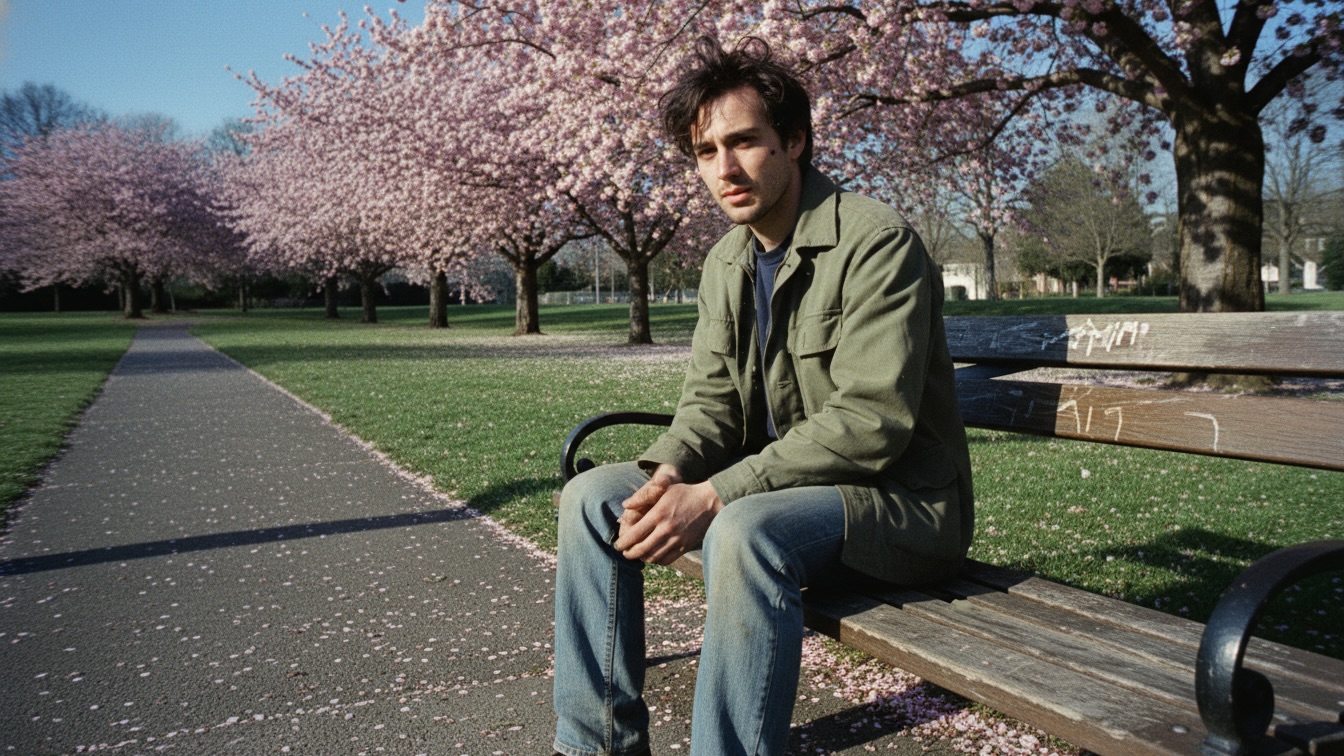
The story follows Leo, a young man navigating the suffocating atmosphere of his family home three weeks after the death of his sister, Maya. His parents have adopted a radical, performative approach to grief, emphasizing a sterile, "peaceful" environment where any mention of the tragedy is strictly forbidden. While his father obsessively manicures the lawn and gardens to maintain an image of resilience, his mother engages in hollow, ritualistic behaviors like serving tea in a house that feels increasingly like a stage set.
As the narrative progresses, the psychological tension escalates into a surreal nightmare. Leo notices a white fragment in the fresh mulch his father has laid down, suggesting a metaphorical or literal attempt to bury the "rot" of their memories. When his parents attempt to draw him into a dark, basement-dwelling ritual to "clean" the house of its remaining disruptions, Leo realizes they have become hollow husks of their former selves. He flees the home, eventually finding a sense of authentic existence in the city where he finally allows himself to experience the raw, unpolished pain of his loss.
The primary theme of the narrative is the destructive nature of repressed grief and the toxicity of "toxic positivity." Leo’s parents attempt to bypass the mourning process by creating a "plastic peace," a state of forced normalcy that functions more like a psychological prison than a sanctuary. By refusing to speak Maya’s name or acknowledge their pain, they have effectively murdered her memory, treating her existence as a "rot" that must be contained or buried.
The story also explores the dichotomy between appearance and reality. The house is described as a "nightmare in a gift box," gleaming with white siding and blooming flowers while harboring a metaphorical beast in the basement. This suggests that the more one focuses on the external "portrait of resilience," the more the internal psyche decays. The father’s obsession with sharp edges and secure borders in the garden reflects an attempt to control the uncontrollable nature of death and trauma.
Finally, the narrative emphasizes the necessity of pain for authentic human existence. Leo’s journey from the sterile, airless house to the dirty, exhaust-filled city represents a transition from a false, theatrical life to a real one. He concludes that it is better to be "broken" and "a mess" than to be a hollow shell. The dandelion he finds at the end symbolizes this theme, as it is a "weed" that thrives in a crack in the sidewalk, representing a life that is stubborn and unmanaged.
Leo serves as the story's protagonist and its moral compass, representing the struggle to remain human in a dehumanizing environment. He is acutely aware of the sensory contradictions in his home, such as the smell of lemon pledge masking the underlying "rot" of the family's trauma. Unlike his parents, he cannot fully commit to the "script" of being okay, which makes him feel like an intruder in his own home. This internal friction manifests as physical symptoms, including a shaking hand and a throat that feels like sandpaper.
His psychological evolution culminates in his decision to embrace his grief rather than bury it. When he looks at the photo of Maya on his phone, he chooses to cry, rejecting the "resilience" his mother demanded. This act of crying is his first true moment of freedom, as it breaks the spell of the theatrical performance his family has been living. By the end of the story, he accepts the dirt under his fingernails as evidence of his reality, signaling a newfound comfort in his own vulnerability.
The mother is a chilling portrait of dissociation and performative motherhood. She uses etiquette and domestic rituals, such as serving tea with silk napkins, as a shield against the reality of her daughter's death. Her eyes are described as "too clear," suggesting that she has surgically removed her own capacity for sorrow to maintain a social facade. She views the neighbors' expectations of their collapse as a challenge to be defeated through a "portrait of resilience."
As the story reaches its climax, she transitions from a grieving woman into a robotic enforcer of the family's "peace." Her physical coldness and her iron grip on Leo’s wrist indicate that she has lost her humanity to the roles she plays. She no longer sees Leo as a son but as a component of the household "system" that needs to be managed. Her refusal to acknowledge the tea spilling over the cup highlights her total disconnection from the physical world and her own internal state.
The father represents the aggressive, controlling aspect of the family’s repression. He uses the lawnmower and the shovel as tools to "secure the borders" and contain the "rot" of memory, treating his grief as a landscaping problem. His voice is described as a "rasp," suggesting that his refusal to speak of his daughter has caused his very ability to communicate to atrophy. He is the architect of the garden, which serves as a literal and figurative burial ground for the family's history.
In the basement scene, he becomes a figure of gothic horror, covered in soot and holding a "pipe snake" made of what appears to be human hair. This transformation suggests that his obsession with "cleaning" has led him into a dark, obsessive madness. He views the "weeds" of memory as a threat that will "take everything" if not ruthlessly suppressed. His final appearance in the doorway, waving like a doll in a dollhouse, confirms that he has become a static, lifeless part of the environment he worked so hard to curate.
The narrative style of the story is heavily reliant on sensory details to create an atmosphere of psychological horror and claustrophobia. The author uses sharp, aggressive imagery, such as the "violent, mechanical scream" of the lawnmower and the "hot" white quartz countertop, to make the domestic setting feel hostile. These sensory inputs reflect Leo's heightened state of anxiety and his inability to find comfort in his surroundings. The contrast between the sterile smells of the house and the heavy, sweet smell of "rotting fruit" outside underscores the tension between the family's lies and the truth of death.
Pacing is used effectively to mirror the protagonist's emotional state, starting with a slow, agonizingly detailed morning in the kitchen. The stillness of the house, where "the windows were locked" and there was "no breeze," creates a sense of stagnation. This slow build-up makes the sudden, frantic energy of Leo's escape feel more visceral. Once he reaches the city, the pacing stabilizes into a reflective, rhythmic flow that mirrors his steady breathing and the movement of the bus.
The narrative voice is deeply introspective, utilizing a first-person perspective to immerse the reader in Leo's paranoia and eventual liberation. The recurring motif of the "theatre" and "actors" provides a framework for understanding the characters' behavior as a forced performance. The transition from the "bright spring sun," which acts as a spotlight for flaws, to the "shadows" of the city where Leo feels safe, illustrates his shift from being an object of scrutiny to an independent agent. This stylistic choice reinforces the idea that truth is often found in the dark, messy corners of life rather than under a sterile, artificial light.


