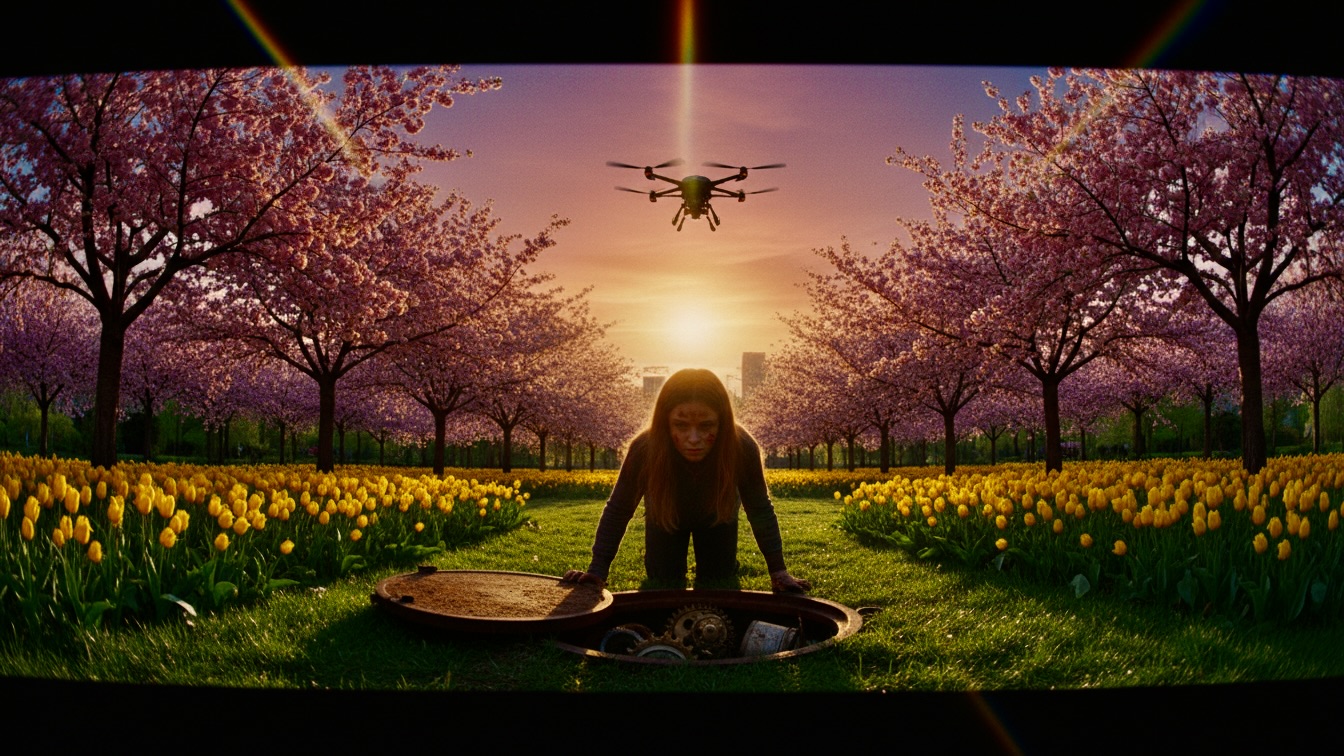
The story follows Marie, a determined young woman navigating a near-future society where the regional government has severed internet access to suppress civil unrest. Alongside her tech-savvy but anxious friend Ted, she utilizes an archaic pneumatic mail system hidden beneath a park's tulip bed to intercept physical government communications. They discover a "Department of Public Compliance" memo revealing that the Governor is using a server farm to simulate public support and drown out strike organizers.
To expose this deception, the duo orchestrates a multi-layered plan involving a carrier pigeon and a drone modified to drop thousands of yellow tulips over a high-society gala. Each flower carries a QR code linking to a localized mesh-net, effectively bypassing the digital blackout. The mission culminates in a tense confrontation between Marie and her brother Samuel, a state officer. Despite his pleas for her to surrender the evidence for her own safety, Marie reveals that the leak is already live, forcing Samuel to choose between his familial bond and his loyalty to a crumbling regime.
The central theme of the narrative revolves around the struggle for information sovereignty in an era of digital authoritarianism. By "pulling the plug" on the regional exchange, the Governor attempts to atomize the population, yet Marie and Ted demonstrate that the physical world remains a viable conduit for truth. The story suggests that while technology can be used to enslave and deceive, the ingenuity of those who understand its "cracks" can repurpose even the most obsolete systems for liberation.
Another prominent theme is the juxtaposition of nature and artifice. The beauty of the cherry blossoms and yellow tulips serves as a mask for both the government’s hidden infrastructure and the rebels' subversive tactics. This contrast highlights the psychological tension of living in a state where appearances are meticulously curated to hide a rotting core. The yellow tulips, traditionally symbols of cheer, are transformed into weapons of transparency, illustrating how even the most benign elements of the environment can be politicized.
The conflict between systemic duty and personal morality is explored through the fractured relationship between Marie and Samuel. Samuel represents the "just following orders" mentality, attempting to justify his role in a deceptive task force under the guise of protection and stability. Marie, conversely, embodies the radical pursuit of truth, arguing that silence is a form of complicity. Their standoff serves as a microcosm of the broader societal divide, where the "truth" is no longer a shared reality but a contested territory.
Marie is a protagonist defined by her technical competence and her unwavering psychological resilience. She possesses a pragmatic, almost clinical approach to the rebellion, viewing the natural world as a "map" rather than a place of leisure. Her internal state is characterized by a "cold, hard clarity" that allows her to prioritize the success of the mission over her personal safety or her emotional connection to her brother. This suggests a personality that has been hardened by the state's oppression, shifting from a student of technology to a soldier of information.
Her motivation is rooted in a deep-seated rejection of artificiality and state-sponsored gaslighting. She feels a sense of betrayal not just by the government, but by Samuel, who she believes has abandoned the very principles of logic and truth he once taught her. This personal stakes-driven rebellion makes her a formidable opponent; she is not just fighting for a cause, but for the soul of her own family. Her refusal to hand over the drive, even when Sam offers her a way out, confirms her evolution into a martyr for the mesh-net.
Ted serves as a psychological foil to Marie, providing a more relatable, human response to the high-stakes environment. While Marie is stoic and focused, Ted is vocal about his anxieties, using humor and modern slang to cope with the pressure of their "domestic sabotage." He represents the segment of the youth who are technically gifted but emotionally overwhelmed by the reality of a police state. His loyalty to Marie is his primary driver, even when he finds the situation "weird" or "mid."
Despite his complaints, Ted’s actions prove his commitment to the cause. He manages the complex logistics of the drone and the pigeon, showing that his nervousness does not translate into incompetence. His character highlights the importance of community and partnership in resistance movements. He provides the necessary support that allows Marie to remain the focused leader, even as he expresses the very real fear that she often suppresses.
Samuel is a tragic figure caught in the cognitive dissonance of serving a regime he knows to be deceptive. He is visibly exhausted, with dark circles under his eyes, suggesting that the psychological weight of his duties is taking a physical toll. He tries to frame his service as a means of protecting Marie, a common psychological defense mechanism used by those in compromised positions to justify their participation in unethical systems. He is trapped between his identity as a "Compliance Officer" and his identity as a brother.
His confrontation with Marie reveals a man who has lost his way, unable to reconcile the "smart" sister he raised with the "martyr" she has become. When Marie forces him to choose between being a "brother or a bot," she strikes at the core of his identity crisis. His trembling hand at the end of the story indicates that his indoctrination is not complete, leaving him in a state of agonizing indecision as the world he helped maintain begins to unravel around him.
The narrative pacing is expertly handled, beginning with a quiet, atmospheric scene in the suburbs before accelerating into a high-stakes heist and a dramatic standoff. The author uses the "deadness" of the world without notifications to create an initial sense of unease, which slowly transitions into the rhythmic "thumping" of the pneumatic tubes—a heartbeat that symbolizes the return of life and truth. This shift in tempo mirrors Marie’s own movement from the periphery of the park to the center of the conflict at the Botanical Gardens.
Sensory details are used to ground the speculative elements of the story in a tactile reality. The smell of "pennies and old oil" in the pneumatic shaft and the "cloying" scent of the tulips create a rich, immersive environment. These descriptions serve to emphasize the physical nature of the resistance; in a world where the digital has been erased, the "receipts" must be felt, smelled, and touched. The contrast between the "pink ash" of cherry blossoms and the "black tactical gear" of the officers visually underscores the clash between life and the state.
The narrative voice is a sophisticated blend of modern cynicism and classic thriller tropes. Phrases like "boomer energy" and "that's so mid" give the characters a contemporary, youthful resonance, making their struggle feel immediate and relevant to a modern audience. At the same time, the descriptions of the "Department of Public Compliance" and "Compliance Officers" evoke a dystopian tradition. This stylistic choice bridges the gap between current social media culture and the timeless struggle against authoritarianism, making the "Yellow Tulip Heist" feel both fresh and archetypal.


