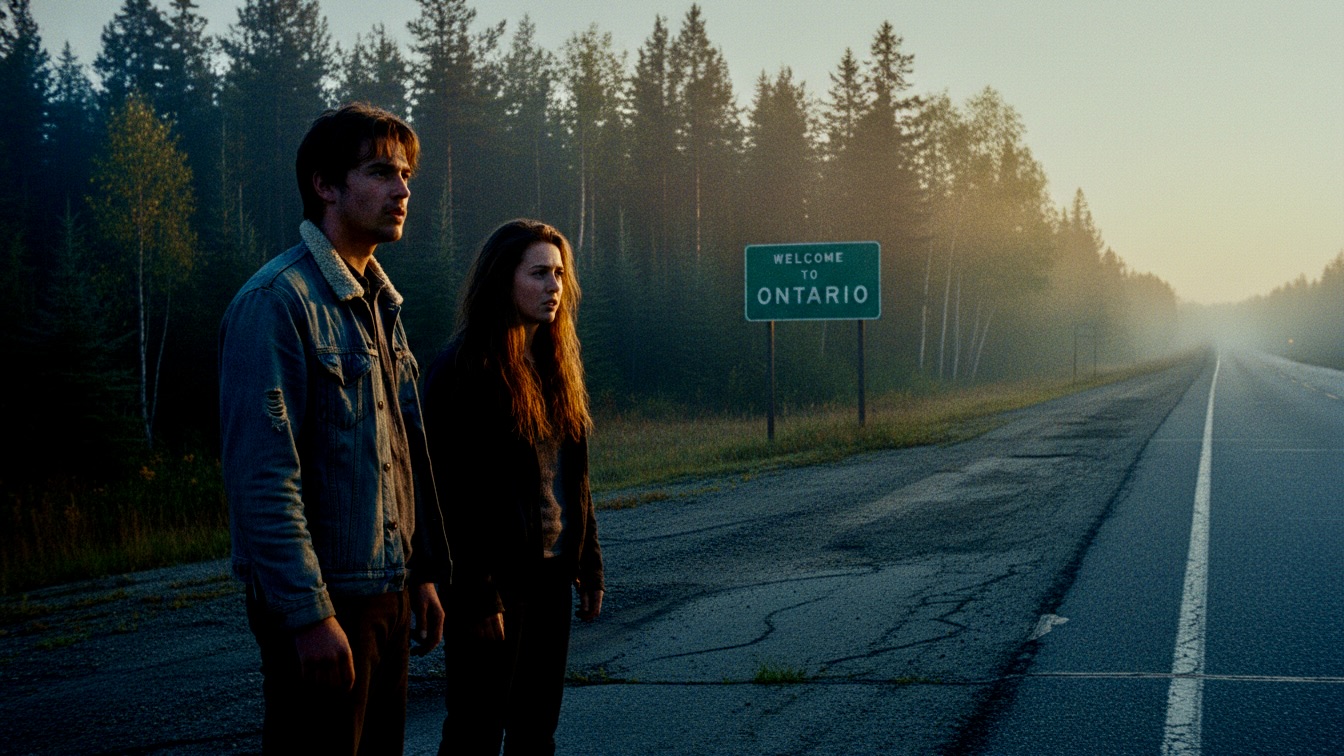
The story follows Tyler and Sarah as they navigate a surreal, purgatorial landscape known as the Shield, a place that manifests their past failures and anxieties as physical objects. The environment acts as a parasitic simulation, rendering their baggage—textbooks, debt, and societal expectations—into white, artificial trees that threaten to consume them. A mysterious, faceless entity representing the burden of their past attempts to force Tyler to accept a duffel bag filled with his regrets. Tyler eventually rejects this temptation, realizing that the labels of his past are irrelevant in this liminal space, which allows him and Sarah to break through the simulation. They emerge onto a real highway in the dawn, seemingly cleansed of their past, though a final, cryptic text message suggests their liberation may be fragile or incomplete.
The narrative functions as a profound meditation on the psychological weight of the past and the existential desire for a clean slate. By literalizing the concept of baggage, the author explores how personal history can become an invasive, paralyzing force that prevents individuals from moving forward. The Shield serves as a metaphor for the stagnation of depression and the feeling of being trapped in a life that no longer aligns with one's identity.
The concept of the "gap" represents the transition between a life defined by external expectations and a life defined by internal agency. The text suggests that the guilt and pressure to succeed are not inherent truths but are instead mental constructs that can be discarded. The shift from the suffocating, static-filled forest to the clarity of the dawn highlights the necessity of shedding one's previous self to achieve genuine survival.
Finally, the story touches upon the ambiguity of transformation. While Tyler and Sarah believe they have escaped their past, the final, mysterious text message serves as a reminder that the world outside the Shield still holds the power to impose its own narrative. The transition from the "white" of the simulation to the "orange and gold" of the sunrise reflects a hope for reality, yet the persistence of the phone implies that the digital tether of their old lives is difficult to fully sever.
Tyler acts as the primary consciousness through which the reader experiences the horror of the Shield. He is a young man struggling with the shame of perceived failure, specifically his decision to drop out of school and his inability to meet the milestones expected of him by his family and society. Throughout the chapter, he demonstrates a desperate need to externalize his guilt, first by trying to discard his phone and later by confronting the entity that offers him his bag of failures. His journey is one of psychological maturation, moving from a state of passive victimhood to an active rejection of his previous, self-deprecating identity.
Tyler's resilience is tested by the temptation to surrender, but his ultimate refusal to accept the bag signals a pivotal shift in his psyche. By realizing that he is "already empty," he finds a paradoxical strength in his lack of direction. This emptiness is no longer a source of shame but a liberation that allows him to define his own path. However, his reaction to the final text message suggests that his sense of self remains precarious, as he is still defined by his relationship to the external messages he receives.
Sarah serves as the emotional anchor for Tyler, though she is initially closer to total psychological collapse. As a female character who has been running from her own life since the age of sixteen, she represents the exhaustion of long-term trauma. Her despair is characterized by a nihilistic view of the future, as she questions whether any destination could ever be different from the life she is fleeing.
Despite her fragility, Sarah becomes a catalyst for Tyler's breakthrough when she allows him to lead her out of the static. Her capacity to regain her focus after Tyler pulls her up suggests that she shares his latent desire for change. Her question about hitching a ride at the end of the chapter demonstrates that while she is ready for a new beginning, she is still navigating the uncertainty of how to exist in a world without the structure of her former life.
The pacing of the narrative is expertly managed to mirror the psychological state of the characters. The beginning of the chapter is heavy and sluggish, mimicking the feeling of walking through deep, abrasive snow, while the middle section accelerates into a frantic, rhythmic intensity as they reach the border. The transition into the final scene is abrupt and sharp, capturing the sensory shock of returning to reality.
The tone is consistently claustrophobic and surreal, utilizing sensory details that evoke discomfort, such as the smell of menthol and the sound of digital static. These elements serve to ground the abstract concept of "baggage" in visceral, relatable experiences. By contrasting the artificial, resin-like texture of the forest with the organic, crisp air of the sunrise, the author emphasizes the difference between the toxic nature of repressed memories and the clarity of living in the present.
The narrative voice remains intimate and urgent, drawing the reader into the claustrophobia of Tyler’s internal struggle. The use of minimalist, punchy dialogue heightens the tension, allowing the subtext of their trauma to remain the focal point. This stylistic choice effectively conveys the sense that the characters are speaking not just to each other, but to the ghosts of their own pasts.


