Format: Short Film / Anthology Episode | Est. Length: 10-12 minutes
The Shield’s Shadow serves as a standalone entry in a speculative anthology series titled The Liminal, which explores the thin, often terrifying veil between mundane reality and the subconscious manifestations of our deepest regrets. Each episode features characters trapped in "The Gap"—a surreal, shifting landscape that mirrors their unresolved trauma—where the environment itself is a physical manifestation of their personal baggage. The overarching series arc suggests that these pockets of reality are not merely accidents, but a purgatorial transit system for those who have reached a breaking point in their lives.
Tyler and Sarah wake up in a forest of white, resin-like trees where the snow feels like crushed glass and their own memories manifest as auditory static. As a faceless figure stalks them with a duffel bag filled with their failures, they realize the environment is actively consuming their pasts to keep them trapped.
Two disillusioned runaways must navigate a surreal, purgatorial forest that manifests their deepest regrets as physical obstacles. To escape, they must abandon the weight of their pasts before they are permanently erased by the entity hunting them.
The episode explores the crushing weight of societal expectations, the paralyzing nature of failure, and the radical act of self-forgiveness. It delves into the concept of "baggage" as a literal, suffocating force, contrasting the artificiality of a life lived for others against the terrifying, liberating truth of starting over from nothing.
The narrative functions as a psychological thriller wrapped in surrealist horror, emphasizing the transition from victimhood to agency. The core emotional undercurrent is the realization that the "man in the suit" is not an external villain, but the internalized voice of guilt that demands payment for every perceived shortcoming.
Tyler and Sarah are at risk of total psychological dissolution, where their identities are absorbed by the forest and replaced by the static of their own failures. If they succumb to the temptation of "going back," they face a life of perpetual, soul-crushing mediocrity, effectively dying while still alive.
The primary conflict is internal, as Tyler and Sarah fight the urge to cling to their familiar, albeit miserable, pasts. Externally, the "Man in the Suit" acts as a manifestation of the status quo, using the characters' own guilt and the physical weight of their "baggage" to force them into submission.
Tyler and Sarah struggle through a white, glitching forest that renders their past failures—textbooks, cigarettes, and missed opportunities—into tangible, suffocating obstacles. The Man in the Suit pursues them, offering a return to their old lives if they only accept the heavy duffel bag of their regrets, while the forest environment actively shrinks around them to force their compliance.
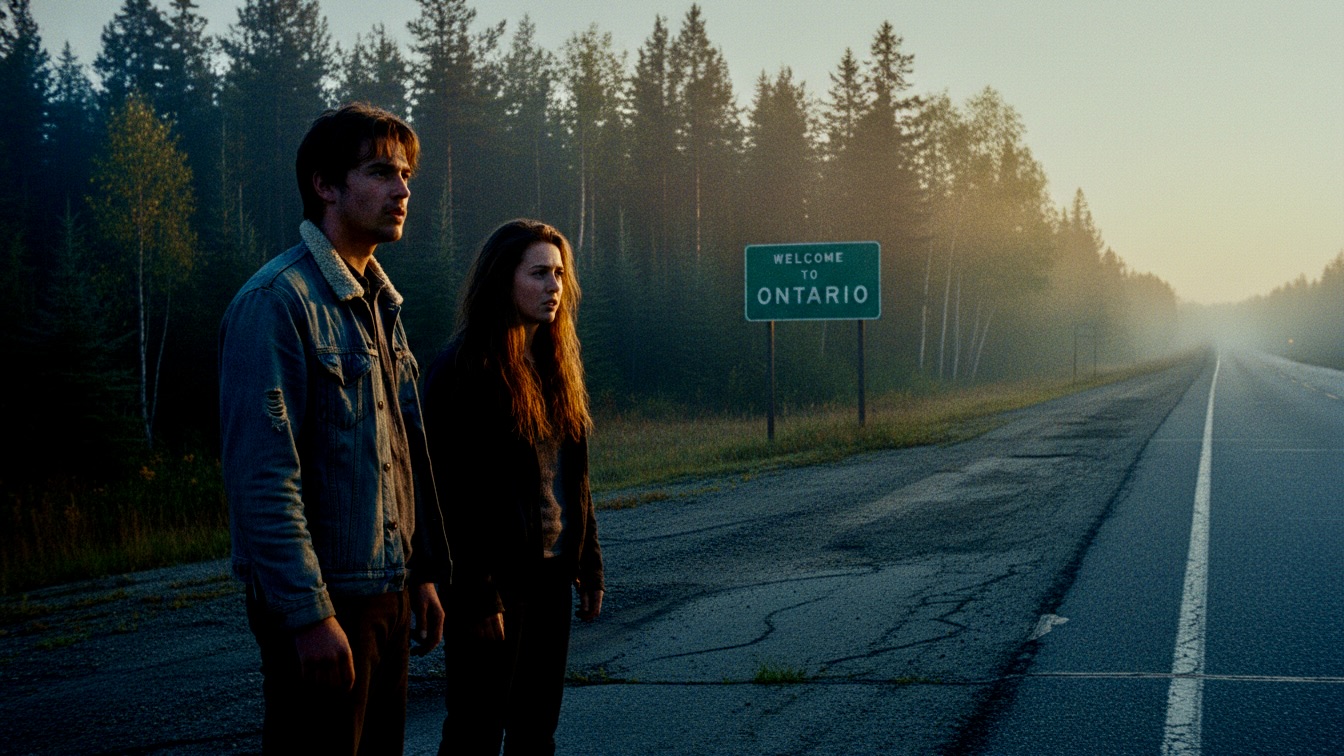
At the brink of giving up, Tyler realizes the futility of his guilt and rejects the bag, triggering a shift in the reality of the forest. The pair breaks through a membrane into a stark, honest landscape, leaving behind the manifestation of their trauma and stepping into a dawn that promises a clean, albeit uncertain, future.
Tyler is a young man paralyzed by the shame of his perceived failures, including dropping out of school and disappointing his family. His arc moves from a state of desperate, guilt-ridden attachment to his past, to a realization that his identity is not defined by his mistakes, ultimately choosing the terrifying freedom of the unknown.
Sarah is a cynical, exhausted runaway who has spent her life fleeing from one dead-end situation to the next. Her arc begins in a state of defeat and nihilistic surrender, but she finds renewed purpose and physical vitality through her shared escape with Tyler, ending the episode with a newfound, fragile hope.
The opening sequence establishes the surreal, abrasive environment of the white forest, immediately setting the tone of disorientation and mounting pressure. The midpoint occurs when the Man in the Suit confronts Tyler, offering him the duffel bag of his failures, forcing a high-stakes choice between the comfort of a known, miserable life and the terrifying void of change. The climax sees Tyler and Sarah rejecting the bag and sprinting toward the light, breaking through the membrane of the forest into the real world, leaving the entity behind as they reclaim their agency.
The episode begins with a claustrophobic, suffocating atmosphere defined by static, gray tones, and high-pitched auditory distortion. As the characters shed their guilt, the mood shifts toward a sharp, crystalline clarity, culminating in a bright, expansive, and hopeful conclusion that feels like a deep, cleansing breath.
If expanded, the series would follow different characters entering "The Gap," with each episode revealing more about the nature of the transit system and the mysterious entity behind it. The overarching arc would track a recurring "Transit Official" or entity that oversees these transitions, hinting at a bureaucratic, cosmic struggle between stagnation and evolution.
As the season progresses, characters from previous episodes might appear as "ghosts" or warnings in the background of new stories, suggesting a shared, interconnected purgatory. The final episodes would likely focus on the protagonists discovering the origin of the Shield and attempting to dismantle the system that feeds on human regret.
The visual style is characterized by high-contrast, desaturated whites and purples, creating a "digital" or "rendered" aesthetic that feels uncanny and artificial. The camera work should be tight and handheld during the forest sequences to emphasize claustrophobia, shifting to wide, steady, and cinematic shots once the characters reach the open plain.
The tone is reminiscent of The Twilight Zone mixed with the surreal, dream-logic horror of It Follows. It prioritizes atmosphere and psychological dread over traditional jump scares, using the environment to tell the story of the characters' internal states.
The target audience is young adults and adults (18-35) who enjoy psychological thrillers, surrealist drama, and high-concept sci-fi. It is designed for viewers who appreciate character-driven narratives that tackle existential themes and the complexities of early-adulthood transitions.
The pacing starts at a frantic, disoriented tempo, mirroring the characters' panic, and gradually slows as they gain clarity and purpose. The narrative structure is a tight, linear progression, utilizing the "run" as a metaphor for the characters' internal journey toward self-actualization.
The forest environment requires a mix of practical set design (smooth, resin-like textures) and subtle, glitch-based VFX to create the sense of a world that is "rendering" in real-time. The transition from the white forest to the real-world highway should be a stark, jarring shift in color palette and lighting, emphasizing the return to organic, natural textures.
The Man in the Suit should be portrayed with minimal movement, relying on sound design—distorted voices and rhythmic, heartbeat-like pulses—to convey his presence. The "bag" should be a practical prop that appears to grow heavier or more burdensome through the characters' physical acting, requiring careful choreography to sell the weight of their emotional baggage.


