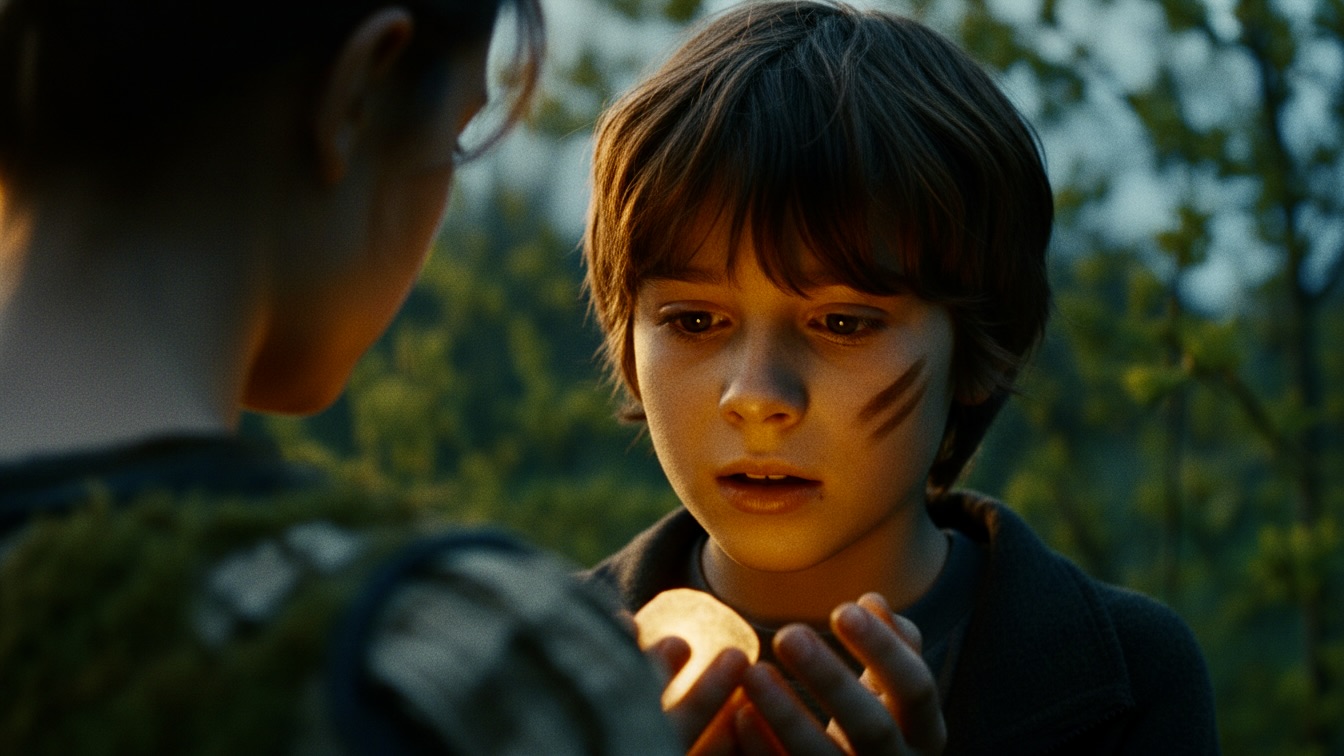
The story begins in the claustrophobic atmosphere of a garage where a young boy named Vern observes the unsettling disappearance of his father’s belongings. He discovers a strange, moss-like creature named Silt hiding beneath a blue plastic tarp, who reveals that a malevolent force called the Fade is consuming the world. This entity does not merely destroy but erases objects and memories, starting with heavy items like metal and stone before moving to living beings.
Driven by the realization that his father’s legacy is being deleted, Vern follows Silt’s guidance to retrieve a protective artifact known as a Spark-stone. They venture into the spring woods, racing against the encroaching shadows that follow the setting sun. Vern successfully recovers the glowing stone from beneath an ancient oak tree, momentarily repelling the darkness. The chapter concludes with Vern committing to a larger quest to find more stones and visit the Stone-Talker in the Sunken City, just as a new threat emerges from the shadows.
The central theme of the narrative is the terrifying nature of entropy and the erasure of identity. The Fade serves as a potent metaphor for the loss of history and the stripping away of a child's security. Unlike traditional destruction, which leaves ruins behind, the Fade leaves a "hole in the world," suggesting that the greatest fear is not death, but the total negation of having ever existed. This resonates deeply with the psychological experience of grief, where the absence of a loved one feels like a physical void in the environment.
Another significant theme is the subversion of seasonal renewal. While spring is traditionally associated with life and rebirth, in this story, it acts as a catalyst for the Fade’s hunger. The warmth and light of the changing season bring a hidden danger, suggesting that growth and decay are inextricably linked. This creates a sense of existential dread, as the very things that should signify safety—the blooming flowers and the melting snow—actually signal the arrival of an all-consuming nothingness.
Memory and its connection to physical objects also play a vital role in the story's thematic framework. Silt explains that the Fade eats "heavy things" and "memories" first, highlighting the idea that our possessions are the anchors of our history. The empty pegboard where the tools once hung represents a hollowed-out past. By saving the Spark-stone, Vern is not just fighting for his life, but for the right to remember and be remembered, turning a simple quest into a battle for ontological survival.
Vern is a character defined by a quiet, observational resilience in the face of profound loss. At the start of the story, he is paralyzed by the "hollow" space left by his father, suggesting a recent or ongoing trauma related to abandonment or death. His initial defense mechanism is to grab a bent screwdriver, a meager tool that symbolizes his diminished sense of power. Despite his fear, he shows a remarkable capacity for empathy by accepting Silt not as a monster, but as a "guest" who is also suffering.
His transition from a passive observer to an active hero is triggered by the realization that his father’s tools were erased rather than moved. This shift represents a psychological breakthrough where Vern moves from mourning to preservation. He overcomes his visceral fear of the dark and the "nothing" to reclaim a sense of agency. By the end of the chapter, the screwdriver is no longer just a scrap of metal but a symbol of his starting point on a journey toward maturity and restoration.
Silt acts as both a herald of doom and a vulnerable companion, representing the fragile remnants of a world being consumed. His physical description—lacking bones and resembling wet moss—suggests a creature that is part of the earth itself, making his fear of the Fade even more poignant. He is a displaced soul, hiding under a tarp because the "yellow light" of the world he is trying to save is too intense for him. This duality makes him a complex guide who is just as dependent on Vern as Vern is on him.
Psychologically, Silt embodies the instinct for survival in a collapsing ecosystem. He uses the word "guest" to describe himself, which implies a sense of politeness and a lack of belonging. His knowledge of the Fade and the Spark-stones suggests he has witnessed the erasure of his own kind or home. By bonding with Vern through a "wiggly hand" grip, he moves from a state of isolated hiding to one of collaborative resistance, providing the necessary lore to ground Vern’s physical courage.
The narrative style is characterized by a stark, sensory-driven prose that heightens the tension between the mundane and the supernatural. The author uses domestic imagery—such as "gray pancakes," "yellow coins," and "kitchen toaster elements"—to describe alien or magical concepts. This technique makes the fantastical elements feel grounded and visceral. It bridges the gap between a child's everyday reality and the cosmic horror of the Fade, making the threat feel more intimate and immediate.
Pacing is expertly managed through the use of light and shadow as a ticking clock. The story begins with a slow, atmospheric exploration of the garage, allowing the reader to feel the "dusty gold" stillness before the action erupts. As the sun dips lower, the sentences become shorter and more urgent. The transition from the static garage to the kinetic run toward the oak tree mirrors Vern’s internal acceleration from dread to determination. This rhythmic shift ensures that the physical journey feels as significant as the emotional one.
The narrative voice maintains a close third-person perspective that emphasizes Vern’s sensory experiences. The reader feels the "hammering" of his heart and the "ice cube" sensation of the Fade’s proximity. This focus on physical sensation serves to contrast the "nothingness" of the Fade. By saturating the text with smells like "old oil" and "cut grass," the author reinforces the value of the physical world that is at risk of being lost. The final cliffhanger, marked by a vibration in the ground, successfully shifts the tone from a moment of relief to one of renewed peril.


