Format: Short Film / Anthology Episode | Est. Length: 10-12 minutes
Imagine a world where the changing of seasons isn't just a biological shift, but a cosmic vulnerability where the fabric of reality thins and the past begins to dissolve. This episode serves as a gateway into The Great Erasure, an anthology series exploring the "Fade"—a sentient void that consumes physical matter and memories during the spring thaw—and the unlikely guardians who must reclaim the world one relic at a time.
The Great Erasure is a high-concept fantasy anthology set in a reality where the "Fade" emerges every spring to delete the history of the world, starting with the heaviest objects and ending with human consciousness. The series follows disparate survivors across a crumbling landscape, centering on an overarching narrative arc where characters like Vern must collect ancient Spark-stones to reignite the "Great Hearth" in the Sunken City. Each episode balances domestic drama with cosmic horror, exploring how humanity clings to its identity and heritage when the very environment is being systematically erased by an impersonal, silent void.
In a garage stripped of its history, a young boy discovers a moss-skinned creature hiding under a blue tarp who warns him that the shadows in the corner are currently eating his father’s existence.
When a sentient void begins erasing his home, a lonely boy must team up with a displaced creature to retrieve a mystical stone before the sunset deletes them both. They must brave the encroaching darkness of a spring evening to stop a hunger that consumes memories as easily as metal.
The primary theme explores the fragility of memory and the physical world, framing loss not as a departure, but as an active, terrifying erasure of one's legacy. It juxtaposes the traditional beauty of spring’s rebirth with the horror of a "Fade" that views growth as a signal to feed, highlighting the resilience required to protect one's heritage against entropy.
The secondary theme focuses on the transition from childhood innocence to proactive responsibility, symbolized by Vern’s movement from a hollowed-out home to the dangerous unknown. The story suggests that while the "Fade" consumes the heavy things of the past, the "Spark" of the future is found in the courage to face the dark with nothing but a bent screwdriver and a new friend.
For Vern, the stakes are existential and deeply personal; if he fails to retrieve the Spark-stone, the remaining traces of his father and his own physical form will be wiped from reality, leaving him a "nothing" in a hollow world. On a broader scale, the failure to secure this specific stone allows the Fade to expand unchecked across the region, signaling the beginning of a seasonal erasure that could eventually consume entire civilizations.
The primary antagonist is the Fade, an impersonal, silent force of entropy that accelerates as the sun sets, creating a relentless race against time. Internal conflict stems from Vern’s grief and paralyzing fear, as he must overcome the trauma of his father’s disappearance to become an active protector of a world he barely understands. Silt provides a secondary layer of tension, as his alien nature and physical vulnerability force Vern to lead a mission he is entirely unprepared for.
Vern discovers his father’s garage is being systematically emptied, not by movers, but by a creeping shadow known as the Fade that leaves only "clean rectangles" where heavy tools once sat. Under a blue plastic tarp, he meets Silt, a mossy, bone-less entity who explains that the warmth of spring triggers this cosmic hunger, which has already consumed his father’s metal tools and is now moving toward the "soft things" like Vern himself. Silt reveals that only a Spark-stone, hidden beneath a nearby ancient oak tree, can repel the darkness, but the sun is rapidly setting, granting the Fade its full strength to erase everything in its path.
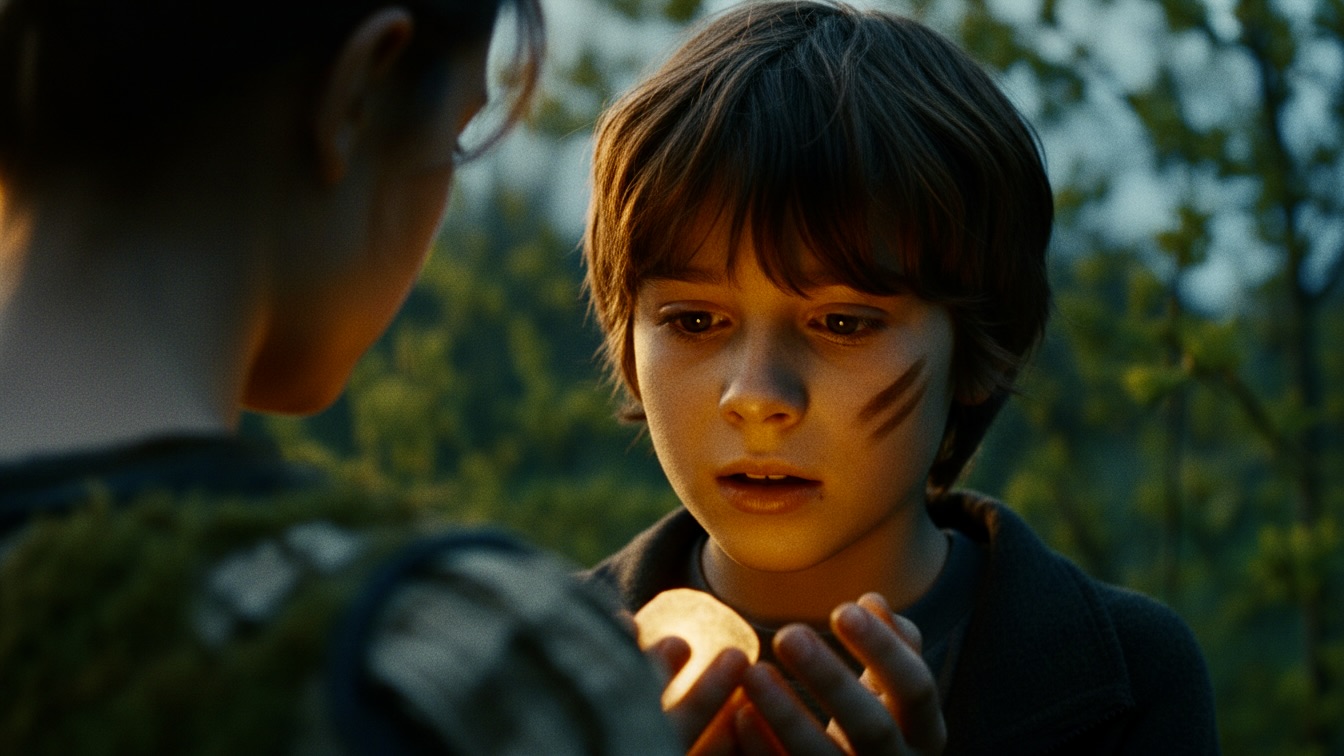
The duo embarks on a desperate sprint across the lawn as the shadows stretch and hiss around them, reaching for Vern’s sneakers with an icy, silent intent. Vern successfully reaches the base of the scarred oak and thrusts his arm into the roots just as the Fade begins to climb the bark, retrieving a glowing, white-hot stone that pulses with orange light. The artifact's heat drives the void back, saving the tree and the boys, but Silt warns that this is merely one skirmish in a global war. Vern, now armed with his father's last screwdriver and the glowing stone, commits to finding the remaining artifacts in the Sunken City as a low growl vibrates through the ground.
Vern: At the start, Vern is a grieving, timid boy paralyzed by the inexplicable loss of his father’s belongings and the hollow silence of his home. His psychological arc moves from passive victimhood to proactive guardianship; by the end of the episode, he has transformed into a "Stone-Seeker," trading his fear for a sense of duty and a willingness to face the unknown. He carries his father's bent screwdriver not just as a tool, but as a symbolic link to the "heavy things" he refuses to let the Fade consume.
Silt: A displaced, mossy entity who acts as a herald of the Fade, Silt begins the story as a terrified refugee hiding under plastic, overwhelmed by the "yellow light" of the sun. He serves as the expositional bridge for the audience, possessing a gravelly voice and a slinky-like physiology that emphasizes his alien nature. His arc is one of finding a protector in Vern, moving from a state of hiding to becoming a vital guide for the journey toward the Sunken City.
Vern stands in a hollowed-out garage, noticing the "clean spots" where his father's heavy tools used to be while the golden hour light reveals a shifting presence under a blue tarp. He armors himself with the only item left—a bent screwdriver—and confronts the intruder, discovering the mossy, coin-eyed Silt who explains that the Fade is eating the "heavy things" first. Silt points to a corner of the workbench that is silently vanishing into a hole in reality, forcing Vern to realize that his father's legacy is being deleted in real-time.
Realizing the Fade is a sentient hunger triggered by the warmth of spring, Vern agrees to help Silt retrieve a Spark-stone from the roots of a scarred oak tree before the sun vanishes completely. They flee the garage as the shadows begin to crawl across the floor like liquid, reaching for Vern’s sneakers with a cold, silent intent that makes the air feel like it is holding its breath. The race through the yard is a frantic blur of lengthening tree shadows and the smell of cut grass, with Silt undulating across the lawn as the temperature drops and the Fade begins to climb the target tree.
Vern dives into the graying grass at the base of the oak, thrusting his arm into a dark hole just as the Fade’s icy touch reaches his back. He retrieves the white-hot Spark-stone, and its orange pulse causes the shadows to hiss with a vibration felt in the teeth, forcing the void to retreat into the woods. The episode concludes with Vern and Silt standing in the starlight, looking toward the distant hills as a low growl shakes the blossoms from the trees, signaling that their journey to the Sunken City has only just begun.
The episode begins with a sense of quiet, atmospheric dread and domestic loss, evoking a "liminal space" aesthetic that feels both familiar and wrong. It transitions into a high-stakes, kinetic thriller as the sun sets, peaking with a moment of intense, cold terror at the base of the tree where the audience feels the literal erasure of the world. The final mood is one of "cozy courage"—the warmth of the stone providing a small circle of safety against an immense, dark world, leaving the audience feeling both unsettled and inspired.
The season follows Vern and Silt’s journey across a landscape being slowly deleted, moving from the suburban outskirts to the surreal, waterlogged ruins of the Sunken City. Each episode introduces a new "Stone" and a different manifestation of the Fade, such as the "Sound-Eater" or the "Color-Thief," escalating the threat as the world becomes increasingly unrecognizable and the characters' own memories begin to flicker.
As Vern collects the stones, he discovers that his father wasn't just a victim of the Fade, but a former Guardian who hid the artifacts to protect his son from a destiny he wasn't ready for. The season finale involves Vern using the assembled stones to reignite the "Great Hearth," temporarily halting the seasonal erasure but revealing a much larger, sentient architect behind the void who is displeased with the return of the light.
The visual style utilizes high-contrast cinematography, moving from the warm, "dusty gold" of the opening to the deep, unnatural blacks of the Fade. The "nothingness" of the Fade should be rendered as a visual glitch—a lack of texture and light that makes the surrounding environment look like a crumbling digital file, creating a stark contrast with the vibrant, tactile greens of the spring woods.
The tone is "Amblin-esque horror," blending the wonder of a child’s adventure with the genuine, cold stakes of cosmic dread. Influences include the atmospheric stillness of Stranger Things and the surreal, biological oddity of Annihilation, maintaining a PG-13 level of intensity that focuses on the psychological horror of being forgotten rather than traditional jump scares.
The target audience is the "New Weird" and "Young Adult" demographic, specifically viewers aged 10-16 and fans of dark fantasy anthologies like Tales from the Loop. It appeals to families who enjoy "gateway horror"—stories that are spooky and high-stakes without being gratuitously violent, focusing instead on emotional resonance and imaginative world-building.
The 10-12 minute runtime demands a lean, three-act structure: the discovery (0-3 mins), the flight (3-8 mins), and the confrontation/resolution (8-12 mins). Pacing starts slow and observational to build the atmosphere of the garage, then accelerates into a relentless "real-time" chase once they leave the side door, ensuring the tension scales perfectly with the setting sun.
The Fade should be achieved through a mix of practical "Vantablack" materials and post-production masking to ensure it looks like a hole in the frame rather than a traditional shadow. This visual "void" effect is crucial for establishing the stakes; it must look like matter is simply ceasing to exist rather than being covered by darkness.
Silt requires a high-quality practical puppet or animatronic for close-ups to maintain the "wet moss" texture and "coin-like" eye reflections, supplemented by CGI for his undulating movement during the chase sequence. The Spark-stone must be a practical light source (LED-integrated prop) to provide realistic interactive lighting on the actors' faces and the environment during the night scenes, grounding the fantasy elements in a tactile reality.


