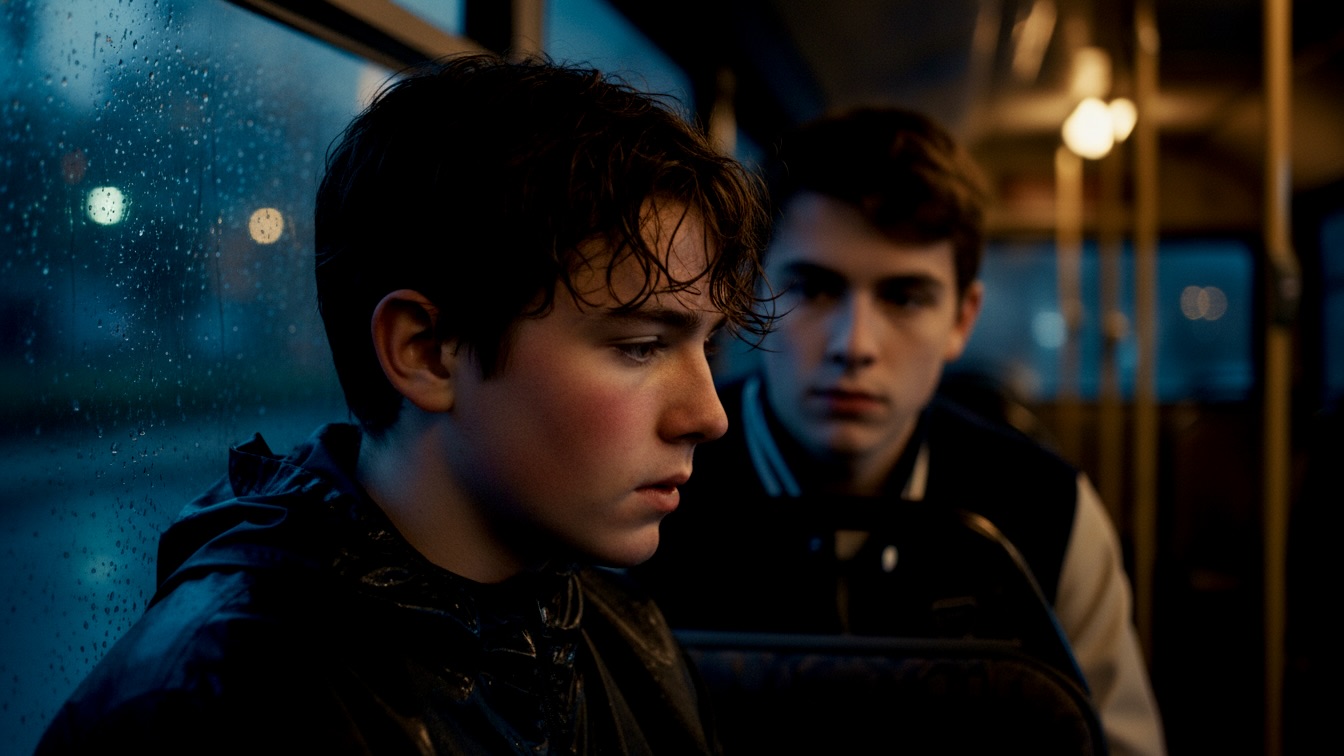
Michael boards a late-night bus with a banged-up knee and gets off with a full-blown identity crisis. Let’s diagnose the vibe.
There is a specific kind of hell reserved for people who realize they’re in love on public transit, and Michael from Route 44 is currently serving his sentence there. The setup sounds almost insultingly small: a bruised knee from practice, a late bus, a best friend sitting too close in the quiet dark. And yet by the time the wheels are turning, Michael is having the internal experience of a Victorian ghost who has just been handed a telegram announcing his own feelings.
The story tells us that on this ride, “the line between teammate and predator begins to blur,” and friends, that one sentence contains an entire psychology textbook if you hold it up to the light.
Here’s what’s actually happening in Michael’s skull, and it’s genuinely fascinating. His nervous system has detected an anomaly — warmth, attraction, a pull toward his best friend — and because Michael has been raised in the kind of environment where male friendship has one (1) acceptable flavor and it is not “my heart does a little kickflip when he looks at me,” his brain has done what brains do with unlabeled phenomena: it filed the feeling under THREAT.
Not crush. Not longing. Predator. His own best friend, the guy he’s probably shared locker rooms and bad pizza with for years, gets mentally reclassified as something dangerous lurking in the dark of the bus. That is the most efficient and most tragic piece of cognitive processing I’ve ever seen.
The attraction didn’t change. The labeling changed. And the labeling is everything.
This is what happens when a culture gives you a twelve-word emotional vocabulary and six of the words are about sports. When the entire acceptable range of male feeling runs from “hungry” to “furious about losing,” anything outside that bandwidth doesn’t get to be a feeling — it gets to be an emergency. And Michael responds like it’s an emergency, because as far as his training is concerned, it is. His pulse is up. His senses are heightened. There’s a creature near him giving off heat. The fact that the creature is his best friend and the heat is “impossible” in the sense that his world has made it unspeakable — that’s a nuance his survival-brain has no time for. Fight or flight does not do nuance. Fight or flight does not even do subtext.
The horror framing of the story is the masterstroke here, because it’s not really supernatural at all. It’s the horror of wanting something you’ve been trained to fear, wearing monster makeup because monster language is the only vocabulary available. Michael can’t think “I like him.” He can only think “something is wrong with the night, and it’s sitting beside me.” And the cruelty of it is that he’s probably convinced he’s handling the situation with tremendous maturity, because he hasn’t said a single word out loud. Sir. The bus can hear you. Silence that loud is a genre of screaming.
Where does this come from socially? It comes from every small town and every locker room where desire between guys gets coded as predation rather than tenderness — where the scariest thing in the room was never a monster, it’s your own honesty catching up with you.
Sports culture in particular runs on a very specific machine: intense physical intimacy between guys, rigidly policed by homophobic joking, so that the body gets all the closeness and the feelings get none of the language. Michael was built in that machine. Of course the first sign of genuine tenderness short-circuits him into seeing a predator. The machine only outputs two settings: teammate, or threat. He was never given a third file to put his friend in.
So does he need therapy? Oh, enormously. But more urgently, he needs one single person to look him in the eye and tell him that “my best friend makes me feel warm” is not a five-alarm event, that attraction is not an ambush, and that the terrifying heat he’s cataloguing is just what unexpressed want feels like when it lives in a body that’s been told wanting is the enemy.
The deepest lesson in Route 44 is hiding in that word “impossible.” The feeling isn’t impossible. The vocabulary is. And until somebody hands Michael a bigger dictionary, every late bus he ever rides is going to feel like this one — dark, humming, and full of a monster that turns out to be his own heart, sitting politely in the seat beside him, waiting to be named.