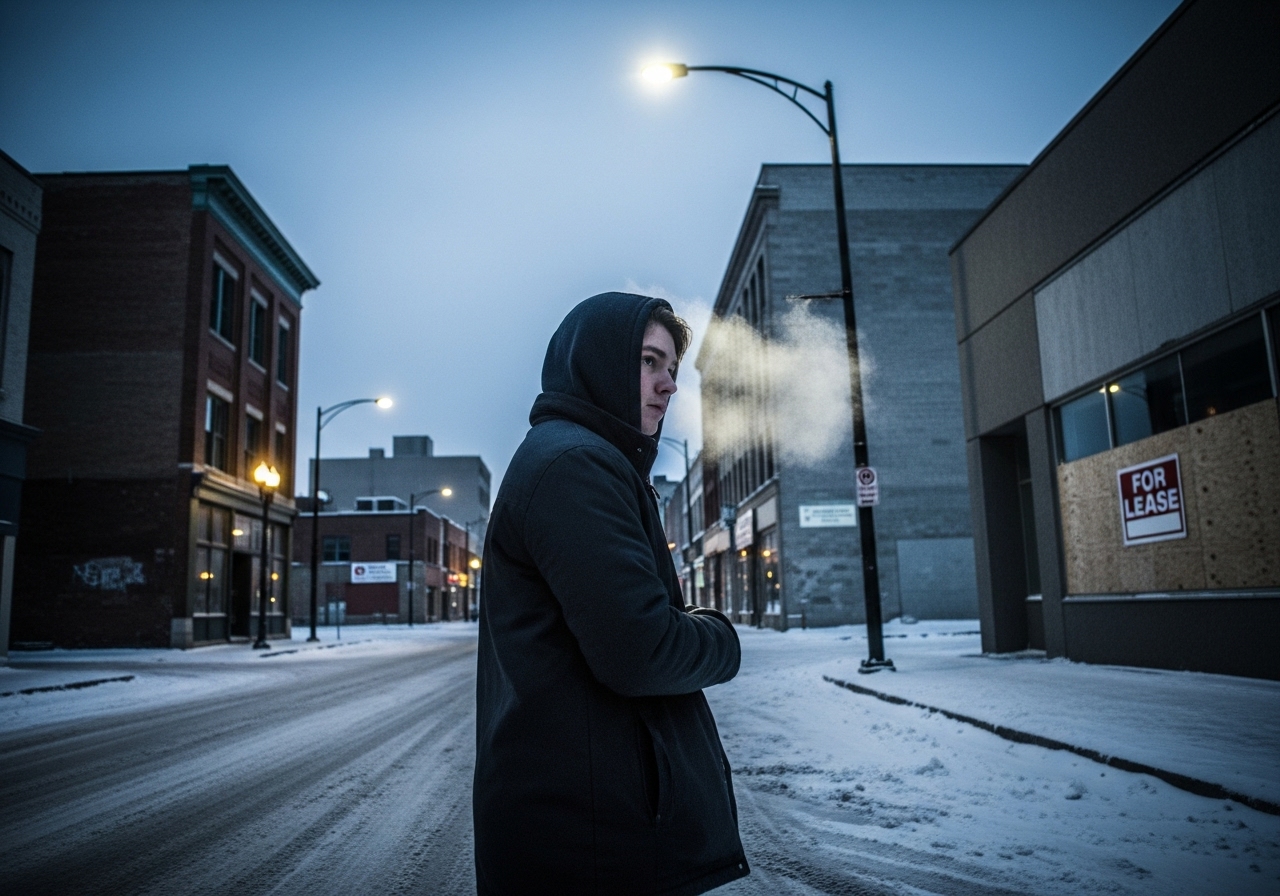
The Barista Crossed the Veil but Kept the Wi-Fi Password of the Soul.
This story was one of our favourites. Cobblestone Fractures.
Julian walks into a Winnipeg coffee shop carrying the kind of problem that doesn’t fit in any container: a life-altering decision, a pivotal moment, his mind swirling with existential dread and paralyzing uncertainty. He needs help. And help arrives, warm and perceptive and patiently wise, in the form of Cathy — the cafe’s proprietor, who listens to his spiraling, offers sage counsel, gently points out that life’s journeys are inherently unplanned, and sends him back into the world changed.
There’s just one wrinkle. Cathy has long since crossed the veil. Yep. She’s dead. A ghost. Julian has received career counseling, emotional support, and possibly the best therapeutic from a ghost, and I need you to understand that this is simultaneously the funniest premise we’ve covered and the most quietly devastating social diagnosis on the list. The dead woman is out-listening everyone alive.
What’s Julian’s actual condition, underneath the supernatural garnish? It’s the post-early-adulthood special: decision paralysis fused with existential dread. He’s at one of those hinges life presents exactly a handful of times — the door where choosing one future means amputating every other possible self, and the grief of those amputations happens in advance, on his side of the threshold, before a single choice has been made. That pre-emptive mourning of unlived lives is paralyzing in a very specific way: you can’t move, because moving feels like murdering your other selves, and he is a kind person, an earnest soul trying to figure it all out, constitutionally incapable of homicide. So he sits in the cafe, stalled, spiraling, doing the only thing a conscientious person can do with an impossible choice — talking about it.
Enter Cathy. Dead. Brilliant. Available.
And here’s where the story stops being cute and starts being profound, because the thing that heals Julian is not the advice. Listen to what actually happens in this exchange: someone — anyone — holds his fear without flinching. Doesn’t rush it, doesn’t minimize it, doesn’t hand him a five-step framework or tell him to journal. Just receives the whole tangled knot of dread, reflects it back at him smaller than it felt from the inside, and hands it back in a form he can carry. That, friends, is not “a chat with a nice lady.” That’s literally the core mechanism of good therapy, executed flawlessly over the course of one coffee. The witnessing. The unhurried attention. The gentle reframing — of course life’s journeys are unplanned; everyone you admire got there by accident and nerve; the map is drawn after the territory. Julian doesn’t leave with a decision. He leaves with his fear metabolized. That’s not advice. That’s medicine.
Now — the mug. The poor, perfect, untouched mug. It sits there cooling the entire conversation, because Julian is too busy finally being heard to keep performing the normalcy of drinking coffee.
That little prop is the whole psychology of the scene in ceramic form. All session he’s been managing the performance of a functional person having a normal cafe visit — and the moment someone actually pays attention, the performance drops, and the mug goes cold, because his hands have better work to do: gesturing, trembling, finally telling the truth. Anyone who’s ever been truly listened to knows this exact sensation — the relief so complete it interrupts basic bodily maintenance. You forget to drink. You forget to perform. You just… talk, and get lighter. Cathy’s whole intervention cost zero dollars and one cup of coffee that nobody drank. The ghost co-pay was nothing. Follow-up appointments are hard to schedule, but on outcomes, she’s currently outperforming most of the living.
Now the part that stings. Julian’s breakthrough comes from a woman whose only qualification — and I say this with a lump in my throat — is that she has nothing left to do all day but pay attention to him. She’s dead. She has no KPIs, no phone buzzing, no other customers waiting, no inbox, no grinding worry about her own rent. She is, in the most literal sense, fully available in a way no living person in his life apparently has been.
And that’s the accidental social diagnosis hiding in this whimsical premise: real listening has become so rare that the only qualified practitioner in Julian’s world is deceased. The living are too busy, too distracted, too stretched thin, too busy performing their own normalcy over their own untouched mugs. Somewhere along the way we built a world of people starving to be heard, surrounded by people too exhausted to listen. Cathy’s spectral availability is a wish-fulfillment figure — the fantasy of being received completely — and the fact that the fantasy requires death to be plausible is the joke that hurts.
Here’s the science: a first heartbreak activates the brain’s pain and attachment systems at maximum volume with zero prior data to modulate it. To a teenager, this isn’t “a sad event.” It’s the collapse of the first world they ever built. That’s why it reads as apocalyptic — neurologically, it basically is. The brain hasn’t learned the “this ends and you continue” pattern yet. Every first heartbreak feels like the last page of the book because you don’t know the book has more pages. The Winnipeg winter is just being honest on the city’s behalf: yes, it’s cold, yes, it ends, yes, you go on.
The genius detail is the cobblestone … the fracturing. The ground itself can’t stay whole under this conversation. First love always ends on terrain that feels cracked afterward. You walk the same street later and the pavement is personally implicated.
Does Julian still need a living therapist? Sure, for continuity — the dead have an opaque cancellation policy and can’t do follow-up. But the deeper prescription isn’t clinical, it’s communal, and the story hands it to us like a note passed in class: be someone’s Cathy while you’re still on this side of the veil. That’s the whole assignment. Not advice — advice is cheap and everywhere; every podcast will sell him a framework by Thursday. Attention is the actual medicine, and it’s in critically short supply, and the only factory that makes it is individual humans deciding, one conversation at a time, to put the phone face-down and receive somebody.
Julian’s transformation doesn’t happen because Cathy was wise. Plenty of living people are wise. It happens because she was there — wholly, unhurriedly, undividedly there — and the eerie, funny, heartbreaking punchline is that being fully present with another person for one hour is now such a rare event that when it happens to us, it feels like the touch of the otherworldly. It shouldn’t. It should feel like Tuesday. It used to be Tuesday.
So … the ghost was real, the healing was real, the lesson is real, and it belongs to the living: advice is cheap and everywhere. Attention is the actual medicine. The mug can go cold. Let it.
Somebody in your life is sitting in a cafe right now, spiraling about a door they’re afraid to walk through, rehearsing a performance of okay-ness over a coffee they keep forgetting to drink. And the entire intervention available to you — no degree required, no veil to cross — is to sit down, put your phone away, and listen like you have nothing left to do all day.
Be the haunt they need. Do it while you’re alive. It’s the one miracle we can all actually perform.
Click here to read Cobblestone Fractures by Jamie Bell from the Unfinished Tales and Short Stories library.