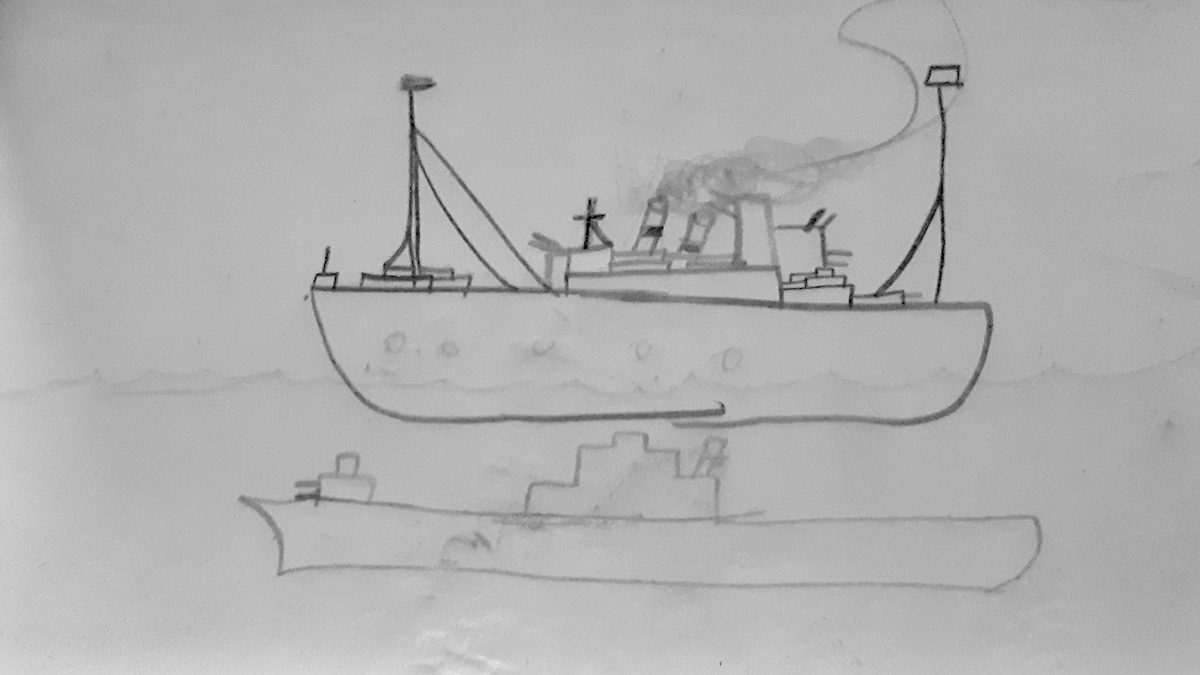
Living History in the Margins: A Student’s View of a World at War Found Inside “How Our World has Changed
It feels incredibly poetic that these drawings were discovered inside a book titled How Our World has Changed. As we were moving the collection into the reading area at Dyment Recreation Hall, the irony wasn’t lost on us.
While the printed text of the book likely aimed to teach students about the steady march of progress, the margins tell the real story of a world shifting in real-time. For a student sitting in this former schoolhouse during the 1940 and 1950s, “change” wasn’t a dry academic concept—it was something happening out on the Atlantic and in the skies over Europe, and they were capturing it one pencil stroke at a time.
The latest find is a hauntingly focused sketch of a merchant ship moving across the surface of the water. Below it, lurking in the white space of the page, is the unmistakable silhouette of a U-boat. There is a chilling silence to the drawing; the student even took the time to add delicate curls of smoke from the ship’s funnels, contrasting the peaceful scene above with the predatory threat waiting below. It’s a remarkable piece of storytelling for a child to produce, capturing the specific, terrifying tension of the Battle of the Atlantic right next to a chapter probably meant to be about the Industrial Revolution or modern trade.
Seeing these two images together—the doomed warplane from the previous book and now this naval ambush—paints a vivid picture of a generation that was deeply preoccupied with the mechanics of war. The student wasn’t just doodling; they were using the margins of How Our World has Changed to document exactly how it was changing. These textbooks were clearly more than just homework to them; they were a canvas for processing a global reality that was far more gripping than whatever the teacher was saying at the front of the room.
We have left these volumes out for the community to explore because they turn our library into a living connection to the past. These aren’t just damaged books; they are artifacts of a childhood lived during a global crisis. The contrast between the formal title of the book and the restless, violent art in its margins is a perfect reminder that history is rarely as neat as the people who write the textbooks want it to be.
Next time you’re at Dyment Hall, have a look through these pages—you’ll find a version of history that was never meant for the curriculum.