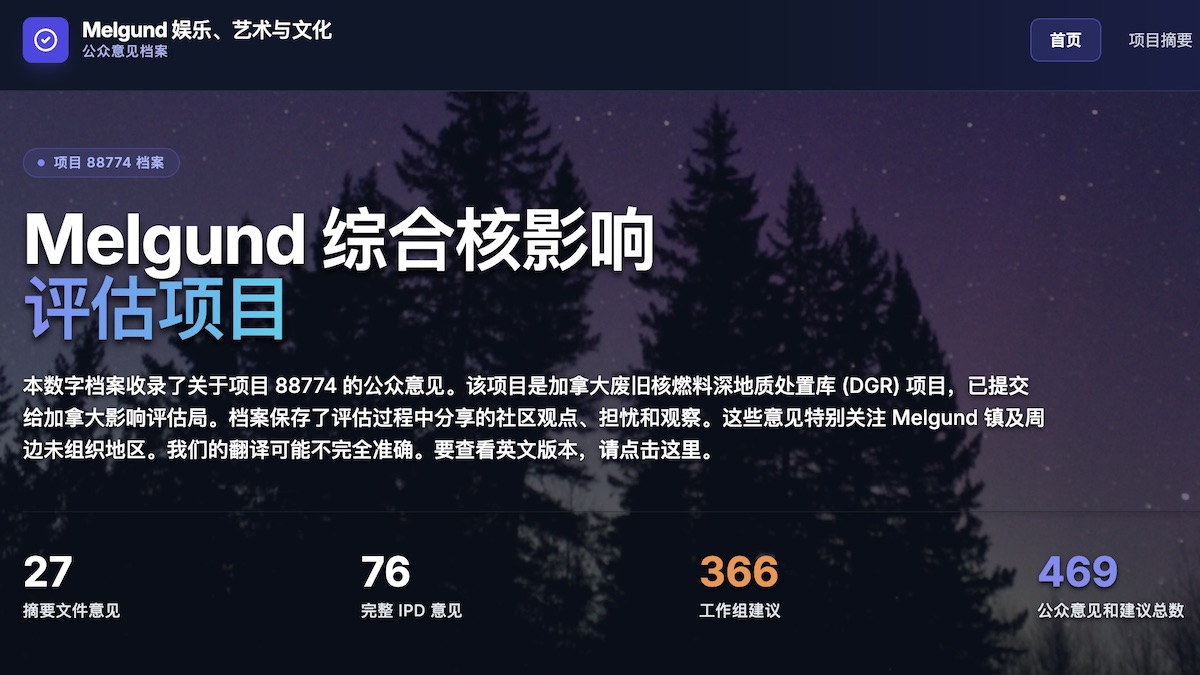
This fun, experimental project explored the use of applied AI research and generative models to translate nuclear waste impact assessment content into Simplified Chinese.
Bridging the Nuclear Divide with Applied AI, Participatory Research and Translation
Abstract
In a world where climate change and energy infrastructure are global concerns, local impact assessments often remain trapped in linguistic silos. This project explores an experimental initiative to deploy Applied AI for the translation of complex regulatory documents into Simplified Mandarin. Driven by audience growth from China and a commitment to innovation through participatory research, this project explores and demonstrates how Artificial Intelligence can democratize access to technical knowledge, foster cross-cultural dialogue, and transform a local nuclear waste consultation into a global case study in digital transparency.
This project was purely for fun and out of curiousity.
Introduction:
Our platforms get a lot of traffic, and honestly, we love it. On any given day, people from all over the world land on our sites to look at our photos, follow our storytelling projects, and dig into our research on things like climate entrepreneurship and Applied AI. Lately, that interest has extended to our community impact assessment project for the Nuclear Waste Management Organization’s (NWMO) proposed Deep Geological Repository (DGR). It’s been incredible to see our local efforts in Northwestern Ontario gain such a massive, international audience.
We also get a huge amount of visitors from China. With a growing number of regular readers from places like Shanghai, Beijing, Lanzhou, Korla, Shenzhen, Guangzhou, Chengdu, Wuhan, Hangzhou, Urumqi, Xi’an, Nanjing, Chongqing, Tianjin, Harbin and many others. While our short stories and storytelling club remain the most popular, we noticed that readers were increasingly sticking around for deep dives into climate change, climate entrepreneurship and nuclear waste.
Like many countries around the world, Canada is in the middle of a global pivot on energy policy. As many nations grapple with the dual needs of decarbonization and energy security, the debate around nuclear power—and specifically, the long-term management of nuclear waste—has become an increasingly popular topic. The questions we are asking here in the Canadian Shield are the same questions being asked in places like the research corridors of Korla or Finland.
We realized we had a unique opportunity. As a fun experiment in Applied AI and Knowledge Mobilization, we decided to launch a small project: building a mirror of our nuclear archive, fully translated into Simplified Mandarin. But instead of hiring an army of translators, we’re using with advanced Large Language Models (LLMs) to ensure our work, from creative stories to technical reports, can be shared and understood across the globe.
The Imperative: Why Mandarin? Why Now?
The decision to translate our work into Chinese was driven by three core realizations:
- The Global Nature of the Nuclear Dialogue: China is currently leading the world in the construction of new nuclear power plants. The technical and social challenges of waste management we face in Canada are relevant to the burgeoning nuclear sector in Asia. By sharing our “local” data, we think we can make our own small contribution to a “global” repository of lessons learned.
- The Innovation Mandate: We view our project not just as a record-keeping exercise, but as part of our living lab for Community-Based Participatory Research (CBPR). If we want to test the limits of digital literacy in a northern and rural context, we must be willing to experiment with emerging tools.
- Knowledge Equity: Language should not be a barrier to understanding the environmental impacts of mega-projects. Since our data is public, why not make it truly public? Let’s make it accessible to the widest possible demographic of interested readers, researchers and citizens.
Methodology: AI as a Research Partner
For us, this project was not a simple exercise in “copy-paste” into a translation widget. That kind of approach often fails when dealing with complex regulatory text. A “Deep Geological Repository” is not just a “hole in the ground”; it is a specific technical and legal concept.
A “Context-Aware” Translation Protocol
Standard translation engines often strip text of its context. In our pipeline, we built a system that understands what it is translating. When the system encounters a submission about “cumulative effects,” it doesn’t just look for the dictionary definition. We feed it the IAAC Context—the specific regulatory framework of the Impact Assessment Act and the processes we’re engaging with—so it understands that “cumulative effects” has a legal weight regarding Indigenous rights and long-term environmental degradation.
We engineered specific prompts (System Instructions) that instructed the model to act as a “Professional English-to-Mandarin Translator specializing in technical regulatory documents.” We enforced strict rules:
- Structural Integrity: The JSON data structures had to remain identical to ensure our frontend code could render the Chinese site without modification.
- Deep Recursion: We needed to translate not just the surface summaries, but the nested “key claims,” “underlying assumptions,” and “strategic rationales” buried deep in our data objects.
- Tone Preservation: The translation had to capture the voice of our community submissions without sounding robotic.
This, we think, is the essence of Participatory AI. We are using state-of-the-art technology to amplify human voices, ensuring that a handwritten letter from a resident in Borups Corners can be read and understood by a policy student in Shenzhen with the same level of emotional and intellectual impact.
Discussion: Democratizing the “Black Box” of Impact Assessments
Historically, Impact Assessments have been “Black Boxes”—dense, impenetrable PDFs stored on government servers, accessible only to lawyers, technical experts and consultants. By digitizing these records and now translating them, we are prying that box open.
This project demonstrates that Applied AI can lower the barrier to entry for complex knowledge sharing. A small community organization with limited resources (like ours) can now operate with the multilingual reach of a multinational NGO.
In some ways, we are effectively collapsing the distance between the “local” and the “global.” When a resident in Melgund raises a concern about the transport of nuclear waste on the Trans-Canada Highway, that data point is now available to international researchers studying logistics safety in hazardous material transport. We are not just translating words; we are translating experience.
The Role of Community in the AI Loop
It is crucial to emphasize that this is a community-led initiative. The AI did the heavy lifting of translation, but the intent, the curation, and the validation were human. We believe this alo represents a new model for Digital Literacy. We don’t want to be passive consumers of AI; we want to be active shapers of it. We are teaching our community that these powerful tools can be harnessed to protect our interests and share our story. We are also demystifying the technology by applying it to the things that matter most to us: our land, our water, and our future.
Conclusion: A Blueprint for the Future
This simple project serves as a proof-of-concept for a world where language barriers no longer impede the flow of critical environmental knowledge. We envision a future where every major environmental assessment is instantly available in dozens of languages, allowing for a truly global peer-review process. Imagine if the lessons from Fukushima, Chernobyl, or Onkalo were instantly accessible to every community facing similar projects, regardless of the language they speak.
And, by combining the passion of community innovation with the power of Generative AI, we are learning to build this new kind of infrastructure. It isn’t made of concrete and copper, but of code and curiosity. It is an infrastructure of understanding.
We invite our new readers from China—and from around the world—to explore the archives. Read the submissions and perspectives of our community and neighbours. Analyze our data. And let us continue this vital conversation, across borders and across languages, for the sake of the planet we all share.
Click here, to visit the site. It’s still a work in progress, and admittedly and experiment we did mostly for fun. But we hope people find it useful. You can visit the English version of our project at: https://melgundrecreation.ca/nuclear
Acknowledgements
*This project was made possible with support from the Melgund Recreation, Arts, and Culture team, the support of the Arts Incubator Winnipeg, and the curiosity of our community members. Thank you for this fun experience, as we learned a lot!
About the Author