Evaluating Subsurface Suitability and Geological Claims
This article is part of a series exploring the views and perspectives of youth, artists and community members working with the Melgund Integrated Nuclear Impact Assessment Project. This initiative is a climate entrepreneurship and arts-based community recreation program, developed through community consultation, engagement participation in the integrated impact assessment process for the NWMO’s proposed Deep Geological Repository for nuclear waste fuel.
What is Proposed
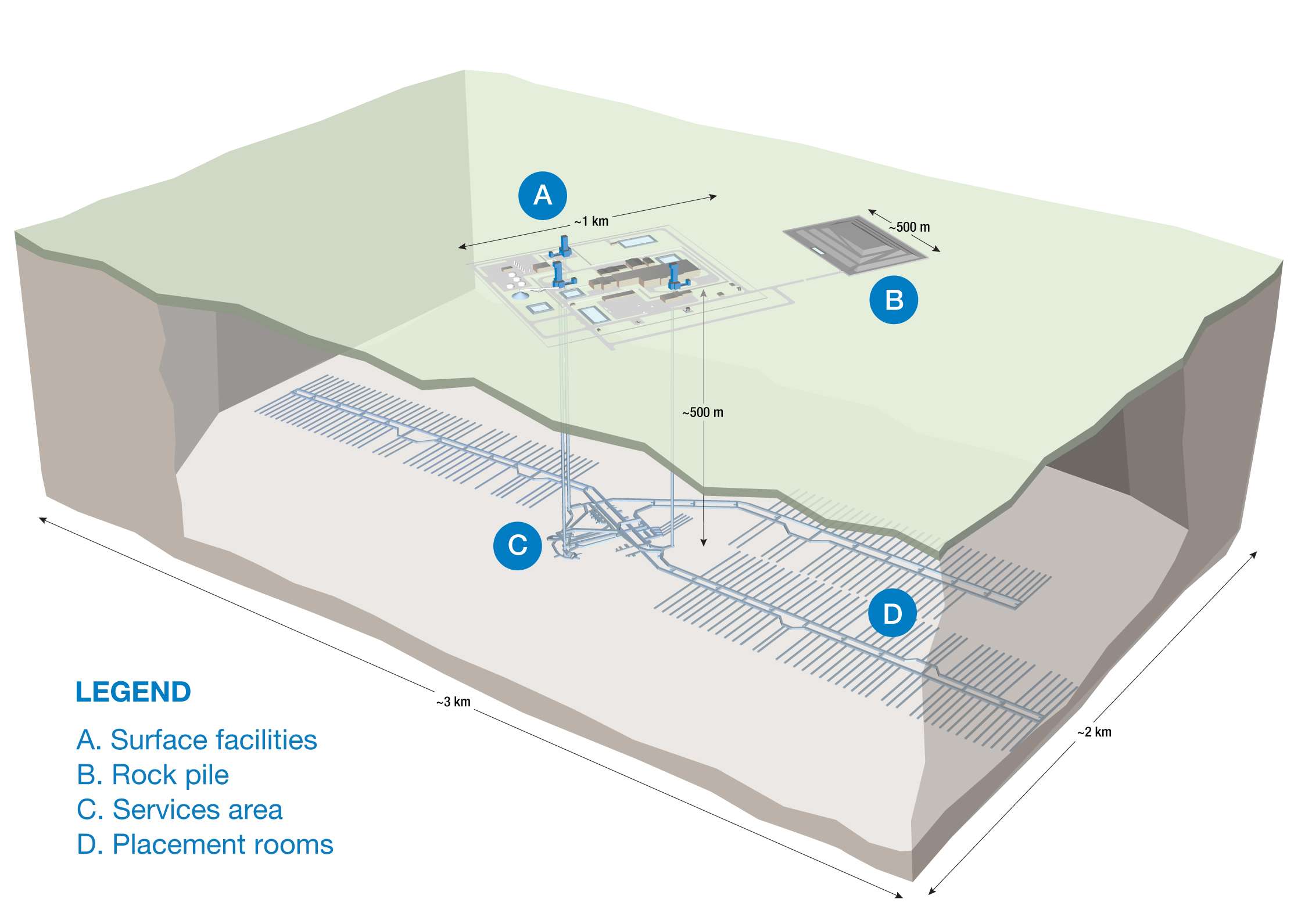
The proponent asserts that the Revell site contains a sufficient volume of homogeneous and competent granitoid rock to host a Deep Geological Repository (DGR). As outlined in the Initial Project Description, the proposed design targets a depth of approximately 750 meters, situated between inferred fracture zones. The proponent claims that the site’s minimal overburden and bedrock exposure facilitate study and that there is no evidence of risks such as landslides, liquefaction, or unstable ground.
Underlying Assumptions
- The “inferred” fracture zones are accurately mapped despite a lack of high-resolution 3D seismic imaging.
- The granitoid rock is truly “homogeneous” despite the presence of identified structural features in the batholith.
- The absence of current evidence for geological hazards equates to a permanent absence of risk over the repository’s lifespan.
- Surface-level observations and “studies to date” provide a sufficient basis for long-term subsurface safety conclusions.
Community Assessment
Our review highlights several critical concerns regarding the transparency and technical rigor of these geological claims. First, the reliance on “inferred” features creates significant uncertainty; if these fracture zones are incorrectly mapped, the structural integrity of the repository could be compromised. Furthermore, the proponent uses the term “homogeneous” while simultaneously acknowledging structural features, a contradiction that may mask localized geological complexities. For our community, these technicalities are vital—they represent the difference between a secure facility and a potential environmental hazard. The dismissal of risks like landslides and liquefaction based on “no evidence” is particularly troubling, as it fails to account for long-term seismic shifts or climate-induced changes that could reactivate dormant faults over the thousands of years the waste remains hazardous.
Path Forward
To ensure public safety and scientific integrity, the proponent must provide a detailed inventory and summary of all “studies to date,” including raw borehole data and geophysical surveys. We recommend the development of a 3D geological model to clarify the spatial relationship between the repository footprint and fracture zones. Additionally, a comprehensive long-term seismic and geomorphological stability analysis is required to justify how current surface conditions translate to safety over the next several millennia, specifically addressing how potential seismic events could impact the integrity of the host rock.
About the Integrated Assessment Process
The federal Impact Assessment Agency of Canada (IAAC) has formally launched the integrated impact assessment process for the proposed Deep Geological Repository (DGR) for Canada’s Used Nuclear Fuel Project, a major national infrastructure initiative led by the Nuclear Waste Management Organization (NWMO).
The proposed underground repository is designed to permanently contain and isolate used nuclear fuel in a secure geological formation. Wabigoon Lake Ojibway Nation and the Township of Ignace have been selected as host communities for the project. The site is located approximately 21 kilometres southeast of Wabigoon Lake Ojibway Nation and 43 kilometres northwest of Ignace, Ontario, near Highway 17.
According to project materials, the repository would provide permanent storage for approximately 5.9 million bundles of used nuclear fuel. The full lifecycle of the project is expected to span roughly 160 years, including site preparation, construction, operations, closure, and long-term monitoring.
Integrated Federal Review
Major nuclear projects in Canada are subject to an integrated assessment process jointly led by the Impact Assessment Agency of Canada and the Canadian Nuclear Safety Commission (CNSC). This “one project, one review” approach is intended to streamline regulatory oversight while ensuring rigorous evaluation of environmental, health, social, economic, and Indigenous rights impacts.
Under this framework, IAAC oversees the impact assessment requirements under the Impact Assessment Act, while the CNSC regulates nuclear safety under the Nuclear Safety and Control Act. The CNSC will issue the initial site preparation licence and manage all subsequent nuclear licensing for the project’s duration.
The integrated assessment also includes a focus on potential impacts on Indigenous Peoples, including rights, land use, cultural practices, health, and socio-economic conditions. Where potential adverse effects are identified, the process is intended to identify mitigation measures to reduce or avoid harm.
Public Comment Period Now Open
The first public comment period for the project is currently open and will run until February 4, 2026. During this phase, the public is invited to provide feedback on the Summary of the Initial Project Description submitted by the NWMO. Submissions received during this period will inform IAAC’s summary of issues, which will guide the next stages of the impact assessment. All comments submitted become part of the public project record and are posted to the federal Impact Assessment Registry.
This plain-language summary is provided by ECO-STAR North and Art Borups Corners to support public engagement.
Disclaimer: The views and perspectives expressed in this article are solely those of the independent arts program led by ECO-STAR North and Art Borups Corners. They do not reflect the official positions of the Nuclear Waste Management Organization (NWMO) or the Government of Canada.




).jpg)