Operationalizing Cognitive Security and OSINT in the Melgund Nuclear Impact Assessment
Abstract
The Melgund Integrated Nuclear Impact Assessment (MINIA) Project represents a paradigm shift in community-led regulatory oversight. Treating the regulatory submission process as an adversarial information environment, the project leverages software to neutralize the resource dominance of a proponent (NWMO). This brief analyzes the current application through the lens of Intelligence Studies—specifically Open Source Intelligence (OSINT), Cognitive Security (CogSec), and Information Operations (IO)—and proposes strategic enhancements to deepen these capabilities.
1. Current Operational Capability: Automated OSINT and Verification
Currently, the application functions as a high-speed OSINT analyst. In traditional intelligence cycles, OSINT involves the collection and analysis of publicly available information to answer intelligence requirements. The application automates the “Processing and Exploitation” phase of this cycle. By ingesting the Initial Project Description (IPD) and subjecting it to rigorous, pre-prompted AI scrutiny, the system strips away the document’s formatting and rhetorical polish to isolate raw data points: “Key Claims” and “Underlying Assumptions.”
This approach effectively “hacks” the information asymmetry by converting a linear reading task (which favors the proponent’s volume of output) into a database query task (which favors the community’s speed of analysis). The system’s ability to cross-reference specific claims against the IAAC’s “Summary of Issues” functions as a form of automated verification, ensuring that the proponent’s narrative cannot quietly decouple from regulatory requirements. This is foundational OSINT: validating the integrity of the source material against established baselines.
2. Cognitive Security (CogSec): Inoculation Against Influence
Cognitive Security focuses on protecting the mental integrity of individuals and groups from manipulation and influence operations. The codebase reveals a sophisticated CogSec posture, particularly within the “Enhanced Narrative” generation modules. The project’s use of advanced dynamic prompt engineering explicitly instructs the AI systems to identify “marketing language disguised as science” and “emotive words designed to minimize perceived impact.”
This mechanism serves as a form of “Cognitive Immunology.” In exposing the rhetorical techniques used to normalize risk (e.g., the use of passive voice to obscure responsibility or technical jargon to discourage scrutiny), the application inoculates the community stakeholders. When a resident reads the “Enhanced Narrative” before the original text, they are primed to recognize the manipulation attempts, rendering those attempts ineffective. This preserves the community’s independent decision-making capability, preventing the “normalization of deviance” often seen in long-term infrastructure projects where communities gradually accept unacceptable risks due to fatigue and desensitization.
3. Information Operations (IO): The Shadow Agenda
The application transitions from passive analysis to active Information Operations through the “Working Group Mandate Generator” and the “WXR Generator.” In IO doctrine, this is akin to “seizing the initiative.” Instead of reacting to the proponent’s agenda, the system generates a “Shadow Agenda”—a structured, evidence-based list of mandates and recommendations for the Environment and People working groups. This forces the regulatory conversation to occur on the community’s terrain, defined by the community’s priorities.
Furthermore, the “WXR Generator” automates the dissemination phase of IO. Converting dense technical findings into SEO-optimized, neighbourly blog posts and social media snippets, the project ensures “information saturation.” This counter-measures the proponent’s public relations budget by flooding the local information ecosystem with critical, evidence-based analysis, ensuring that the proponent cannot monopolize the public narrative.
4. Proposed Enhancements: Expanding the Intelligence Spectrum
To further leverage these approaches, the project could integrate the following disciplines:
- Geospatial Intelligence (GEOINT): Currently, the analysis is textual. An enhancement could involve mapping the “Critical Observations” to physical coordinates. If the text mentions “transportation routes” or “water crossings,” the system could visualize these on a map of Melgund Township. This would allow the community to conduct “pattern of life” analysis, identifying which specific geographic zones are bearing the brunt of the proposed risks, moving from abstract text to concrete spatial reality.
- Social Media Intelligence (SOCMINT): While the app currently outputs social media content, it does not ingest it. An enhancement could involve scraping public sentiment (e.g., local Facebook groups, town hall transcripts) to identify the specific anxieties or misconceptions growing in the community. The AI could then prioritize analysis of IPD sections that address these specific fears, creating a feedback loop where community sentiment drives technical inquiry.
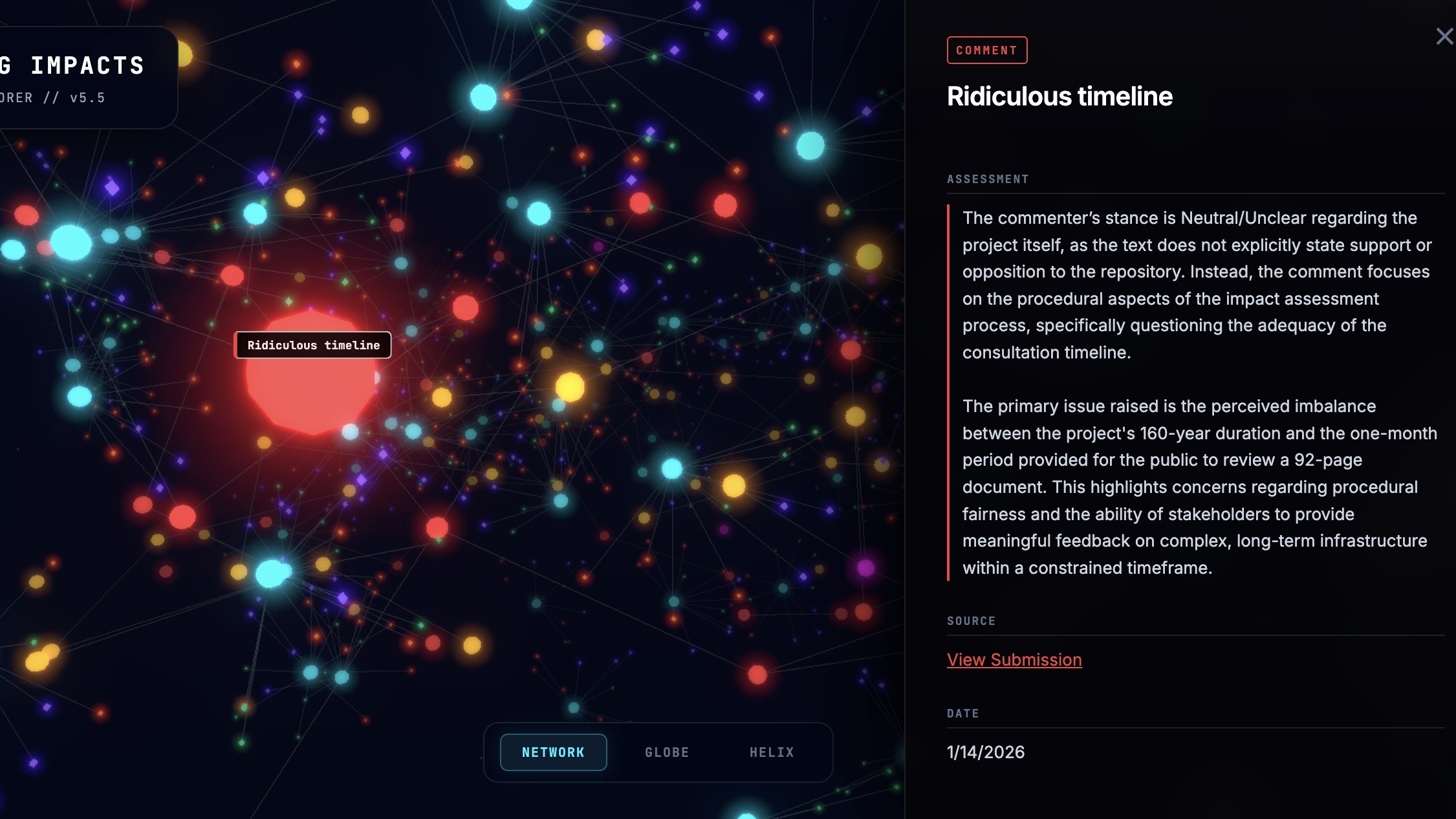
- Semantic Network Analysis: The system could be enhanced to track the “lineage” of specific claims across thousands of pages. By treating the documentation as a network graph, the app could identify circular reasoning—where Document A references Document B, which references Document A—a common tactic in bureaucratic obfuscation. This would elevate the OSINT capability from page-level analysis to document-corpus structural analysis.
Conclusion
The Melgund Integrated Nuclear Impact Assessment Project is a operational proof-of-concept that code is a form of governance. Applying principles of OSINT to mine for truth, CogSec to defend against manipulation, and IO to project community power, the application corrects the structural power imbalance inherent in the Impact Assessment Act. It demonstrates that with the right cognitive architecture and technology, a small community program can operate with the analytical sophistication of a state-level actor.